
Disclosure: This page may contain affiliate links. Prices were checked on the date shown and may change.
An introduction to RODE Broadcaster, based on information from the maker and distributors: what it does, how to use it and who it may suit. It is not scored.
The Broadcaster is a premium large-diaphragm, end-address condenser microphone designed to provide the ultimate performance for broadcast applications.
— RODE official site
What is Broadcaster?
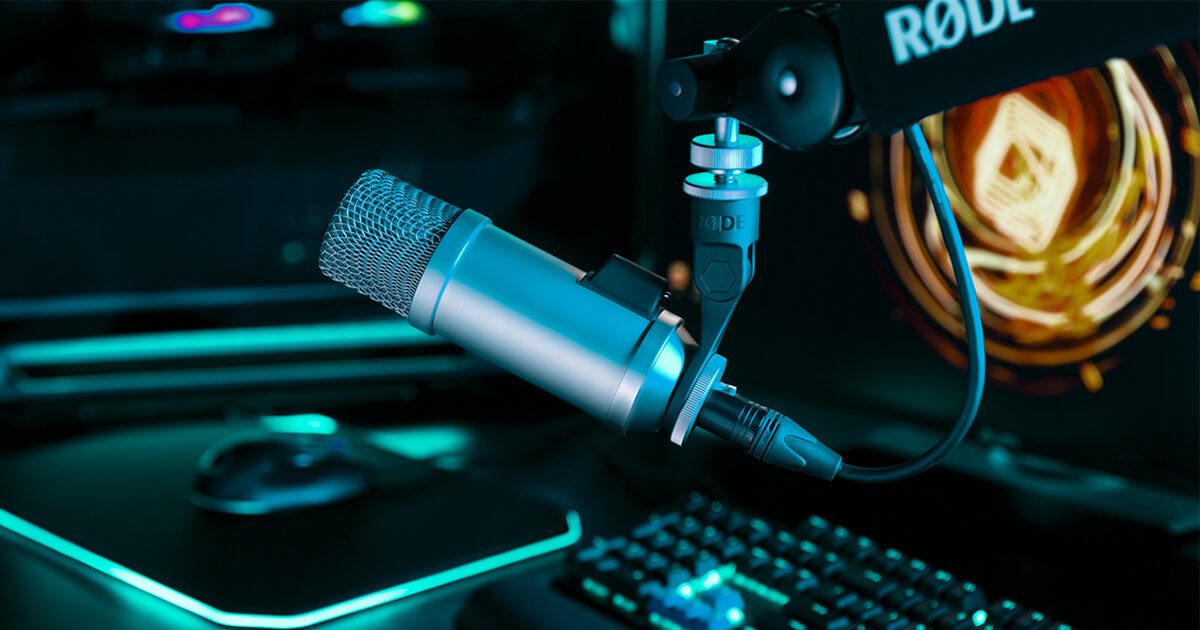
The Broadcaster is a large-diaphragm, end-address condenser microphone from Australian maker RODE, aimed at broadcast work such as radio, podcasting and voice-over. It is spoken into from the head of the mic, and the company says its frequency response is tailored for broadcast.
The capsule is a 1-inch gold-sputtered diaphragm (HF2) with a cardioid pattern. RODE says it has a rich, controlled proximity effect used in radio stations. An internal pop filter is built in to reduce plosives that would overdrive the capsule.
A switch at the rear engages a 75 Hz high-pass filter to reduce low-frequency noise from air conditioners, traffic, machinery and foot tapping. There is also an On Air LED indicator of the kind used in broadcast studios, which a console's contacts can switch on and off.
The body is stainless steel and weighs 577 g. An RM2 stand mount and a ZP1 zip pouch are included, and registering online extends the warranty to ten years. It runs on phantom power (P48 or P24), so it is used with an audio interface or mixer.
Key features
Response tailored for broadcast
The frequency range is 20 Hz to 20 kHz, and RODE says it is tailored for broadcast, podcasting and voice-over. With proximity effect, the low end swells as you move closer, so you find the sound you want by changing position.
1-inch gold-sputtered diaphragm
The HF2 capsule uses a 1-inch gold-plated diaphragm. The official spec lists sensitivity of -34 dB re 1 V/Pa (20 mV at 94 dB SPL) +/-2 dB and equivalent noise of 14 dB SPL (A-weighted).
Internal pop filter
The built-in pop filter reduces plosives that move the diaphragm and cause distortion. It aims to cut the need for a separate pop filter. RODE lists accessories such as the WS2 as compatible.
Switchable 75 Hz high-pass filter
A toggle switch at the rear engages the high-pass filter. When off, the response is flat; when on, it rolls off below 75 Hz. It is one option when the recording space has low-frequency noise.
On Air LED indicator
The On Air LED is controlled by opening or closing pins 4 and 5 of the output connector. If nothing is connected, it stays on whenever phantom power is applied. The manual notes that the LED does not interfere with the audio circuit and the mic does not mute itself.
Stainless steel body and ten-year warranty
RODE cites a rugged stainless steel body, Australian design and manufacture, and a ten-year warranty with online registration. It weighs 577 g and is about 167 mm long.
Works with P48 or P24 phantom power
It runs on P48 (48 V) or P24 (24 V) phantom power, drawing 5 mA on P48 and 4.5 mA on P24. The official spec lists maximum SPL of 128 dB, a signal-to-noise ratio of 80 dB and dynamic range above 114 dB.
Specifications
| Item | Details |
|---|---|
| Type | Large-diaphragm condenser (pressure gradient) |
| Polar pattern | Cardioid, end address |
| Frequency range | 20 Hz to 20 kHz |
| Sensitivity | -34 dB re 1 V/Pa (20 mV at 94 dB SPL) +/-2 dB at 1 kHz |
| Equivalent noise | 14 dB SPL (A-weighted) |
| Maximum SPL | 128 dB SPL (1 kHz, 1% THD into 1 kilohm load) |
| Signal-to-noise ratio | 80 dB (A-weighted) |
| Dynamic range | >114 dB (A-weighted) |
| Maximum output | +2 dBu (1 kHz, 1% THD into 1 kilohm load) |
| Power | P48 (48 V) or P24 (24 V) phantom |
| Current consumption | 5 mA (P48), 4.5 mA (P24) |
| Weight | 577 g |
| Dimensions | Length 167 mm (width 65 mm, height 50 mm per the datasheet) |
| High-pass filter | 75 Hz, switchable |
What is included and system requirements
- Broadcaster microphone
- RM2 stand mount
- ZP1 zip pouch
- Compatible accessories sold separately: WS2 pop filter, PSA1+ / PSA1 studio arm, 5-pin On Air indicator adaptor
How to use it
- Mount the mic in a stand or arm with the supplied RM2 mount.
- The Broadcaster is an end-address mic, so mount it lengthways and speak directly into the head.
- Connect it to a mixer or interface with a high-quality, short XLR cable.
- Check all connections before applying 48 V phantom power.
- After powering on, wait a few moments for the mic to stabilise before recording.
- If low-frequency noise is a problem, engage the 75 Hz high-pass filter with the rear switch.
- Moving closer adds warmth and bass (proximity effect), so try different distances to find the sound you want.
- To use the On Air light, wire pins 4 and 5 as the manual describes, ideally with help from a technician.
Where it may come in handy
Podcasts and radio-style shows
This is the use RODE has in mind. The On Air LED can tell people in a studio that a recording is in progress.
Narration and voice-over
RODE says it is suitable as a voice-over microphone for film and television. You could consider it for video explanations and reading aloud.
Streaming and commentary
As an end-address mic, you could mount it on a desk arm pointing at your mouth. The high-pass filter might help reduce low-frequency noise such as computer fans.
Home vocal recording
RODE describes it as tailored for broadcast rather than a vocal-specific mic. Whether to use it for singing is something to decide after testing it with your voice.
Who it may suit
- People making podcasts or broadcast-style shows
- People building a narration or reading setup
- People who want a studio-style setup with an On Air light
- People who already have an interface with XLR input and phantom power
Good to know before you buy
- It needs phantom power (P48 or P24) and cannot connect over USB directly.
- The product page lists height 167 mm, width 50 mm and depth 65 mm, while the datasheet lists length 167 mm, width 65 mm and height 50 mm.
- The manual and datasheet give different output impedance figures, so none is listed here.
- The official US page lists $439.
How it differs from similar products
We do not pick a winner; the official figures are placed side by side.
SM4
The Broadcaster has a maximum SPL of 128 dB, 14 dB SPL equivalent noise, 577 g weight and an end-address design. The Shure SM4 has a maximum SPL of 140 dB, 13 dB SPL self-noise, 463 g and a side-address design. Both are cardioid condensers.
Price
$439 (RODE official site, checked 2026-10-27). Prices can vary by region and promotion, so check the official page before buying.
See Broadcaster on the product page
More of the same kind
We have introduced 100 microphones. Here are some of the others.
- LEWITT LCT 1040
- SR3D SR3D Binaural Pro XLR
- Audio-Technica AT875R
- Sennheiser MKH 416
- LEWITT LCT 441 FLEX
- ZealSound ZealSound USB Microphone K66
We have introduced 1 other product from RODE.
For a side-by-side comparison scored on the same criteria, see our comparison of microphones.
See the full list in Product database: Microphones and accessories.
Sources: rode.com edge.rode.com shure.com (checked 2026-10-27)









Comments