
Disclosure: This page may contain affiliate links. Prices were checked on the date shown and may change.
An introduction to Fiedler Audio Spacelab Interstellar, based on information from the maker and distributors: what it does, how to use it and who it may suit. It is not scored.
Spacelab is more than just reverb, more than just panning and more than just spatial audio.
— Fiedler Audio official site
What is Spacelab Interstellar?
Spacelab Interstellar is a 3D reverb and panner from Fiedler Audio of Germany. It combines reverb, panning and spatial audio in one plug-in and is presented for music as well as film, broadcast, games and VR/AR mixing.
The reverb algorithm is described as developed with Fraunhofer IIS, known for MP3. Room size ranges from small boxes to large venues, and output can be mono, stereo, surround, 3D speaker layouts or binaural.
It handles up to 256 inputs (objects) and renders to arbitrary speaker layouts of up to 256 channels. Each source becomes an object placed in a virtual room around the listener. Six degrees of freedom for the listener is a feature of the higher Interstellar version.
It connects directly to Fiedler’s Dolby Atmos Composer and fits into Atmos mixing workflows. It supports macOS (VST3, AU, AAX) and Windows (VST3, AAX), and an upgrade from the lower Spacelab Ignition version is available.
Key features
Object-based 3D panner
Sources are placed in a virtual room around the listener. Mouse movement can be recorded as automation and a 3D view shows the arrangement.
Spatial EQ
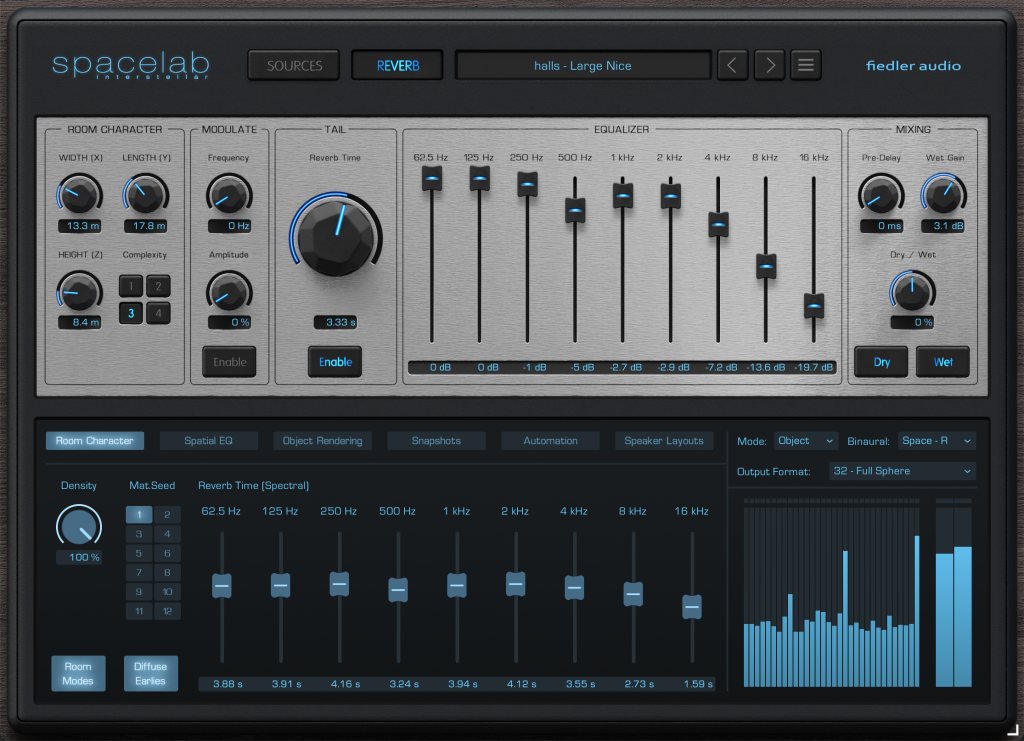
The reverb tail can be sculpted by band across 8 directions, which may help keep it from clouding the mix.
Reverb time on 9 bands
Reverb time can be set separately on nine frequency bands, for example shorter lows and longer highs.
Per-source early reflections
Early reflection patterns depend on each source’s position and change as it moves, which may help a natural sense of placement.
Any output format and binaural
Speaker layouts from mono to full-sphere 3D can be created, and a binaural mode allows monitoring and producing for headphones.
Atmos workflow and snapshots
It connects directly to Dolby Atmos Composer. Snapshot automation lets reverb settings change during a session.
Spacelab Beam
A companion plug-in that bypasses DAW routing limits so audio can be sent to Spacelab from anywhere.
Specifications
| Item | Details |
|---|---|
| Type | 3D reverb / object-based panner |
| I/O | Up to 256 inputs (objects) and 256 outputs |
| Reverb time | Adjustable on 9 bands |
| Listener | 6 degrees of freedom (position and orientation) |
| Formats (Mac) | VST3, AU, AAX |
| Formats (Windows) | VST3, AAX |
| Supported OS | macOS 10.14 to 14.x / Windows 10 and 11 |
| Requirements | 2 GHz or faster x64 (SSE3) or Apple Silicon, 4 GB RAM, 1440 x 900 display, OpenGL 3.3 |
| Sample rates | 48 kHz and 96 kHz |
What is included and system requirements
- Spacelab Interstellar plug-in
- Spacelab Beam plug-in
- DAW session templates (Knowledge Base)
- Manual (PDF)
- Demo / trial
How to use it
- Purchase with a Fiedler Audio account and download the installer.
- Install and rescan plug-ins in your DAW.
- Choose Classic mode for send/return use or Object mode for object-based mixing.
- Select a speaker layout or create one in the layout editor.
- Place sources in the 3D view and record movement as automation.
- Shape the reverb tail with the Spatial EQ and reverb time.
- For Atmos work, connect to Dolby Atmos Composer and render.
Where it may come in handy
Dolby Atmos mixing
Combined with Atmos Composer, reverb and object placement may be handled in one environment.
Space design for film and games
Reverb with different room sizes may suit building a space for each scene.
Binaural headphone production
It may also be used to produce 3D audio for headphones.
Reverb for stereo music
Even in stereo-focused work, the 9-band control and Spatial EQ may be useful.
Who it may suit
- People producing Dolby Atmos or 3D audio
- Those mixing for film, games or VR/AR
- Anyone who wants detailed control of the reverb tail
- Producers moving from stereo to immersive work
Good to know before you buy
- The lower Spacelab Ignition differs in I/O count, snapshots, spatial EQ and other features.
- An upgrade purchase from Ignition is available.
- The official site shows the price as the same number in dollars or euros, and rent-to-own is also offered.
- Sample rates of 48 kHz and 96 kHz are supported.
How it differs from similar products
We do not pick a winner; the official figures are placed side by side.
Spacelab Ignition
Interstellar offers 256 I/O, snapshots, spatial EQ, per-source spread, map view and a listener with 6 degrees of freedom. Ignition’s listener has 3 degrees of freedom (position).
Price
$299 (Plugin Boutique, checked 2026-10-27). Prices can vary by region and promotion, so check the official page before buying.
See Spacelab Interstellar on the product page
More of the same kind
We have introduced 18 stereo and imaging tools. Here are some of the others.
- NUGEN Audio Stereoizer
- Solid State Logic SSL Fusion Stereo Image
- Zynaptiq WIDE
- MeldaProduction MAutopanMB
- W. A. Production Dynawide
- Harrison Tremolo Panner
We have introduced 4 other products from Fiedler Audio.
- Fiedler Audio gravitas MDS
- Fiedler Audio armada
- Fiedler Audio Mastering Console
- Fiedler Audio Dolby Atmos Composer
See the full list in Product database: Effects.
Sources: fiedler-audio.com pluginboutique.com (checked 2026-10-27)










Comments