
Disclosure: This page may contain affiliate links. Prices were checked on the date shown and may change.
An introduction to Antelope Audio Antelope Audio VP Brainiac II, based on information from the maker and distributors: what it does, how to use it and who it may suit. It is not scored.
The VP BRAINIAC II is ideal for fast transient grabbing of dynamic vocals, drums, and other acoustic & percussive instruments.
— Antelope Audio official site
What is Antelope Audio VP Brainiac II?
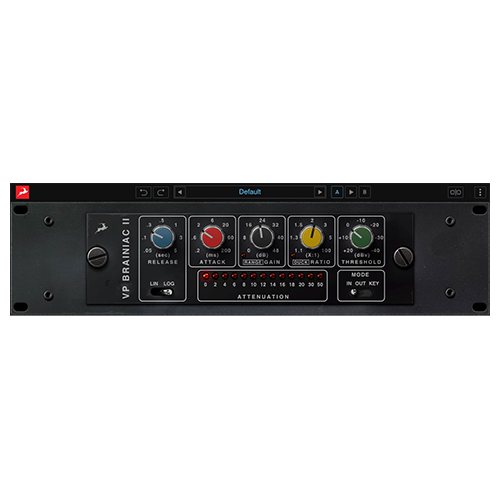
VP BRAINIAC II is a VCA-based compressor/limiter plugin from Antelope Audio, modeled after the Gain Brain family of hardware from the 1970s. The maker says it is suited to fast transient grabbing.
The original Gain Brain was introduced by Allison Research in 1971 as a broadcast unit, a FET variable-ratio limiter. It was later rebuilt around the Valley TA101 VCA, becoming the Valley People Gain Brain II. The design aim is described as applying large amounts of compression while remaining musical.
The controls are the familiar Gain, Ratio, Attack, Release and Threshold. A proprietary gain reduction design with program-dependent response is described, and the Release Mode switch between Linear and Logarithmic is recreated.
A peak reversion correction circuit compensates for the low end lost under heavy compression. A native version and a real-time version for Synergy Core devices are offered, and it is also available through an Antelope Cosmos subscription.
Key features
Fast VCA response
The maker says VCA circuits offer faster attack and release than tube designs. It may help when you want to catch sharp peaks of drums or vocals quickly.
Program-dependent response
The gain reduction response changes with the complexity of the incoming waveform. A feature is that, even with few controls, the behavior adapts to the source.
Linear / Logarithmic release
The release can be switched between a linear and a logarithmic recovery. The recovery changes even at the same setting, so you can look for the one that blends with the song.
Peak reversion correction
The circuit that compensates for low end lost in heavy compression is recreated. It may be worth trying on a deeply compressed drum bus where you want to keep low-end weight.
External sidechain
The Synergy Core real-time version supports external sidechaining. Switch to key mode and choose the input source.
Native and real-time versions
You can choose the native version in the DAW or the low-latency real-time version on supported devices. People who want to apply it while recording may consider the real-time version.
Specifications
| Item | Details |
|---|---|
| Type | VCA compressor / limiter |
| Original | Valley People Gain Brain II (from the 1971 Gain Brain) |
| Controls | Gain / Ratio / Attack / Release / Threshold |
| Release | Linear / Logarithmic switch |
| Correction | Peak reversion correction |
| Versions | Native / Synergy Core real-time |
| Price (native) | $179 (maker) |
What is included and system requirements
- Native plugin (Mac / Windows, no extra hardware needed)
- Synergy Core real-time version (compatible devices)
- See the maker's page for system requirements
How to use it
- Buy with an Antelope account and install.
- Insert VP BRAINIAC II on a track or bus in the DAW.
- Set a low ratio and lower the threshold gradually.
- Match attack to the source; try faster settings for sounds with strong attacks.
- Switch release between Linear and Logarithmic and choose the more natural recovery.
- Listen to low-end weight under heavy compression and adjust gain if needed.
- For parallel use, balance it against the dry signal.
Where it may come in handy
Vocal peaks
The maker lists fast peak grabbing of dynamic vocals. It may be worth trying when you want to restrain loud parts of a voice while keeping it natural.
Drums and percussion
It is said to suit drums and other percussion. With a circuit that compensates for lost low end under heavy compression, it may be a candidate for driving a drum bus hard.
Parallel compression
A user comment on the sales page mentions using it in parallel. You might try blending it with the dry signal to add energy.
External sidechain
The Synergy Core version supports external sidechaining. You can switch to key mode and select a source to link the effect.
Who it may suit
- People looking for a fast VCA compressor
- People who want to compress a drum bus strongly
- People interested in vintage gear history and design
- Synergy Core users who want real-time processing
Good to know before you buy
- The Synergy Core version requires compatible Antelope hardware.
- The page notes that the original unit's manufacturer has not endorsed or sponsored the product.
- Antelope Cosmos is a subscription service; see the official page for pricing.
- External sidechaining is described as a feature of the Synergy Core real-time version.
How it differs from similar products
We do not pick a winner; the official figures are placed side by side.
Antelope Audio Gyratec X
VP BRAINIAC II is a VCA design based on the 1971 Gain Brain, at $179. Gyratec X is modeled after Gyraf Audio's stereo Vari-Mu tube compressor, at $169 (both as listed in the Antelope store).
Price
$179 (Antelope Audio official site, checked 2026-10-27). Prices can vary by region and promotion, so check the official page before buying.
Also available through an Antelope Cosmos subscription.
See Antelope Audio VP Brainiac II on the product page
More of the same kind
We have introduced 27 limiters and maximizers. Here are some of the others.
- Orra Audio Orra Cream Limiter
- McDSP Compressor Bank
- IK Multimedia White 2A Leveling Amplifier
- Klevgrand Korvpressor
- Waves L3 Multimaximizer
- NUGEN Audio ISL 2
We have introduced 54 other products from Antelope Audio.
- Antelope Audio Antelope Audio x903
- Antelope Audio Tube 176
- Antelope Audio VP Gate Keeper II
- Antelope Audio Antelope Audio Filtek Mk3
- Antelope Audio VEQ-HLF
For a side-by-side comparison scored on the same criteria, see our comparison of limiters and maximizers.
See the full list in Product database: Effects.
Sources: antelopeaudio.com pluginboutique.com (checked 2026-10-27)










Comments