
Disclosure: This page may contain affiliate links. Prices were checked on the date shown and may change.
An introduction to Cherry Audio Mercury-4, based on information from the maker and distributors: what it does, how to use it and who it may suit. It is not scored.
Cherry Audio’s Mercury-4 improves upon the original’s design by offering 16-voice polyphony, infinite patch storage, velocity sensitivity, MPE support, and much more.
— Cherry Audio official site
What is Mercury-4?
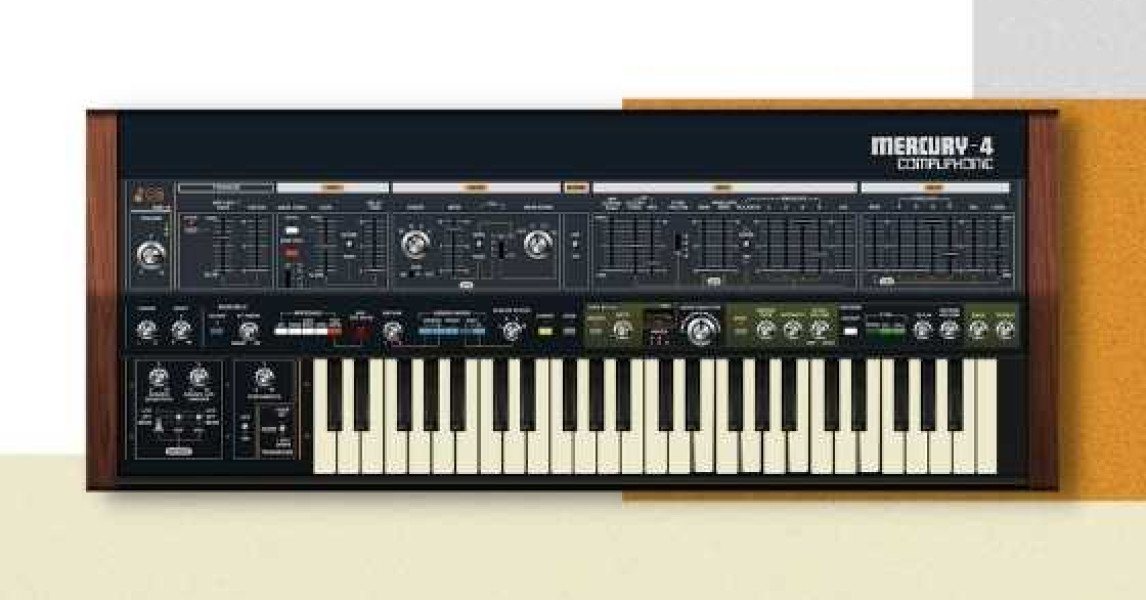
Mercury-4 is a software synthesizer from Cherry Audio, based on the Roland Jupiter-4 released in 1978. Cherry Audio says it is modeled on a unit once owned by Greg Hawkes, keyboardist of The Cars.
The original was an early instrument that combined voice-assign polyphony with digital patch storage, but it had only four voices and little patch storage, according to Cherry Audio. Mercury-4 goes up to 16 voices, has no limit on stored patches, and supports velocity and MPE.
It recreates the oscillator with sub-oscillator, dual filters and an easily overdriven VCA, and Cherry Audio says it also recreates the original's arpeggiator and two unison modes. A Drift knob adjusts analog-style instability.
A stereo ensemble effect and a tape-echo-style effect with several reverb modes are built in. More than 400 presets are included, 75 of them by Huston Singletary, and a 30-day trial is offered.
Key features
Up to 16-voice polyphony
Against the original's four voices, it plays up to 16. Running out of voices is less likely in chords, which may help when layering pads.
Oscillator with sub-oscillator
The original's oscillator and sub-oscillator are modeled, along with filter characteristics including strong low-frequency resonance.
Arpeggiator and unison
The original's arpeggiator is recreated with tempo sync. A detunable unison mode and single-key chord memory are also included.
LFO and Drift
The wide-range LFO keeps the original's inverted modulation characteristics and can be tempo-synced. A Drift knob adds analog-style instability.
Ensemble and tape echo
A stereo ensemble effect and a tape-echo-style effect are built in. The echo has several reverb modes, and per Plugin Boutique's description they include plate and hall in addition to spring.
MPE and MIDI control
With an MPE controller, you can add expression to each note separately. All controls support MIDI control and DAW automation.
Light CPU use and zoom
Cherry Audio says the code is optimized for low CPU load. It also has an oversampling setting and one-click UI magnification.
Specifications
| Item | Details |
|---|---|
| Type | Software synth (poly synth based on the Roland Jupiter-4) |
| Polyphony | Up to 16 voices |
| Presets | 400+ (75 by Huston Singletary) |
| Effects | Stereo ensemble, tape echo (with reverb modes) |
| Other | Arpeggiator (tempo sync), unison, chord memory, MPE |
| Formats | AU / VST / VST3 / AAX / Standalone |
| System | macOS 10.13 or later (macOS 13 Ventura supported, native Apple M1 and later), Windows 7 or later (including 11), both 64-bit. A quad-core CPU and 8 GB RAM are recommended |
| Trial | 30 days (plays white noise periodically, otherwise unlimited) |
What is included and system requirements
- Plugin (AU / VST / VST3 / AAX / Standalone)
- 400+ presets (including the Jupiter-4's front-panel factory presets)
- 30-day free trial (download)
How to use it
- Log in with your Cherry Audio account and run the installer.
- Authorize your purchased license.
- Load Mercury-4 on an instrument track in your DAW.
- Pick a pad, bass or lead from the presets.
- Adjust the oscillator and sub-oscillator levels and the filter cutoff and resonance.
- Add a little Drift to set the amount of instability.
- Sync the arpeggiator to your DAW's tempo and play phrases.
- Turn on the ensemble and tape echo for width, then save the sound.
Where it may come in handy
New wave-style tracks
You might make arpeggios and leads for a synth-pop or new wave feel from around 1980. Sounds that use the ensemble effect may suit it.
String-like pads
With 16 voices you could layer chords into a pad. Adding the tape echo might give a background sound with depth.
Playing with an MPE controller
With an MPE keyboard you could perform leads where each note carries its own expression.
Who it may suit
- People curious about the relatively rare Jupiter-4.
- Those who want 80s-style synth sounds with light CPU use.
- Producers who use arpeggios often.
Good to know before you buy
- The trial lasts 30 days and plays white noise from time to time.
- Roland, Jupiter-4 and similar names are trademarks of their owners. This is not an official Roland product.
- The preset count is listed as 400+ by Cherry Audio and 300+ by Plugin Boutique. This article follows the official figure.
- The list price is $49; the price may be lower during sales.
How it differs from similar products
We do not pick a winner; the official figures are placed side by side.
Elka-XCherry Audio
Mercury-4 has 400+ presets, an arpeggiator and a tape echo. Elka-X has 600+ presets, a two-part split/layer mode and a four-track sequencer. Both go up to 16 voices; list prices are $49 for Mercury-4 and $59 for Elka-X.
Price
$49 (Cherry Audio official site, checked 2026-10-27). Prices can vary by region and promotion, so check the official page before buying.
See Mercury-4 on the product page
More of the same kind
We have introduced 178 synthesizers. Here are some of the others.
- Rob Papen PowerChord
- Arturia Arturia Modular V
- Native Instruments Rounds
- Tracktion Horizen
- Arturia OP-Xa V
- Waldorf Blofeld Plugin
We have introduced 31 other products from Cherry Audio.
- Cherry Audio Cherry Audio Memorymode 2
- Cherry Audio Yellowjacket
- Cherry Audio Lowdown
- Cherry Audio Elka-X
- Cherry Audio GX-80
For a side-by-side comparison scored on the same criteria, see our comparison of synthesizers.
See the full list in Product database: Instruments.
Sources: cherryaudio.com pluginboutique.com (checked 2026-10-27)










Comments