
Disclosure: This page may contain affiliate links. Prices were checked on the date shown and may change.
An introduction to Zynaptiq ADAPTIVERB, based on information from the maker and distributors: what it does, how to use it and who it may suit. It is not scored.
Unlike traditional reflection-based acoustic room modeling, ADAPTIVERB adds perceived depth, harmonic richness, and butter-smooth tails without obscuring the source.
— Zynaptiq official site
What is ADAPTIVERB?
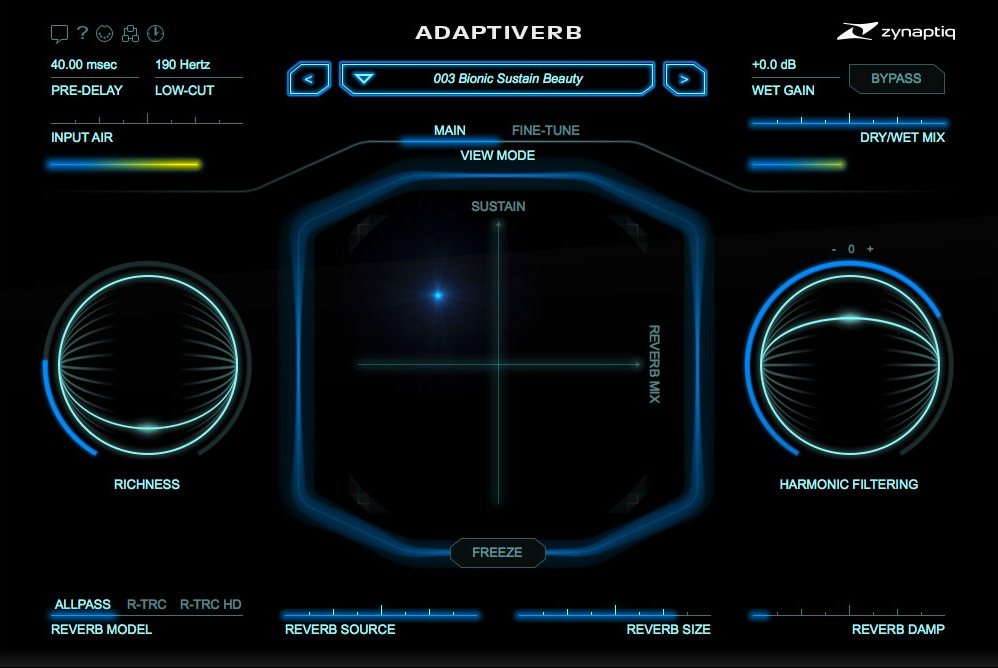
ADAPTIVERB is a reverb plug-in from Germany's Zynaptiq, billed as a "Harmonic Tracking Resynthesis" reverb. Rather than modeling reflections in an acoustic room, it is described as reflectionless, adding perceived depth, harmonic richness and smooth tails.
At its core is the Bionic Sustain Resynthesizer. Hundreds of oscillators learn to recreate only the pitched parts of the input, and that becomes the material for the reverb. Noise and transients therefore tend to stay out of the tail, which is said to give less grainy results even on difficult material such as the master bus or field recordings.
After it comes the Harmonic Contour Filter (HCF), which removes pitches that do not match the input. It can reduce the smearing of old chords after a chord change, or pass only the notes you choose on an on-screen keyboard. A ray-tracing reverb simulating about 16,000 paths is also included.
Further tools include FREEZE, which keeps sound going without input, SIMPLIFY, which reduces the number of oscillators, and RICHNESS, which adds fifth or octave harmonics. More than 400 presets are included, and the maker warns of high CPU use.
Key features
Bionic Sustain Resynthesis
By resynthesizing only the harmonic content of the input, it makes tails with less noise or grain, aiming for the feel of longer sustain.
Harmonic Contour Filter (HCF)
It removes pitches that clash with the input, which may make long reverbs more usable across chord changes. In keyboard mode you set the allowed notes and store five snapshots.
Cross-filtering with HCF HOLD
The filtering of one sound can be held and applied to the reverb of another, for effects like voice-colored reverbs.
Ray tracing reverb
It simulates about 16,000 sound paths without calculating individual reflections, producing a dense, smooth tail. A traditional allpass-based reverb is also available.
FREEZE, SIMPLIFY and RICHNESS
FREEZE makes drones and pads, SIMPLIFY gives additive-synth-like timbres and RICHNESS adds fifth or octave harmonics, aimed at sound design and film music.
400+ presets and MIDI control
Presets range from everyday reverbs and "invisible" reverbs to voice- or instrument-colored reverbs, drones and pads, and key parameters accept MIDI control.
Specifications
| Item | Details |
|---|---|
| Type | Harmonic tracking resynthesis reverb |
| Presets | 400+ |
| Maximum sample rate | 192 kHz |
| Plug-in formats | AU (Mac) / VST 2.4 / VST3 / AAX (including AudioSuite) |
| Supported OS | macOS 10.15 or newer (Apple Silicon, or Intel with 2+ cores) / Windows 10 or newer |
| Authorization | iLok.com account required (iLok 2/3 or machine activation); first-generation iLok not supported |
What is included and system requirements
- ADAPTIVERB plug-in
- 400+ presets
- A 30-day free trial is offered by the maker
- Requirements: CPU with 2 or more cores (i7 or better recommended), internet connection for activation
How to use it
- Create a free account at iLok.com.
- Get the installer from the official site and install it.
- Activate the trial or product license in your iLok account.
- Insert ADAPTIVERB on a track or aux in your DAW.
- Pick a preset and set the reverb mix.
- Turn on the HCF and listen for fewer clashing pitches.
- If needed, set the allowed notes in keyboard mode.
- Add FREEZE or SIMPLIFY to try drones and pads.
Where it may come in handy
Adding air in mixing and mastering
The maker says it suits adding size, glue and body in mixing and mastering. Its input-following nature may let you use it as an unobtrusive reverb.
Drones for ambient and film music
FREEZE and SIMPLIFY could create pads that keep sounding without input.
Reverb for vocals and narration
With speech-oriented presets, it may be worth trying when you want reverb that keeps the voice clear.
Processing effects and field recordings
Its resistance to noise could be used to add space to ambient recordings.
Who it may suit
- People who want long reverb in songs with chord changes
- Those making ambient, drones or pads
- Film composers and sound designers
- Anyone who wants subtle reverb on the master bus
Good to know before you buy
- The maker explicitly states that ADAPTIVERB uses a lot of CPU and recommends testing the trial in your own DAW.
- A free iLok.com account is required, including for the demo. Machine activation works without a dongle, but a system without internet access needs an iLok 2.
- The official page lists EUR 149 including 19% VAT.
How it differs from similar products
We do not pick a winner; the official figures are placed side by side.
PSP PianoVerb2
ADAPTIVERB is a $149 reverb that shapes its tail to the pitch of the input, with 400+ presets. PianoVerb2 is a $69 resonant reverb using 12 resonant filters.
Price
$149 (Zynaptiq official site, checked 2026-10-27). Prices can vary by region and promotion, so check the official page before buying.
See ADAPTIVERB on the product page
More of the same kind
Other introduction articles of the same kind.
- Waves Magma StressBox
- accentize dxLevel
- Waves Doppler
- W. A. Production DERES
- McDSP McDSP 6050 Ultimate Channel Strip HD v7
- Waves Eddie Kramer Bass Channel
We have introduced 10 other products from Zynaptiq.
- Zynaptiq ORANGE VOCODER NANO
- Zynaptiq UNVEIL
- Zynaptiq MORPH 3 PRO
- Zynaptiq UNFILTER
- Zynaptiq REPAIR Bundle / ZAP Bundle
See the full list in Product database: Effects.
Sources: zynaptiq.com pluginboutique.com (checked 2026-10-27)










Comments