
Disclosure: This page may contain affiliate links. Prices were checked on the date shown and may change.
An introduction to Kuassa Amplifikation Matchlock, based on information from the maker and distributors: what it does, how to use it and who it may suit. It is not scored.
Freely adjustable dual-miking with mono or stereo configuration, just like a real-life guitar recording session with mix option.
— Kuassa official site
What is Amplifikation Matchlock?
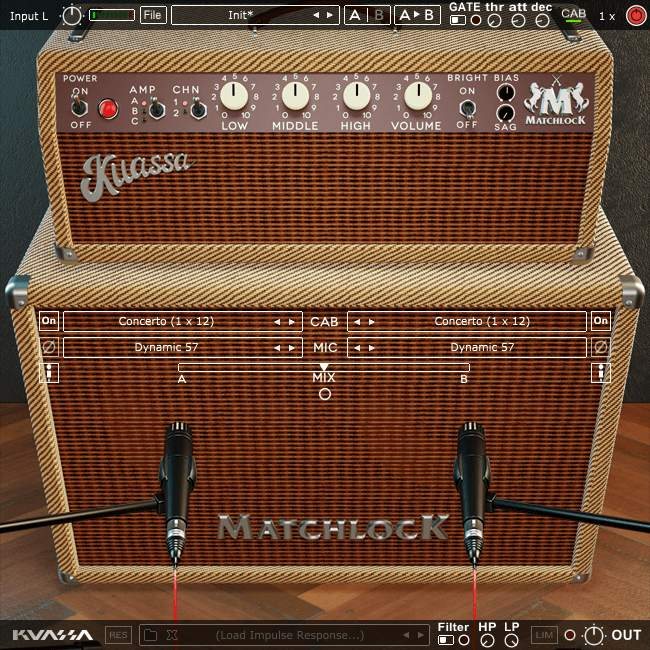
Amplifikation Matchlock is a guitar amp simulator from Indonesia's Kuassa. It is inspired by Fender combo amps and uses the company's third-generation tube simulation engine. The maker presents it as a product aimed at American-style, clean-oriented tone building.
There are three amp types, which the maker describes as taking influence from the Twin Reverb, Super Reverb and Custom Vibrolux Reverb. Each amp has Clean and Boosted channels, and the power amp section offers Sag and Bias adjustment.
For miking, five cabinets and seven microphones are available (Shure SM57, Sennheiser MD421 and MD441, Shure KSM313, Royer R121, AKG C414 and Neumann TLM103). Dual-mic setups can be arranged in mono or stereo, with an adjustable mix.
It also has low-pass and high-pass filters, a noise gate and a limiter, and supports up to 8x oversampling and sample rates up to 192 kHz. Besides VST, VST3, AU and AAX plug-ins, standalone and Amplifikation 360 module versions are available.
Key features
Three amp types
Three types inspired by the Twin Reverb, Super Reverb and Custom Vibrolux Reverb can be switched, so clean-leaning tones can be compared and chosen for a song.
Clean and Boosted channels
Each amp has a clean channel and a boosted one, so tracking clean and adding more drive can both be done in the same plug-in.
Power amp Sag and Bias
The sag behavior and bias can be adjusted, which may help move the playing feel toward a preferred response.
Five cabinets and seven mics
Cabinets and microphones are selected and two mics can be combined in mono or stereo, changing the texture through mic type and blend.
Noise gate and limiter
The built-in gate reduces unwanted noise and the limiter guards against excessive levels, tidying the input stage without extra plug-ins.
Oversampling and sample rate
Up to 8x oversampling and 192 kHz are supported, a setting worth trying when finer handling of distortion is wanted at the cost of CPU load.
Amplifikation 360 module
It also works as a module inside Amplifikation 360, where it can be combined with other Kuassa guitar plug-ins to stack pedals, amps and cabs.
Specifications
| Item | Details |
|---|---|
| Manufacturer | Kuassa |
| Type | Guitar amp simulator |
| Amp types | 3 (each with Clean / Boosted) |
| Cabinets | 5 |
| Microphones | 7 |
| Filters | High-pass / low-pass |
| Other | Noise gate, limiter, Sag / Bias |
| Oversampling | Up to 8x |
| Sample rate | Up to 192 kHz |
| Formats | VST, VST3, AU, AAX, standalone, A360 module |
What is included and system requirements
- Three amp types (each Clean / Boosted)
- Five cabinets and seven microphones
- Noise gate, limiter, high-pass and low-pass filters
- Formats: VST, VST3, AU, AAX, standalone, Amplifikation 360 module
- Windows: Windows Vista or later (64-bit), 4 GB RAM or more
- Mac: macOS 10.11 or later (64-bit), 4 GB RAM or more
- Demo version: no feature limit, with noise every 40 seconds
How to use it
- Download the demo from Kuassa's site to try it (a noise burst plays every 40 seconds, but there is no feature or time limit).
- After purchase, enter the license key to remove the demo limitation.
- Load the plug-in on a guitar track in your DAW.
- Choose the amp type and channel (Clean or Boosted).
- Select the cabinet and microphones and adjust the mix of the two mics.
- Use Sag and Bias to adjust how it responds to your playing.
- If needed, use the noise gate and filters to reduce noise and unwanted bands.
- The same settings can also be tried in the standalone version or Amplifikation 360.
Where it may come in handy
Clean guitar tracking
As the product is aimed at clean-oriented tone building, it may be worth trying on clean parts such as chord strums and arpeggios.
Building tone with pedals
The maker mentions combining it with effect pedals, so placing pedals before it in Amplifikation 360 may be worth exploring.
As the front end of a home recording
DI guitar recorded at home may be re-amped later by choosing the amp and mics afterward.
Checking a light rig for live use
The standalone version may be used to check the amp's tendency before taking it into a DAW.
Who it may suit
- People looking for American-style clean amp tones
- Those who want to choose the amp and mics after a DI recording
- Users who want to try a demo before buying
- Players who want to combine it with Kuassa's pedal plug-ins
Good to know before you buy
- The official price is shown excluding taxes.
- The demo plays a noise burst every 40 seconds.
- A Rack Extension version exists separately (sold separately).
- Amp names and similar trademarks belong to their owners and are not affiliated with Kuassa.
How it differs from similar products
We do not pick a winner; the official figures are placed side by side.
Amplifikation VVV
Matchlock has three amp types (each Clean / Boosted) and seven microphones, while VVV has three channels (Red / Green / Blue), three amp types and nine microphones. Both have five cabinets.
Price
$49 (Kuassa official site, checked 2026-10-27). Prices can vary by region and promotion, so check the official page before buying.
See Amplifikation Matchlock on the product page
More of the same kind
We have introduced 28 guitar amp simulators. Here are some of the others.
- MeldaProduction MTurboAmp
- Blue Cat Audio Blue Cat's Axiom 2
- Waves Voltage Amps
- IK Multimedia AmpliTube 5 MAX v2
- Softube Eden WT800
- Bogren Digital Ampknob BDH 5169
We have introduced 43 other products from Kuassa.
- Kuassa Amplifikation Creme
- Kuassa Amplifikation Vermilion
- Kuassa Amplifikation Clarent
- Kuassa Amplifikation Rectifor
- Kuassa Amplifikation Caliburn
For a side-by-side comparison scored on the same criteria, see our comparison of guitar amp simulators.
See the full list in Product database: Effects.
Sources: kuassa.com pluginboutique.com (checked 2026-10-27)










Comments