
Disclosure: This page may contain affiliate links. Prices were checked on the date shown and may change.
An introduction to Arturia DX7 V, based on information from the maker and distributors: what it does, how to use it and who it may suit. It is not scored.
DX7 V is a software reimagining of the icon, bringing that iconic glassy, punchy, crystal-clear sound to your DAW.
— Arturia official site
What is DX7 V?
DX7 V is a software synthesizer from the French company Arturia, modeled on the 1983 digital synth DX7. Arturia describes the original as the best-selling synth of all time and aims to bring its glassy, crystal-clear sound into the DAW. Arturia describes the character as glassy, punchy and crystal-clear.
FM synthesis modulates one waveform with another at audio rate to create complex harmonics. DX7 V has the same six operators and 32 algorithms as the original, along with all the original parameters, and it can import original DX7 SysEx data.
Features the hardware lacked are added: each operator can use 25 waveforms and has its own multi-mode filter and feedback. A modulation matrix, step sequencer, arpeggiator and four effect slots are also included.
Vintage and Modern DAC modes let you choose how closely the original converter sound is reproduced. Formats are standalone, VST, AAX, AU and NKS, and a free demo is available on the official site.
Key features
Six operators and 32 algorithms
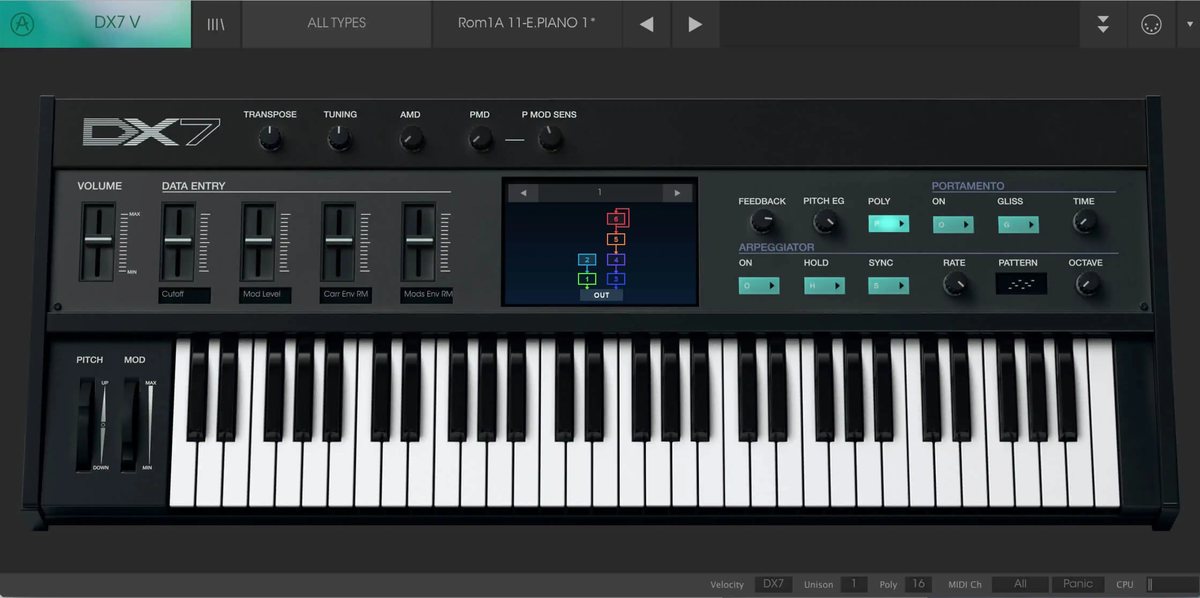
The six operators work as carriers or modulators. The 32 algorithms provide the building blocks, and color-coded operators make editing easier. For people used to the original DX7 algorithm numbers, being able to recall them as they are may be easy to follow.
25 waveforms and filters
The original operators produced only sine waves; in DX7 V each operator can use 25 waveforms and also has a filter and feedback. It may help when you want a wider range of harmonic structures.
Envelopes and modulation
DX7-style, DADSR and multi-segment envelopes can be chosen per operator, with sync and looping. There are also two modulation envelopes, four macros and a modulation matrix. Each operator can have detailed movement in level and tone over time, so you can build anything from percussive attacks to slowly opening sounds.
Sequencer, arpeggiator and effects
A step sequencer, two LFOs with six waveforms and an arpeggiator are built in. Four effect slots can be routed in series or parallel, and an oscilloscope shows the waveform. The company says that in hardware, features like these would make for a very expensive synthesizer.
Vintage and Modern DAC modes
Vintage reproduces the characteristics of the original converter, while Modern is more contemporary. You can choose based on whether you value the original's texture or ease of use.
Preset browser and 32-voice polyphony
A browser with keyword and tag search supports favorites and playlists. It offers up to 32-voice polyphony and four-voice unison.
Specifications
| Item | Details |
|---|---|
| Type | FM synthesizer (DX7 recreation plus extensions) |
| Operators | 6 (25 waveforms, filter and feedback each) |
| Algorithms | 32 |
| Polyphony | 32 voices (4 unison voices) |
| Effects | 4 slots (series/parallel) |
| Formats | Standalone / VST / AAX / AU / NKS |
| OS | Windows 10 or later (64-bit) / macOS 10.13 or later |
| Requirements | 4 GB RAM, 4-core 3.4 GHz CPU or Apple Silicon, 3 GB free disk, OpenGL 2.0 GPU |
| Presets | 432 to 540 (the official page gives different numbers in different places) |
What is included and system requirements
- DX7 V (standalone and plug-in)
- Factory presets (432 to 540)
- Import of original DX7 SysEx
- In-app tutorials
- Management through the Arturia Software Center
- Preset browser
- Resizable GUI
- Pre-mapped settings for the Arturia KeyLab range
How to use it
- Create an Arturia account and register your license.
- Install the Arturia Software Center and download DX7 V.
- Choose the formats you need, such as VST3 or AU, and install.
- Load it in the DAW and pick a sound in the preset browser first.
- Look at the algorithm display to see which operators produce the sound.
- Try the data entry sliders, which move several parameters at once.
- Open the in-app tutorials to check basic operation.
- Mark favorites and collect them in a playlist.
Where it may come in handy
80s-style electric pianos, basses and bells
The company names electric pianos, struck or plucked sounds and percussive keys as DX specialties, so this direction may suit it.
Synth pop and city pop
Using presets as a starting point, you might build phrases with the atmosphere of 1980s songs.
Reusing your own hardware patches
If you own a DX7, you may be able to load patches saved as SysEx and keep using them inside the DAW.
Designing new sounds
By combining filters, feedback and many waveforms you may find sounds hard to make on the original DX7.
Who it may suit
- People interested in the DX7 sound or FM synthesis itself
- Those who thought FM programming looked too hard
- Anyone with patch data made on a real DX7
- Producers who want 80s-style sound in their tracks
Good to know before you buy
- The preset count is given as 540 in the main text and 432 in the main features list. Check the latest figure before buying.
- ARM processors are not supported on Windows.
- It needs 3 GB of free disk space.
- DX7 V is also included in the larger V Collection 11 Pro set.
How it differs from similar products
We do not pick a winner; the official figures are placed side by side.
Sugar Bytes Aparillo
DX7 V has six operators, 32 algorithms and 32 voices. Aparillo has two FM operators and 16 voices, but adds the Orbiter that moves 15 targets. Both are FM synths published by their makers.
Price
$149 (Arturia official site, checked 2026-10-27). Prices can vary by region and promotion, so check the official page before buying.
More of the same kind
We have introduced 178 synthesizers. Here are some of the others.
- LANDR LANDR Strata
- Applied Acoustics Systems Ultra Analog Session
- Krotos Simple Concept
- Sound Particles SkyDust 3D
- GForce Software Oberheim OB-X
- Cherry Audio Mercury-4
We have introduced 45 other products from Arturia.
For a side-by-side comparison scored on the same criteria, see our comparison of synthesizers.
See the full list in Product database: Instruments.
Sources: arturia.com pluginboutique.com (checked 2026-10-27)










Comments