
Disclosure: This page may contain affiliate links. Prices were checked on the date shown and may change.
An introduction to Arturia Solina V, based on information from the maker and distributors: what it does, how to use it and who it may suit. It is not scored.
Solina V models the hugely popular ensemble keyboard made by Eminent and later rebadged by ARP.
— Arturia official site
What is Solina V?
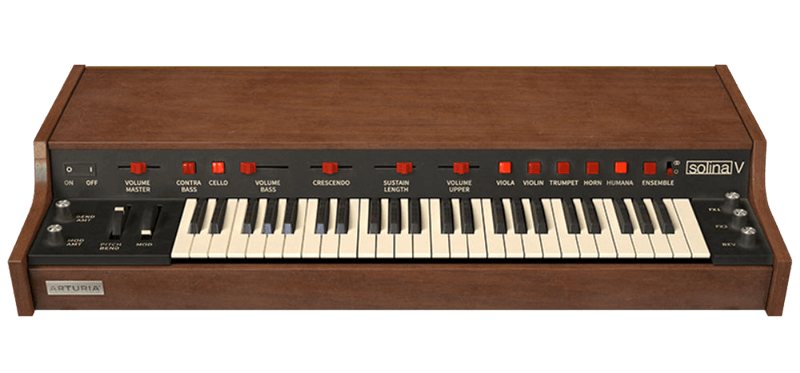
Solina V is Arturia's software string machine. It recreates the Eminent Solina, later sold as the ARP String Ensemble, a keyboard widely heard in the 1970s, using Arturia's physical modeling.
A string machine is an electronic keyboard that produces ensemble-like strings and brass-type voices such as violin, viola, cello, horn and trumpet. Arturia names the ENSEMBLE chorus-like effect as central to the sound.
Besides the Solina MK1 controls, it adds the Vox Humana and resonators from a 1978 Moog polysynth, a filter and arpeggiator for the bass section, an LFO, and velocity and aftertouch response. It is designed to work both as a string machine and as a synth.
Effects include phaser, chorus, analog delay, a sync delay and a convolution reverb with 24 reverbs. It ships with 150 presets and is also part of the V Collection.
Arturia's site gives a detailed history of string machines, from Ken Freeman's experiments in the 1960s through Eminent's home organs to the Solina of 1974, later licensed and sold by ARP. Knowing this background of an instrument associated with prog, funk and disco may help set a target for your sound.
Key features
Model of the Solina MK1
The original Violin, Viola, Cello, Horn and Trumpet voices and the ENSEMBLE effect are modeled, with MK1 and MK2 ensemble modes to switch between.
Vox Humana and resonators
The Vox Humana voice and a three-band resonator section come from a 1978 Moog polysynth, offering fine emphasis of specific frequencies.
Added bass section features
The bass section has a 24 dB per octave resonant filter and a one-octave arpeggiator. Splitting the keyboard lets you play bass with the left hand.
Paraphonic and polyphonic modes
You can choose the classic paraphonic operation or a new polyphonic mode, depending on how you play chords.
LFO and expressive control
A tempo-syncable LFO handles vibrato, tremolo and filter modulation, and velocity and aftertouch can control volume and brightness.
Built-in effects and 150 presets
A three-mode stereo chorus, dual phaser, analog delay, sync delay and 24 reverbs are included, with 150 presets.
Specifications
| Item | Details |
|---|---|
| Engine | Physical modeling (TAE) |
| Modeled instrument | Eminent Solina MK1 (ARP String Ensemble) |
| Added features | Vox Humana, resonators, bass-section filter and arpeggiator, LFO |
| Effects | Stereo chorus, dual phaser, analog delay, sync delay, convolution reverb (24 reverbs) |
| Presets | 150 |
| Formats | Standalone, VST, AAX, Audio Unit, NKS (64-bit DAWs only) |
| Operating systems | macOS 10.13+ / Windows 10+ (64-bit) |
| Requirements | 4 GB RAM, 4-core 3.4 GHz CPU or Apple Silicon, 3 GB free disk space, OpenGL 2.0 GPU |
What is included and system requirements
- Solina V (Standalone, VST, AAX, Audio Unit, NKS)
- 150 presets
- Effects: chorus, phasers, delays and reverb
- Requirements: macOS 10.13+ / Windows 10+ (64-bit), 4 GB RAM, 3 GB free disk space
- License management through Arturia Software Center
How to use it
- Download Solina V from the Arturia Software Center and activate it.
- Load it on an instrument track in your DAW.
- Pick a preset close to what you want, such as a pad-type sound, in the browser.
- Turn ENSEMBLE on and switch between MK1 and MK2 to compare.
- Open the Advanced Panel and set the bass split and filter.
- Add chorus, phaser or reverb to decide the sense of space.
- Match the velocity and aftertouch response to your keyboard.
- Save your settings as a preset.
Where it may come in handy
Nu-disco and ambient strings
Slowly spreading string chords could be laid down as a background. ENSEMBLE combined with the phaser can also be tried.
Funk and disco-style tracks
Playing a split bass section and upper strings by yourself may be possible.
Synth-style pads
Moving the resonators and filter could produce pads that lean more toward a synth than a string machine.
Filling the background of a mix
Using velocity and aftertouch to vary volume and brightness, you could look for strings that blend into the back of a track.
Who it may suit
- Producers who want 1970s-style strings in their songs
- Players who prefer shaping strings by parameters instead of samples
- Anyone who wants something between a string machine and a synth
- People collecting Arturia's V instruments individually
Good to know before you buy
- Activation is via the Arturia Software Center, with up to five devices per license.
- ARM on Windows is not supported.
- It is part of the V Collection.
- Arturia's site shows 99 dollars while a Black Friday banner is displayed, so check the regular price before buying.
How it differs from similar products
We do not pick a winner; the official figures are placed side by side.
Arturia MiniBrute V
Solina V is a string machine with 150 presets and 24 convolution reverbs. MiniBrute V is an analog-style synth with 8 voices of polyphony, 168 presets and a four-slot FX rack with 17 effect types.
Price
$99 (Plugin Boutique, checked 2026-10-27). Prices can vary by region and promotion, so check the official page before buying.
See Solina V on the product page
More of the same kind
Other introduction articles of the same kind.
- AIR Music Technology Mellotron
- UJAM UJAM Usynth GLAM
- Native Instruments Super*Saw
- Samplemodeling French Horn & Tuba v3
- ProjectSAM The Free Orchestra
- IK Multimedia AmpliTube MESA/Boogie
We have introduced 45 other products from Arturia.
- Arturia Analog Lab Pro
- Arturia Flanger BL-20
- Arturia Delay ETERNITY
- Arturia Pure LoFi
- Arturia ARP 2600 V
See the full list in Product database: Instruments.
Sources: arturia.com pluginboutique.com (checked 2026-10-27)










Comments