
Disclosure: This page may contain affiliate links. Prices were checked on the date shown and may change.
An introduction to Arturia ARP 2600 V, based on information from the maker and distributors: what it does, how to use it and who it may suit. It is not scored.
ARP 2600 V reproduces one of the most desired synthesizers ever created, responsible for sounds ranging from ’70s funk textures to unmistakable special FX.
— Arturia official site
What is ARP 2600 V?
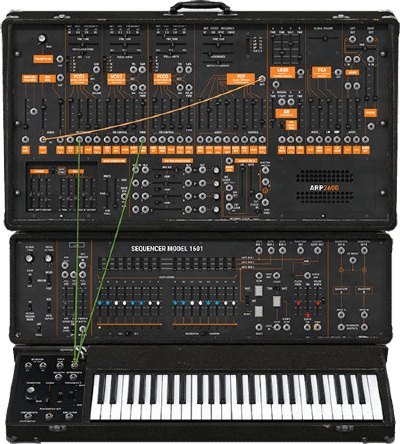
ARP 2600 V is a software synthesizer by the French company Arturia that recreates the ARP 2600, the semi-modular analog synth first released in 1972. Arturia presents it as an instrument responsible for sounds ranging from funk textures to special effects.
As with the original, the signal path is normalled, so it produces sound without any patch cables, and cables can be added to rewire it freely. The layout follows the signal flow from left to right, and Arturia describes it as suitable for learning the fundamentals of synthesis.
Arturia's TAE (True Analog Emulation) technology reproduces how analog circuits behave. Three VCOs, a 24 dB/octave low-pass filter, a spring reverb and the ARP 1601 sequencer are included, with the original parameters and patch points reproduced.
The original was monophonic, but ARP 2600 V supports 2 to 32 voices. Additions include an ARP 2500-style multimode filter, four tracking generators, chorus and a tempo-synced delay, and more than 500 presets are listed.
Key features
Full set of original parameters
The original's feature set is covered: three VCOs, Osc2-to-Osc1 sync, a 24 dB/octave resonant filter, LFO, sample and hold, ring modulator, noise generator, and ADSR and AR envelope follower.
ARP 2500-style multimode filter
Beyond the original filter, a 12 dB/octave multimode filter with low-pass, high-pass, band-pass and notch is added, and Arturia also lists 24 dB and 12 dB low-pass options.
ARP 1601 sequencer
The original 1601 sequencer is included down to its controls. It can be patched to different parts of the sound for pattern-based playing.
Polyphony and unison
Polyphony from 2 to 32 voices is supported, and unison thickens the sound. This was not possible on the original and allows playing chords.
Tracking generators and bonus LFO
Up to four custom curves can be created and any signal patched through them. An extra patchable, tempo-syncable LFO means you do not have to tie up a main oscillator.
Effects and expression
Chorus, a tempo-synced stereo delay and a spring reverb are built in. Velocity and aftertouch can be patched to any destination so playing dynamics shape the sound.
Guided patch points
Clicking a patch point lights up all eligible points for the other end of the cable. Arturia presents this as a way to make the original's complex-looking patching easier to follow.
Voltage processors and envelope follower
Four voltage processors can mix, lag or invert signals. Tracks from the DAW or live interface inputs can be run through the envelope follower, so processing drum loops is one possible use.
Specifications
| Item | Details |
|---|---|
| Type | Software recreation of a semi-modular analog synth (ARP 2600) |
| Oscillators | 3 VCOs, Osc2-to-Osc1 sync |
| Filters | 24 dB/oct low-pass (resonant, self-oscillating), ARP2500-style 12 dB/oct multimode |
| Polyphony | 2 to 32 voices plus unison |
| Effects | Chorus, MIDI-syncable stereo delay, reverb |
| Presets | 500+ |
| Formats | Standalone, VST, AAX, AU, NKS (64-bit) |
| Requirements (Windows) | Win 10+ (64-bit), 4 GB RAM, 4-core 3.4 GHz, 3 GB free, OpenGL 2.0 GPU, no ARM |
| Requirements (macOS) | macOS 10.13+, 4 GB RAM, 4-core 3.4 GHz or Apple Silicon, 3 GB free, OpenGL 2.0 GPU |
What is included and system requirements
- ARP 2600 V instrument
- 500+ presets
- ARP 1601 sequencer and tracking generators
- Arturia Software Center (license management, five devices per license)
- Also included in V Collection
How to use it
- Create an Arturia account and install Arturia Software Center.
- Register your license and install ARP 2600 V.
- Load it in your DAW or run it standalone with a MIDI keyboard.
- Select tags in the preset browser to find sounds.
- Without cables, move the filter and envelope sliders.
- Click a patch point and eligible destinations light up; connect one cable and listen.
- Patch the 1601 sequencer to play a phrase automatically.
Where it may come in handy
Funk and fusion basses and leads
In the 1970s direction that Arturia cites, you may be able to build basses and leads.
Sound effects and sci-fi sounds
Sample and hold and ring modulation could produce effects with random movement.
A way to learn synthesis basics
Since signal flows left to right, adding one cable at a time may help you learn how the sound changes.
Who it may suit
- Producers who want to try the ARP 2600 approach in a DAW
- Learners who want guided semi-modular patching
- Players who want polyphonic use beyond the original
Good to know before you buy
- Windows ARM is not supported.
- Licenses are managed in Arturia Software Center and cover five devices.
- The preset count follows the Plugin Boutique description.
- It is also part of V Collection.
How it differs from similar products
We do not pick a winner; the official figures are placed side by side.
Arturia KORG MS-20 V
ARP 2600 V offers 2 to 32 voices and 500+ presets. KORG MS-20 V offers up to 6 voices and 200 presets.
Price
$149 (Plugin Boutique, checked 2026-10-27). Prices can vary by region and promotion, so check the official page before buying.
See ARP 2600 V on the product page
More of the same kind
We have introduced 178 synthesizers. Here are some of the others.
- Cherry Audio SH-MAX
- AIR Music Technology OPx-4
- GForce Oberheim TVS Pro
- Rob Papen Quad
- AIR Music Technology Fabric Vintage CS
- Native Instruments Blocks Primes
We have introduced 45 other products from Arturia.
For a side-by-side comparison scored on the same criteria, see our comparison of synthesizers.
See the full list in Product database: Instruments.
Sources: arturia.com pluginboutique.com (checked 2026-10-27)










Comments