
Disclosure: This page may contain affiliate links. Prices were checked on the date shown and may change.
An introduction to Arturia Vox Continental V, based on information from the maker and distributors: what it does, how to use it and who it may suit. It is not scored.
Vox Continental V puts this sizzling sound front and center in your mix, combining faithful modeling with modern software convenience.
— Arturia official site
What is Vox Continental V?
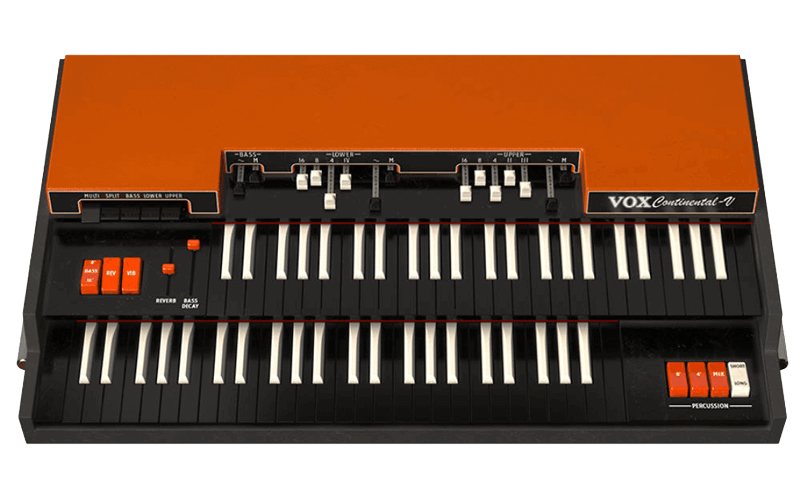
Vox Continental V is Arturia's software recreation of the VOX Continental 300, the 1960s combo organ. Arturia describes it as bringing the transistor-organ sound associated with bands such as The Doors and The Animals into a modern plugin.
It is built with Arturia's TAE (True Analog Emulation) physical modeling. Beyond the circuit behavior of the dual-manual organ, it also models key-contact timing and background noise, an approach Arturia contrasts with sample-based organs.
The Jennings J70, a later organ designed by Tom Jennings, is modeled too. You can switch between the two models, so one product covers two combo organs.
Extended mode adds drawbars for each harmonic and a percussion section with short and long decay times. Open mode lets you adjust the tuning of each pitch, key-contact timing and noise bleed, which allows you to imitate an older, worn instrument.
The interface comes in a classic red and orange skin or a UK-style gray skin. The upper manual, lower manual and bass pedal sections can be played from one MIDI keyboard or several. Arturia says MIDI mapping extends to pedals, effects and engine parameters.
Key features
Physical model of the VOX Continental 300
Two manuals, drawbars and a bass pedal section follow the original organ's controls. The drawbars can also be mapped to a MIDI controller.
Jennings J70 voice engine
You can switch to the Jennings J70 engine. The look can be the classic red and orange or a UK-style gray.
Extended and Open modes
Extended mode adds drawbars and percussion plus vibrato, tremolo and overdrive. Open mode lets you adjust tuning per pitch, key-contact randomness and noise.
Pedal effects with amp and mic models
Pedals include flanger, phaser, analog delay and wah. Modeled amps include Fender Deluxe Reverb, Twin Reverb, Bassman, Marshall Plexi and Leslie, and mics include the Shure SM57.
Convolution reverb
A convolution reverb with classic spring reverbs is included, which may suit adding vintage-gear ambience.
Flexible MIDI mapping
You can split the keyboard or use separate MIDI channels per manual, and map MIDI to pedals, effects and engine parameters broadly.
Specifications
| Item | Details |
|---|---|
| Engine | Physical modeling (TAE) |
| Modeled instruments | VOX Continental 300, Jennings J70 |
| Modes | Standard / Extended / Open |
| Outputs | Guitar amp, Leslie, direct |
| Formats | Standalone, VST, VST3, AAX, Audio Unit, NKS |
| Operating systems | macOS 10.13+ / Windows 10+ (64-bit) |
| Requirements | 4 GB RAM, 4-core 3.4 GHz CPU or Apple Silicon, 3 GB free disk space, OpenGL 2.0 GPU |
| Licensing | Arturia Software Center (up to five activations per license) |
What is included and system requirements
- Vox Continental V (Standalone, VST, VST3, AAX, Audio Unit, NKS)
- Two models: VOX Continental 300 and Jennings J70
- Pedal effects, amps, microphones and a convolution reverb
- Requirements: macOS 10.13+ / Windows 10+ (64-bit), 4 GB RAM, 3 GB free disk space
- Activation via Arturia Software Center (five devices per license)
How to use it
- Sign in to the Arturia Software Center and download Vox Continental V.
- Load it on an instrument track in your DAW.
- Connect a MIDI keyboard and pick a preset by tag in the browser.
- Move the drawbars of the upper manual to find the thickness you want.
- Choose pedals and an amp output (guitar amp or Leslie) to set the character.
- Switch to Extended mode to try the extra drawbars and percussion.
- In Open mode, adjust noise bleed and key-contact timing.
- Save your settings as a preset.
Where it may come in handy
Garage rock and psychedelic pop
The rough transistor-organ texture may suit riffs in 1960s-style band tracks, perhaps with the guitar amp output.
New wave and ska
Short chord stabs or percussion-heavy settings could fit. Wah and delay pedals can be tried as well.
Loop source material
Adding noise and timing irregularity in Open mode could produce material with an old-gear feel.
Stage playing
Since it also runs standalone, it may serve as a keyboard rig with a laptop and a MIDI keyboard on stage.
Who it may suit
- Producers who want a 1960s–80s rock or pop style organ
- Players who want to adjust the quirks of the instrument rather than a fixed sample set
- Anyone who wants pedals and amps in one instrument
- Existing users of Arturia's V instruments
Good to know before you buy
- Activation is through the Arturia Software Center, with up to five instances per license.
- It is also included in the V Collection.
- ARM on Windows is not supported.
- A free demo is available on Arturia's site.
- Prices can change during sales, so check before buying.
How it differs from similar products
We do not pick a winner; the official figures are placed side by side.
Arturia Solina V
Both are Arturia physical-modeling instruments around 99 euros or dollars. Vox Continental V is an organ with two manuals and drawbars. Solina V is a string machine with 150 presets and a convolution reverb with 24 reverbs.
Price
$99 (Plugin Boutique, checked 2026-10-27). Prices can vary by region and promotion, so check the official page before buying.
See Vox Continental V on the product page
More of the same kind
We have introduced 22 piano and keyboard instruments. Here are some of the others.
- Soundpaint 1928 Vintage Grand Steinway
- Applied Acoustics Systems Lounge Lizard EP-5
- Modartt Pianoteq 9
- Synthogy Ivory II Italian Grand
- Universal Audio Electra 88 Vintage Keyboard Studio
- Synthogy Ivory II Upright Pianos
We have introduced 45 other products from Arturia.
For a side-by-side comparison scored on the same criteria, see our comparison of piano and keyboard instruments.
See the full list in Product database: Instruments.
Sources: arturia.com pluginboutique.com (checked 2026-10-27)










Comments