
Disclosure: This page may contain affiliate links. Prices were checked on the date shown and may change.
An introduction to Waldorf PPG Wave 3.V 2.0, based on information from the maker and distributors: what it does, how to use it and who it may suit. It is not scored.
Step back in time to move forward with PPG Wave 3.V 2.0. This updated version honors the famous Waldorf Microwave synthesizer, bringing back its best features.
— Waldorf official site
What is PPG Wave 3.V 2.0?
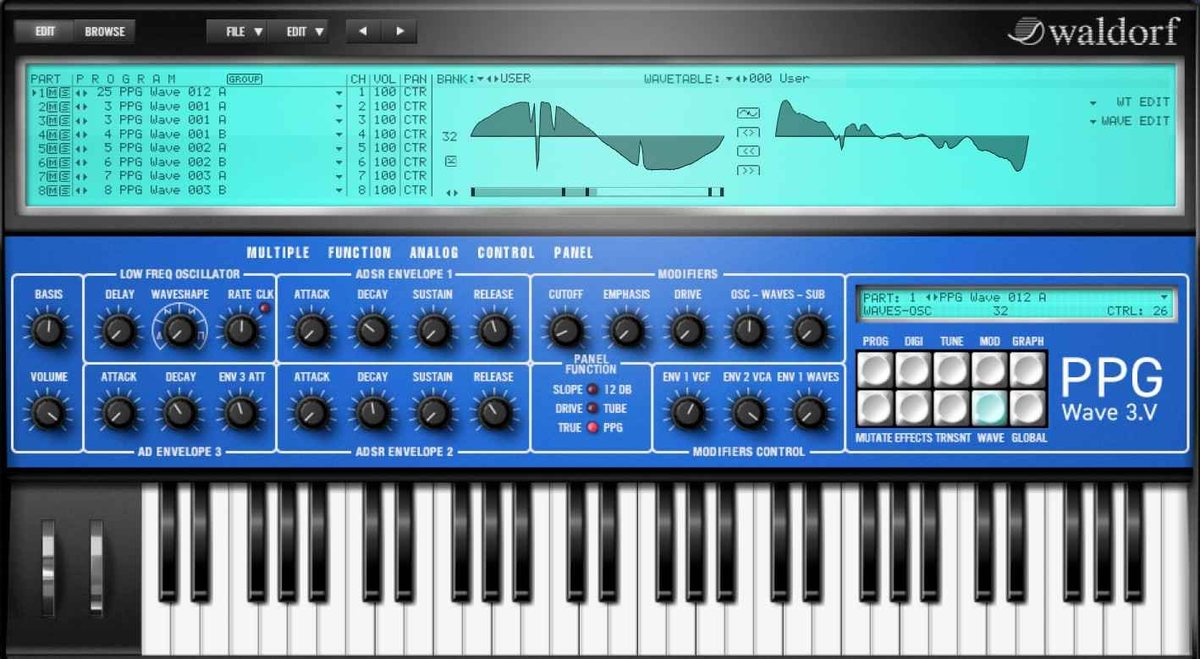
PPG Wave 3.V from Germany's Waldorf is a software recreation of the PPG Wave, a classic wavetable synthesizer. Wavetable synthesis reads through a series of stored waveforms to change the tone.
Version 2.0 is a major update that brings features from Waldorf's Microwave synthesizer back to the PPG. According to the maker it adds a resizable user interface, an integrated wavetable editor for user wavetables, the Mutator patch randomizer and new factory wavetables.
Each instance supports up to 256 voices (depending on CPU power), an 8-part multimode and 8 stereo outputs. It also includes the original PPG Wave factory sounds, the original Waveterm B factory sample library, and over 100 new wavetables created by Wolfgang Palm.
Most parameters can be automated from the host or a MIDI controller. The price at Plugin Boutique is 165 US dollars. Waldorf's site offers purchase through MyWaldorf, an update purchase for existing owners and a trial version.
Key features
User wavetables and editor
Added in 2.0, an integrated wavetable editor lets you build your own wavetables, which may appeal to people who want sounds beyond the stock ones.
Mutator patch randomizer
Inspired by the Microwave plug-in, this generates patches at random. It may be a way to find a starting point or to break out of a rut.
Resizable interface
The UI can be scaled to different screen sizes, which the maker presents as an improvement for different monitors and laptops.
Up to 256 voices and 8-part multimode
Up to 256 voices per instance (depending on CPU), with an 8-part multimode and 8 stereo outputs, which may be handy for keeping several sounds separate in a mix.
100+ new wavetables
More than 100 new wavetables created by Wolfgang Palm, creator of the PPG Wave, are included, expanding the pool of source material.
Original sounds and Waveterm B library
The original PPG Wave factory sounds and the Waveterm B factory sample library are included, which may serve as starting points for classic PPG-style sounds.
Host and MIDI automation
Most parameters can be automated by the host and MIDI controllers, which may suit evolving sounds or live-style control.
Specifications
| Item | Details |
|---|---|
| Type | Wavetable synthesizer (software instrument) |
| Voices | Up to 256 per instance (depending on CPU) |
| Multimode | 8 parts |
| Outputs | 8 stereo outputs |
| New wavetables | 100+ (created by Wolfgang Palm) |
| Formats | VST2 / VST3 / AU / AAX |
| OS | Windows 7 / 10 / 11 (Intel- or AMD-based PC) / macOS 10.13+ (Intel- or M1-based Mac) |
What is included and system requirements
- PPG Wave 3.V 2.0 (VST2, VST3, AU, AAX)
- Original PPG Wave factory sounds
- Original Waveterm B factory sample library
- Over 100 new wavetables by Wolfgang Palm
- Integrated wavetable editor and Mutator
How to use it
- If bought at Plugin Boutique, register the license by entering the serial in your Waldorf account.
- Note your license key and download the installer for your operating system.
- Run the installer, follow the prompts, and restart if needed.
- Open your DAW, load PPG Wave 3.V and authorize with your registered email and key.
- Choose a factory sound and move the wavetable position to hear how the tone changes.
- Use the Mutator to generate new patches and save the ones you like.
- Create your own wavetable in the editor and load it into the instrument.
- Assign multiple parts in multimode and send each output to the mixer.
Where it may come in handy
1980s-style wavetable sounds
The original PPG-style sounds and new wavetables could be used to look for pad and bell-like tones.
Making your own wavetables
Because waveforms can be built in the editor, it may suit people who want sounds nobody else has.
Layering multiple parts
The 8-part multimode may let you handle several sounds of an arrangement inside one plug-in.
Idea generation with randomization
Patches from the Mutator may lead you to a direction for a track that you had not planned.
Who it may suit
- People who want to try a wavetable synth
- People interested in the Waldorf Microwave approach
- People who want to build their own waveforms into a sound source
- Owners of the earlier PPG Wave 3.V considering the update
Good to know before you buy
- Waldorf's site lists a separate update purchase through MyWaldorf for owners of the earlier version.
- The system requirements listed at Plugin Boutique are Windows 7/10/11 and macOS 10.13 or later; check Waldorf's site for the latest OS support.
- The price is the regular price at Plugin Boutique on 27 October 2026.
How it differs from similar products
We do not pick a winner; the official figures are placed side by side.
Native Instruments Absynth 6
PPG Wave 3.V 2.0 centres on wavetable synthesis with up to 256 voices and an 8-part multimode. Absynth 6 combines several synthesis methods on three oscillator channels and ships with over 2,000 presets.
Price
$165 (Plugin Boutique, checked 2026-10-27). Prices can vary by region and promotion, so check the official page before buying.
See PPG Wave 3.V 2.0 on the product page
More of the same kind
We have introduced 178 synthesizers. Here are some of the others.
- Arturia Jup-8 V
- Sugar Bytes Factory
- Cherry Audio CA2600
- LANDR LANDR Strata
- Arturia Mini V
- AIR Music Technology Fabric Vintage Andromeda
We have introduced 4 other products from Waldorf.
For a side-by-side comparison scored on the same criteria, see our comparison of synthesizers.
See the full list in Product database: Instruments.
Sources: waldorfmusic.com pluginboutique.com (checked 2026-10-27)










Comments