
Disclosure: This page may contain affiliate links. Prices were checked on the date shown and may change.
An introduction to Cherry Audio Atomika, based on information from the maker and distributors: what it does, how to use it and who it may suit. It is not scored.
Atomika is Cherry Audio's painstakingly crafted emulation of the Polivoks synthesizer manufactured at the Formanta Radio Factory between 1982 and 1990.
— Cherry Audio official site
What is Atomika?
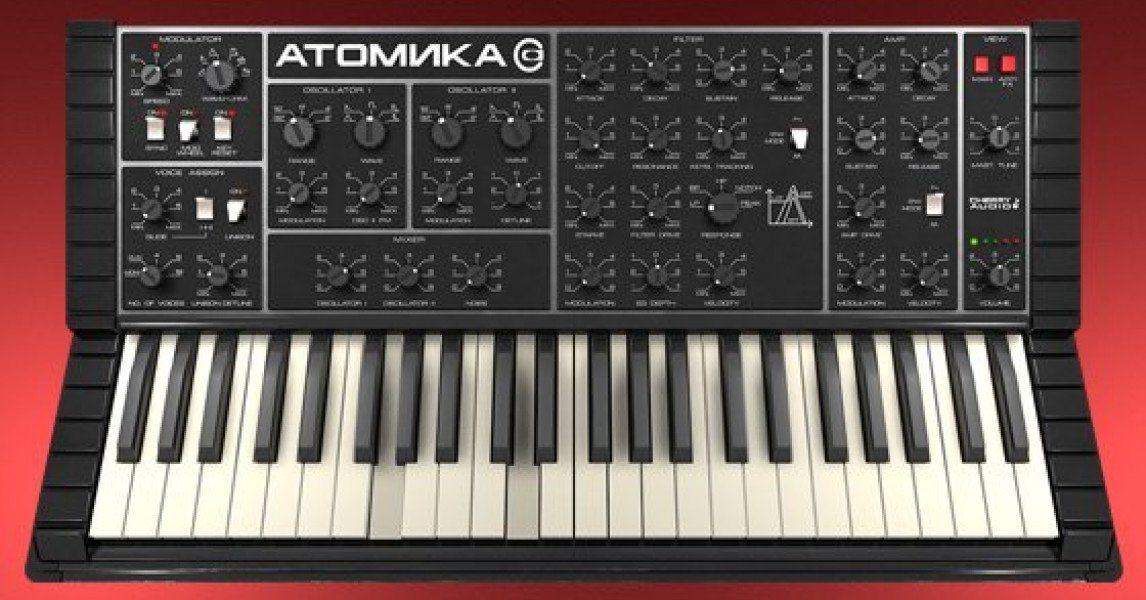
Atomika is a software synthesizer from Cherry Audio. It emulates the Polivoks synthesizer made at the Formanta Radio Factory in the former Soviet Union between 1982 and 1990, using circuit-modeled DSP by Mark Barton.
The Polivoks is known for a distinctive filter that uses programmable op-amps not originally intended for audio filter circuits, rather than the components used in typical filters. Two loopable envelopes and a duophonic mode are among its unusual features.
Atomika goes beyond copying the original. It adds new controls such as Starve, Filter Drive and Amp Drive, plus highpass, notch and peak filter modes. It also extends the original's duophonic design to up to 16 voices and adds unison, velocity and aftertouch response.
A second panel provides an arpeggiator and four effects (phasor, flange/chorus, echo and reverb), and panel labels can be switched to Cyrillic text. Over 350 presets are included.
Key features
Polivoks filter, modeled and extended
The original op-amp-based filter circuit is modeled, with highpass, notch and peak responses added to lowpass and bandpass. Starve and Filter Drive may let you adjust how rough the sound gets.
Mono, duophonic and up to 16-voice polyphony
Besides the original duophonic mode, 4, 8 or 16-voice polyphony is available. With unison and two glide types, it can be used for leads as well as chords.
Two VCOs and noise
The two VCOs offer triangle, saw, square, wide pulse and narrow pulse, plus oscillator FM and noise.
Loopable envelopes
Looping the filter and amp ADSRs creates repeating changes like an LFO. It may be used to build unusual pulsing movements.
Arpeggiator and four effects
The arpeggiator (Up / Down / Up-Down / Random) syncs to MIDI tempo. Built-in effects are a 4/6/12-stage phasor, flange/chorus, three echo types and five reverb types, with a dedicated FX LFO.
350+ presets and MIDI mapping
More than 350 presets from the sound design team are included, with MIDI learn, DAW automation and preset-level or global mapping.
Cyrillic panel labels
Panel labels can be switched to Cyrillic text like the original, and a hide-keyboard option frees screen space.
Specifications
| Item | Details |
|---|---|
| Type | Software synth (circuit model of the Polivoks) |
| Voices | Mono / duophonic / 4, 8 or 16-voice polyphony |
| Oscillators | 2 VCOs (triangle, saw, square, pulse) + FM + noise |
| Filter | Lowpass / bandpass / highpass / notch / peak |
| LFO | Ramp, saw, triangle, square, noise, S&H (syncable) |
| Effects | Phasor, flange/chorus, echo, reverb |
| Presets | 350+ |
| Formats | AU / VST / VST3 / AAX / Standalone |
| OS | Windows 7 or later (64-bit, including Windows 11) / macOS 10.13 or later (64-bit, native on Apple M1 or later) |
| Disk space | 197 MB |
What is included and system requirements
- Atomika instrument (AU / VST / VST3 / AAX / Standalone)
- 350+ presets
- 30-day demo available (plays white noise periodically, otherwise unlimited)
- Optional Chain Reactions for Atomika preset pack (100 presets, $9.99), sold separately
- Filtomika, an effect plugin built around the same filter, is a separate product
How to use it
- Purchase with a Cherry Audio account and download the installer.
- Run the installer and choose the formats you want (AU / VST / VST3 / AAX / Standalone).
- Activate the product while connected to the internet.
- Create a new MIDI / instrument track in your DAW and load the plugin.
- Pick a nearby sound in the preset browser, then move the filter cutoff and resonance.
- Raise Filter Drive, Amp Drive and Starve a little at a time and listen to how the roughness changes.
- Switch the voice count to use mono for leads and poly for chords.
- Add the arpeggiator and effects on the second panel.
Where it may come in handy
Synthwave and darkwave
Making basses and leads that use the rough filter and 1980s-style texture may be one use.
Industrial and techno
Pushing Filter Drive or Starve may help create distorted, aggressive sounds.
Film and game music
Looping envelopes and the arpeggiator may be used to build uneasy sequences.
Who it may suit
- People interested in the quirky filter of the Soviet-made Polivoks
- People who want rough analog-style sounds in a polyphonic synth
- People looking for a synth with many ready-to-use presets
Good to know before you buy
- An internet connection is required for product activation.
- The demo plays white noise periodically.
- The official page carries a disclaimer that the product celebrates synthesizers developed in the former Soviet Union and is not an endorsement of the current Russian government or its actions.
How it differs from similar products
We do not pick a winner; the official figures are placed side by side.
Cherry Audio Pro Soloist
Atomika offers up to 16 voices and 350+ presets, while Pro Soloist has a dual-layer design with 16 voices per layer and 450 presets.
Price
$49 (Cherry Audio official site, checked 2026-10-27). Prices can vary by region and promotion, so check the official page before buying.
See Atomika on the product page
More of the same kind
We have introduced 178 synthesizers. Here are some of the others.
- Arturia Arturia SEM V
- AIR Music Technology The Riser
- Klevgrand Baervaag
- Arturia SQ80 V
- Arturia KORG MS-20 V
- W. A. Production ImPerfect
We have introduced 31 other products from Cherry Audio.
- Cherry Audio Eight Voice
- Cherry Audio Polymode
- Cherry Audio Yellowjacket
- Cherry Audio Miniverse
- Cherry Audio Dreamsynth
For a side-by-side comparison scored on the same criteria, see our comparison of synthesizers.
See the full list in Product database: Instruments.
Sources: cherryaudio.com pluginboutique.com (checked 2026-10-27)










Comments