
Disclosure: This page may contain affiliate links. Prices were checked on the date shown and may change.
An introduction to Cherry Audio Eight Voice, based on information from the maker and distributors: what it does, how to use it and who it may suit. It is not scored.
Cherry Audio’s Eight Voice polyphonic synthesizer meticulously emulates the immense sound of the Oberheim® Eight Voice, one of the world’s rarest and most desirable vintage instruments.
— Cherry Audio official site
What is Eight Voice?
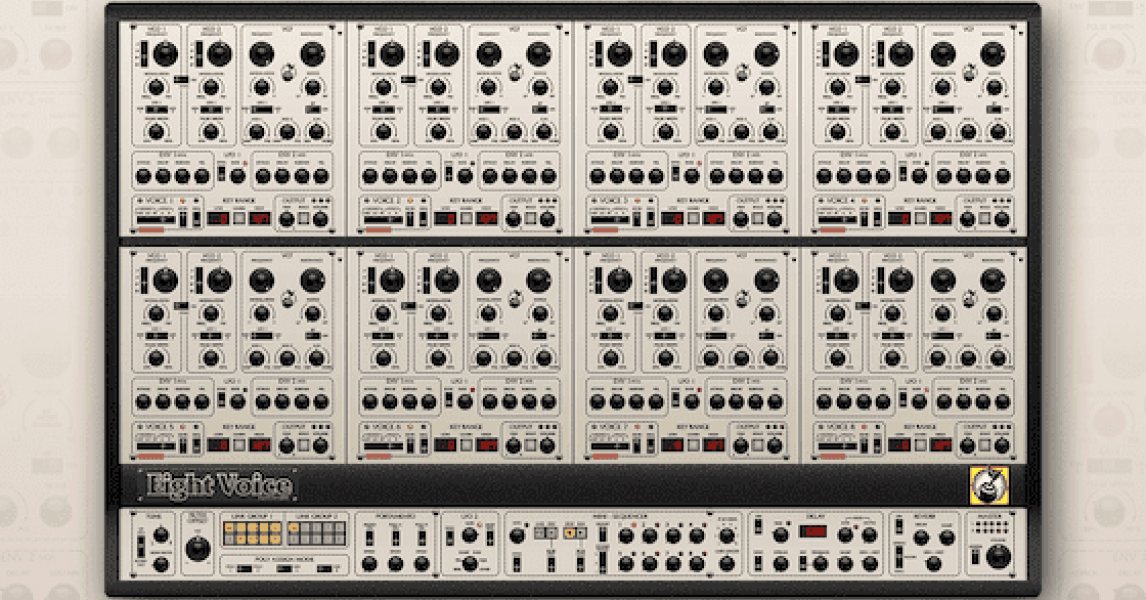
Eight Voice is a polyphonic software synthesizer from Cherry Audio. It is modeled on the Oberheim Eight Voice, a large vintage instrument built from eight separate synth voice modules, and it is available as AU, VST, VST3, AAX and standalone.
The original had eight independent dual-oscillator voice modules, which took effort to program. This version adds Voice Link controls that group the voice modules, so a uniform polyphonic sound does not require setting each module one by one.
The filter is an emulation of the Oberheim state-variable filter by synth designer Mark Barton (MRB). The instrument also includes an eight-step mini sequencer, an LFO with six waveforms and tempo sync, and a modulation delay and reverb that sync to tempo.
It ships with more than 330 presets. A wide choice of keyboard assign modes supports zoning and layering across the keyboard. A free 30-day demo is available.
Key features
Eight independent voice modules
There are eight dual-oscillator voice modules, each set independently. Varying the settings per voice can add thickness and slight movement to chords.
Grouped control with Voice Link
Voice Link connects the controls of several voices so they move together. It reduces the work of matching eight modules by hand when a homogeneous poly sound is wanted.
Focus buttons for enlarged panels
Any area of the interface can be enlarged instantly. On a panel with many controls, this lets you work on the section you are editing at a larger size.
Flexible keyboard assignment
Many mono and poly assign modes are provided, with independent key ranges. This allows splits, zones and layered sounds across the keyboard.
Filter emulation by MRB
Mark Barton (MRB) designed the emulation of the Oberheim multi-mode filter. It supports the basic approach of shaping oscillator output with the filter in a way that follows the original instrument.
Sequencer, LFO and effects
An eight-step mini sequencer with half-step quantizer, a six-waveform LFO, reverb and mod delay are included, all with tempo sync. A sound can be completed without external effects.
Specifications
| Item | Details |
|---|---|
| Formats | AU / VST / VST3 / AAX / Standalone |
| Presets | 330+ |
| Voices | Eight independent dual-oscillator voice modules |
| Sequencer | Eight steps (half-step quantizer, tempo sync) |
| LFO | Six waveforms, tempo sync |
| Effects | Reverb and mod delay (tempo sync) |
| MIDI / automation | All controls |
| Demo | 30 days (unrestricted apart from periodic white noise) |
What is included and system requirements
- The synthesizer (AU, VST, VST3, AAX, standalone)
- 330+ presets
- macOS 10.13 or later (64-bit required, native Apple Silicon); 3.4 GHz quad-core or M1 and 8 GB RAM recommended
- Windows 7 or later including Windows 11 (64-bit required); quad-core and 8 GB RAM recommended
- Internet connection is required for activation
How to use it
- Download the demo or purchased version from Cherry Audio and install it.
- Activate the product while connected to the internet.
- Load it in your DAW as an instrument in AU, VST, VST3 or AAX format.
- Start by auditioning presets in categories such as Poly or Brass.
- Turn on Voice Link for a sound you like and adjust the filter and envelopes together.
- Use a Focus button to enlarge the section you want to refine.
- Add the eight-step sequencer, reverb and delay as needed.
Where it may come in handy
Thick poly pads and brass
Stacked voices may suit rock or pop parts that call for thick chords. Voice Link may let you shape them quickly.
Split and layered parts
Independent key ranges may make it easier to give bass to the low zone and pads to the high zone, covering two parts with one instrument.
A base for sequenced ideas
The eight-step mini sequencer combined with a tempo-synced delay may give you a starting point for short repeating phrases.
Who it may suit
- Those interested in the layout of vintage polyphonic synths
- Producers who want thick polyphonic chords in a track
- Users who want to try editing several voices as a group
Good to know before you buy
- Oberheim is a registered trademark of Tom Oberheim; Cherry Audio states there is no association or endorsement.
- Internet connection is required for activation.
- The demo runs for 30 days and plays white noise periodically.
How it differs from similar products
We do not pick a winner; the official figures are placed side by side.
Cherry Audio Mercury-6
Eight Voice has eight dual-oscillator voice modules and 330+ presets. Mercury-6 has 16 voices per layer in a two-layer architecture and 500+ presets. The instruments they are based on differ in era and layout.
Price
$39 (Cherry Audio official site, checked 2026-10-27). Prices can vary by region and promotion, so check the official page before buying.
See Eight Voice on the product page
More of the same kind
We have introduced 178 synthesizers. Here are some of the others.
- Tracktion Hyperion
- Tracktion Waverazor
- Tracktion Tracktion BioTek 3
- Tracktion Atmosia
- Stagecraft Software Theremin
- TAL Software TAL-Pha
We have introduced 31 other products from Cherry Audio.
- Cherry Audio Lowdown
- Cherry Audio P-10 Synthesizer
- Cherry Audio PS-20
- Cherry Audio CA2600
- Cherry Audio Mercury-8
For a side-by-side comparison scored on the same criteria, see our comparison of synthesizers.
See the full list in Product database: Instruments.
Sources: cherryaudio.com pluginboutique.com (checked 2026-10-27)










Comments