
Disclosure: This page may contain affiliate links. Prices were checked on the date shown and may change.
An introduction to Arturia Acid V, based on information from the maker and distributors: what it does, how to use it and who it may suit. It is not scored.
Acid V is a software instrument modeled on the cult-classic bass synth that defined the punchy, abrasive sound of acid and rave.
— Arturia official site
What is Acid V?
Acid V is a software instrument from French maker Arturia, modeled on the TB-303 bass synthesizer released in 1981. The official description credits the instrument's biting, abrasive sound with defining acid house and rave music.
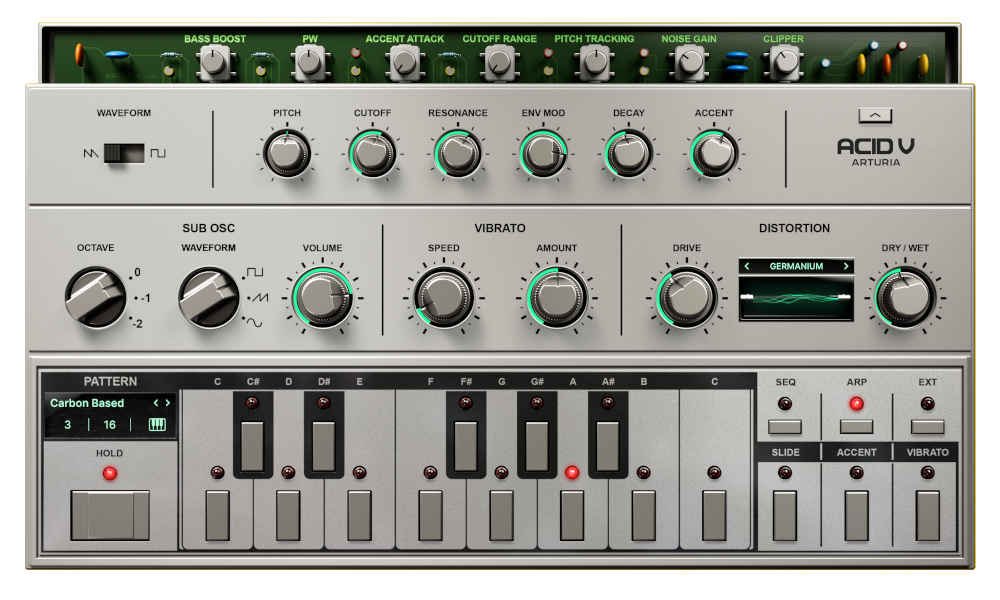
Rather than a straight reproduction, Acid V adds modern features: a sub oscillator with a two-octave range, vibrato that runs from slow detune to audio rate, and a distortion section with 14 algorithms.
The sequencer has up to 64 steps with slide, accent and octave shifting. Transmutation rewrites a pattern in one click, scales can be locked in, and patterns can be dragged into the DAW as MIDI, which may speed up building acid-style phrases.
It includes over 150 presets and more than 350 sequence presets. A hidden panel called the hatch lets you adjust analog-component quirks such as pitch drift and noise found in vintage units. The price at Plugin Boutique is 149 US dollars.
Key features
Circuit-modeled 303-style voice
The maker describes a circuit-accurate remodeling of the TB-303. With square and sawtooth waveforms and a resonant low-pass filter, it is centred on moving cutoff and resonance for sharp changes of tone.
Sub oscillator and vibrato
A two-octave sub oscillator with three waveforms and a vibrato that goes from subtle pitch movement to FM-like effects have been added, which may help when you want more weight or grit in a bass.
Distortion with 14 algorithms
A built-in distortion offers 14 algorithms, from valve-style to bit-crush, with adjustable drive and dry/wet balance.
Up to 64-step sequencer
A polymetric sequencer and arpeggiator with slide, accent and octave shifting. Patterns can be dragged into the DAW as MIDI blocks.
Transmutation and scales
Transmutation rewrites a pattern in one click, and scales chosen with modern styles in mind can be locked in. They may help when ideas run dry.
The hatch for analog fine-tuning
The hidden hatch panel exposes detailed analog component adjustments, such as the pitch drift and noise of vintage units.
Modulation and effects
Three multi-mode function generators and four FX slots with 17 effects to choose from. MTS-ESP microtuning is supported.
Specifications
| Item | Details |
|---|---|
| Type | TB-303-modeled bass synth (software instrument) |
| Oscillators | Square and sawtooth waves (the feature list also mentions triangle), sub oscillator (2 octaves, 3 waveforms) |
| Distortion | 14 algorithms |
| Sequencer | Up to 64 steps with slide, accent and octave shifting |
| Presets | 150+ (350+ sequence presets) |
| FX | 4 slots / 17 effects |
| Formats | Standalone / VST / AAX / Audio Unit / NKS |
| OS | Windows 10+ (64-bit, ARM not supported) / macOS 11+ |
| System | 4 GB RAM, 4-core 3.4 GHz CPU (or M1), 3 GB free disk, OpenGL 2.0 GPU |
What is included and system requirements
- Acid V instrument (Standalone, VST, AAX, AU, NKS)
- Over 150 factory presets
- Over 350 sequence presets
- Installation and activation managed through Arturia Software Center
How to use it
- Install Arturia Software Center, register your license and download Acid V.
- Open your DAW and load Acid V on an instrument track (it also runs standalone).
- Pick a preset and play a bass note.
- Move cutoff and resonance to hear how the tone changes.
- Enter steps and add slide and accent to build a basic phrase.
- Use Transmutation or scales to create variations of the phrase.
- Choose a distortion and effects to set grit and space.
- Drag a pattern you like into the DAW as MIDI and build it into your track.
Where it may come in handy
Acid house and techno production
It may be worth trying for bass lines and lead phrases, and since sequencer patterns can be handed to the DAW, ideas look easy to move into a track.
Heavy EDM bass
Adding weight with the sub oscillator and distortion may make it usable for EDM-leaning basses.
Generating pattern ideas
Rewriting your own phrase with Transmutation may help you find developments you had not thought of.
A software alternative to hardware
When owning the hardware is difficult, it may be an option for having a 303-style sound at hand in software.
Who it may suit
- People who want acid-style bass lines
- People who like building phrases around a sequencer
- People looking for a bass synth that lives inside the DAW
- People who enjoy fine-tuning vintage-style quirks
Good to know before you buy
- Windows on ARM processors is not supported.
- System requirements follow the maker's page and differ slightly from the Plugin Boutique listing (maker: 3 GB free disk, macOS 11+).
- The price is the regular price at Plugin Boutique on 27 October 2026. It may also be included in Arturia bundles, so check contents before buying.
How it differs from similar products
We do not pick a winner; the official figures are placed side by side.
Sugar Bytes Cyclop
Acid V is a 303-style monophonic bass synth with a sequencer of up to 64 steps. Sugar Bytes Cyclop is also monophonic but has two sound generators, a 10×2 filter and a wobble generator.
Price
$149 (Plugin Boutique, checked 2026-10-27). Prices can vary by region and promotion, so check the official page before buying.
See Acid V on the product page
More of the same kind
We have introduced 178 synthesizers. Here are some of the others.
- Tracktion Tracktion BioTek 3
- Native Instruments Blocks Primes
- Baby Audio BA-1
- Waves Flow Motion FM Synth
- D16 Group LuSH-2
- AIR Music Technology Loom II
We have introduced 45 other products from Arturia.
For a side-by-side comparison scored on the same criteria, see our comparison of synthesizers.
See the full list in Product database: Instruments.
Sources: arturia.com pluginboutique.com (checked 2026-10-27)










Comments