
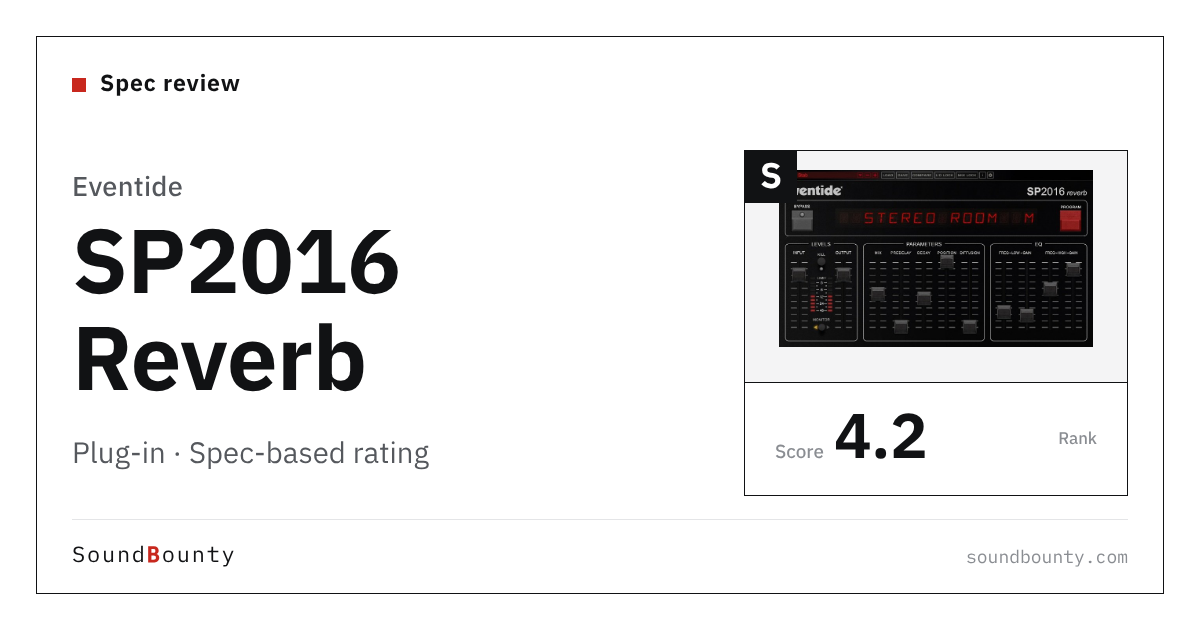
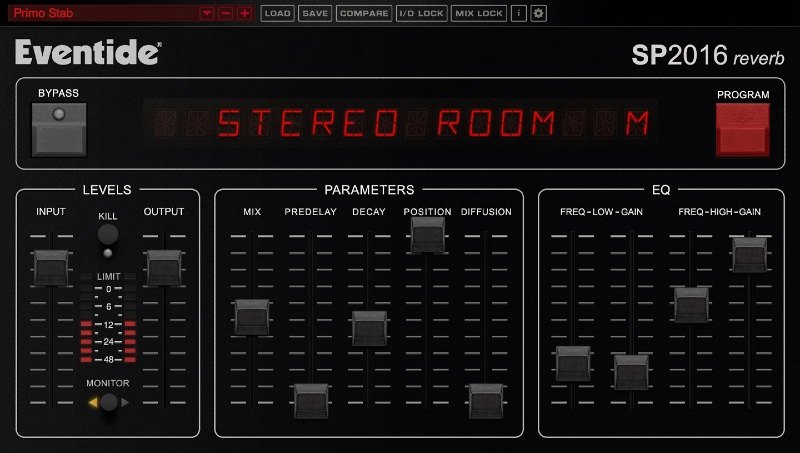
Eventide’s SP2016 Reverb recreates the reverbs of Eventide’s SP2016 effects unit, which appeared in 1982. It offers Room, Stereo Room and Hi-Density Plate in Vintage and Modern versions, and a Position slider moves the listening position from front to back.
A reverb adds the sound of a room or hall to a recording. For vocals, it adds space and helps the voice sit in the mix with the backing track.
In this article we compare SP2016 Reverb with 12 reverb plug-ins and rate how well it serves its purpose on three criteria. The basis is official manufacturer information.
Disclosure: This article contains affiliate links. If you buy through them, SoundBounty may earn a commission at no extra cost to you. Prices and sale information are as of the date we checked them and can change.
Score 4.3 / 5 (average of the 12 products compared: 3.6)
- Specs last checked
- 2026/09/25
- Vocal-friendly sounds
- Room, hall, plate
- Easy to blend
- Pre-delay + EQ
- Speed
- Distance by Position
- Price (store, date)
- $99 [PB, checked Oct 26]
Summary
Among the 12 reverb plug-ins, SP2016 Reverb is rank S. The ranks run S, A, B and C, and S is the top. Averaging the scores for each criterion (out of 5, with the one criterion that matters most for the purpose counted double) gives 4.3.
Strengths
- Vocal-friendly sounds (5 points): it has the reverb sounds commonly used on vocals, so it is easy to use on a voice.
- Speed (4 points): clear controls and automatic settings get you to the sound you want quickly.
Who it suits: people who want the vintage sound of an 80s digital reverb.
Main features of SP2016 Reverb
Three sounds in two versions
SP2016 Reverb recreates the Room, Stereo Room and Hi-Density Plate of the 1982 SP2016. Stereo Room sounds like a large concert hall and Hi-Density Plate like a large, heavy plate. Each has a Vintage version that reproduces the original’s low bit depth and a Modern version that is brighter and denser, so you can choose from six in total.
Position moves the listening spot front to back
Position moves where you are listening in the room, from front to back, with a single slider. The manual describes it as changing the balance between the first reflections and the later tail. You can place the sound “a little further back” without upsetting the other settings.
Long pre-delay and shelving EQ
Pre-delay is the gap before the reverb starts, and SP2016 Reverb can stretch it to 999 ms. Set long, it can be used like an echo. There is also a shelving EQ that raises or lowers the low and high frequencies of the tail, which helps tame a reverb that sounds muddy.
Video: “Introducing the SP2016 Reverb Time Machine for your D.A.W.” (official Eventide Audio YouTube channel; narration in English) Watch on YouTube
Where it is useful
- Adding the classic digital-reverb sound to a vocal with Stereo Room or Hi-Density Plate
- Moving Position back to place backing vocals and harmonies behind the lead
- Adding room sound to a snare or percussion with a short Room
Rating by criterion
Vocal-friendly sounds: 5 / 5
We check whether it has the reverb types vocalists use most (plate, hall and room).
There are three sounds: Room, Stereo Room (the sound of a large concert hall) and Hi-Density Plate, each with a Vintage version close to the original and a brighter Modern version.
Easy to blend: 3 / 5
We check whether you can adjust the reverb so it does not get in the way of the voice and sits well with the backing track.
It has pre-delay of up to 999 ms and a shelving EQ that raises or lowers the low and high frequencies of the tail.
Speed: 4 / 5
We check whether it has features that get you to the sound you want quickly, such as automatic settings or controls that work by feel, like distance.
One Position slider moves the listening position from the front of the room to the back.
How we score (Reverb plug-ins)
| Criterion | Basis | 5 pt | 4 pt | 3 pt | 2 pt | 1 pt |
|---|---|---|---|---|---|---|
| Vocal-friendly sounds | Whether it offers the reverb types vocalists rely on (plate, hall and room) | Three or more standard sounds to choose from, including plate | Two or more including plate, or several plate models | Two or more standard sounds other than plate | One standard sound | Mainly special-effect sounds |
| Easy to blend | Controls for blending the reverb into a mix and a voice | Ducking, per-band decay time and reverb EQ are all included | Two of those, or a feature that adjusts automatically to the sound | One or two controls such as pre-delay or EQ | — | Not mentioned on the official page |
| Speed | How quickly you can reach the sound you want | AI builds the reverb automatically to suit the sound | Easy-to-understand controls, such as distance | Just pick a mode | Standard controls | — |
Each criterion is scored from 1 to 5 on how well the product serves one goal: adding a natural sense of space to a vocal and blending it into the backing track. Scores follow the conditions in the table above, and the rank is based on an average in which "Vocal-friendly sounds" counts double. The basis is official manufacturer information. Sound quality and CPU load are not measured, so they are not scored; reviews from trade magazines are introduced in the articles for reference. Price is not part of the score. Features that cannot be confirmed from the manufacturer's or a retailer's description are scored as if absent. The "OBS (streaming)" column in the table shows whether the official page lists the VST2 format that the streaming software OBS Studio can use (○). OBS does not support the VST3 format. It is not part of the score.
SP2016 Reverb system requirements and getting started
| Operating system | Windows 10 or later / Mac (macOS 10.14 or later) |
|---|---|
| Plug-in formats | Windows: VST2, VST3, AAX / Mac: AU, VST2, VST3, AAX |
| Other | An iLok account is required (no USB key needed) |
| Trial | 14-day trial available |
| OBS (streaming) | Works as it is (VST2 is listed) |
Checked on the manufacturer’s official pages on September 27, 2026.
Compared with other reverb plug-ins
Click a heading to sort. On a phone, the table scrolls sideways.
| Product | RankAvg. score | Vocal-friendly sounds | Easy to blend | Speed | Free | OBS (streaming) | Price (store, date) |
|---|---|---|---|---|---|---|---|
| FabFilterPro-R 2 | S 4.8 | Room to plate | Ducking + reverb EQ | Clear controls | — | ○ | $199 [PB, checked Oct 26] |
| soniblesmart:reverb 2 | S 4.8 | Switch among 4 types | Auto + ducking | AI auto | — | ○ | $129 [PB, checked Oct 26] |
| EventideBlackhole | C 1.8 | Special effects | Pre-delay + EQ | Standard | — | ○ | $49 (sale; regular $99) [PB, checked Oct 26] |
| EventideSP2016 Reverb | S 4.3 | Room, hall, plate | Pre-delay + EQ | Distance by Position | — | ○ | $99 [PB, checked Oct 26] |
| Native InstrumentsRAUM | B 3.0 | Room + hall | Pre-delay + filter | Choose from 3 modes | Free | ○ | Not listed |
| MeldaProductionMReverb | A 3.5 | Hall + room | Per-band decay + EQ | Drag the position | — | ○ | $43 [PB, checked Oct 26] |
| SoundtoysSuperPlate | A 3.8 | 5 plate models | Ducking + EQ | Choose from 5 models | — | ○ | $149 [PB, checked Oct 26] |
| Valhalla DSPVintageVerb | A 4.0 | 22 reverb sounds | Damping | Pick a mode | — | ○ | $50 [Official, checked Oct 26] |
| Valhalla DSPValhallaRoom | A 3.8 | Room, hall, chamber | Per-band decay + cuts | Pick a mode | — | ○ | $50 [Official, checked Oct 26] |
| Valhalla DSPValhallaPlate | A 3.5 | 12 plate-only modes | EQ + pre-delay | Pick a mode | — | ○ | $50 [Official, checked Oct 26] |
| Valhalla DSPValhallaSupermassive | C 2.5 | 22 modes built for spaciousness | High Cut + Low Cut | Pick a mode | Free | ○ | Not listed |
| ArturiaRev PLATE-140 | A 3.5 | 3 plates incl. EMT 140 | Pre-filter + EQ | Pick a plate | — | Not confirmed | $79 [Official, checked Oct 26] |
Features checked on each manufacturer's official website on September 25, 2026. Check the store page behind the buy button for the price.
Read next
- Pro-R 2: features and rating (rank S)
- smart:reverb 2: features and rating (rank S)
- VintageVerb: features and rating (rank A)
- RAUM: features and rating (rank B)

Comments