
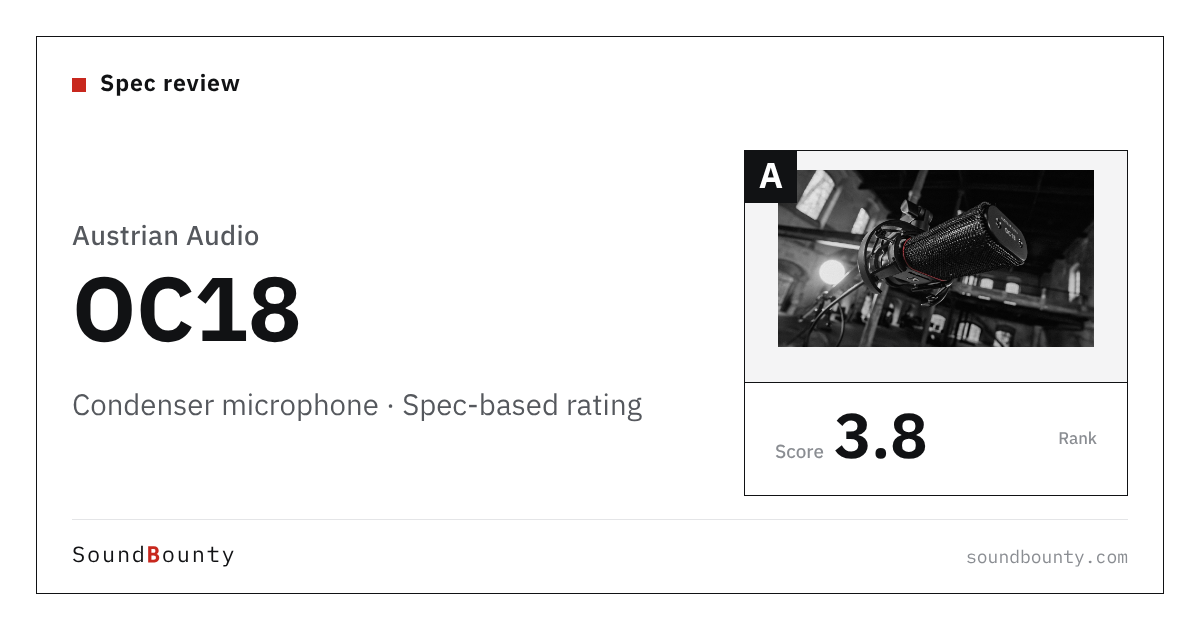
Austrian Audio’s OC18 is a cardioid condenser microphone with XLR connection.
A condenser microphone records small sounds in fine detail. It is often used to record singing and narration.
In this article we rate it on 5 criteria using only the specifications the manufacturer publishes, and show how it ranks among the 32 microphones we compare.
Disclosure: This site takes part in affiliate programs. Specifications are as of the date we checked them and can change.
Score 3.8 / 5 (average of the 32 models compared: 3.3)
- Specs last checked
- 2026/10/19
- Self-noise
- 9dB(A)
- Sensitivity
- 13mV/Pa
- Weight
- 335g
- Max SPL
- 148dB
- Price (store, date)
- Not disclosed
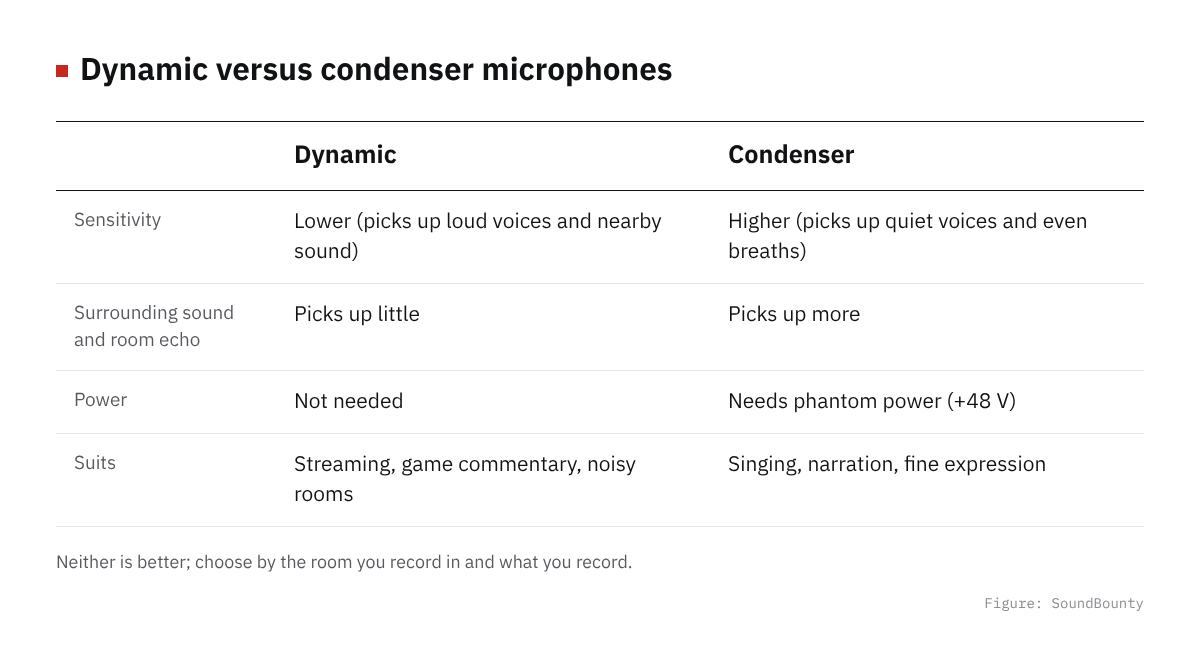
Figure: SoundBounty
Summary
Among the 32 microphones, OC18 is rank A. The ranks run S, A, B and C, and A is second from the top. Averaging the scores for each criterion (out of 5) gives 3.8.
Strengths
- Quietness (9 dB(A), 4 points): The microphone itself makes little noise, so whispers and quiet songs record cleanly.
- Handling of loud sound (148 dB, 5 points): Loud voices and instruments recorded up close are unlikely to distort.
- Features (2 of 3, 4 points): You can adjust to the sound you are recording with switches on the body.
- Lightness (335 g, 4 points): It is light, so there is little load on the microphone stand.
Things to keep in mind
- Sensitivity (13 mV/Pa, 2 points): Sensitivity is low, so you need to turn the gain knob on the audio interface up a lot.
Who it suits: judging from the specifications, it suits people who want to record quiet voices and whispers cleanly; people who record loud voices or instruments up close; people who want to adjust the recording with switches on the body, such as the pad and low-cut.
Main features of OC18
Three steps each of pad and low-cut
The pad can be set to −10 dB or −20 dB, and the low-cut to 40 Hz, 80 Hz or 160 Hz. The maximum SPL is 148 dB, and with the pad it handles up to 158 dB SPL.
Self-noise of 9 dB SPL(A), sensitivity of 13 mV/Pa
According to the official spec sheet, the equivalent noise level is 9 dB SPL(A) and the sensitivity is 13 mV/Pa. It is a cardioid microphone, and the body weighs 335 g.
The same acoustic design as the higher-end OC818
The official spec sheet describes it as an affordable large-diaphragm microphone with the same acoustic characteristics as the OC818. The Studio Set comes with a spider mount, a windshield, a microphone clip and a case.
Video: “Austrian Audio OC18 Deep Dive 1” (official Austrian Audio YouTube channel; narration in English) Watch on YouTube
Where it is useful
- Recording vocals and narration
- Recording loud instruments such as drums and guitar amps
Rating by criterion
Quietness: 4 / 5
How little of the small hiss the microphone itself makes (self-noise). The smaller the number, the quieter.
OC18: 9 dB(A). That is a high rating among the products we compared. The microphone itself makes little noise, so whispers and quiet songs record cleanly.
Sensitivity: 2 / 5
How large a signal the same voice produces (sensitivity). The bigger the number, the easier it is to get a good level from a quiet voice.
OC18: 13 mV/Pa. That is a modest rating among the products we compared. Sensitivity is low, so you need to turn the gain knob on the audio interface up a lot.
Handling of loud sound: 5 / 5
How loud a sound it can record without distortion (maximum SPL).
OC18: 148 dB. That is a high rating among the products we compared. Loud voices and instruments recorded up close are unlikely to distort.
Features: 4 / 5
How many of the pad (lowers loud sound), low-cut (reduces low noise) and pickup-pattern switch it has.
OC18: 2 of 3. That is a high rating among the products we compared. You can adjust to the sound you are recording with switches on the body.
Lightness: 4 / 5
The weight of the microphone. The lighter it is, the less load on the microphone stand.
OC18: 335 g. That is a high rating among the products we compared. It is light, so there is little load on the microphone stand.
The gray marks in the figure below (the dotted line on the pentagon) show the average of the 32 products we compared. Price is not part of the score.
How we score (Microphones)
| Criterion | Basis | 5 pt | 4 pt | 3 pt | 2 pt | 1 pt |
|---|---|---|---|---|---|---|
| Quietness | Self-noise | ≤7 | ≤12 | ≤16 | ≤20 | >20 |
| Sensitivity | Sensitivity | ≥25 | ≥20 | ≥15 | ≥10 | <10 |
| Handling of loud sound | Maximum SPL (without the pad) | ≥148 | ≥144 | ≥140 | ≥135 | <135 |
| Features | Pad, low-cut and pickup-pattern switch | All 3 | 2 | 1 | — | None |
| Lightness | Weight | ≤300 | ≤350 | ≤400 | ≤450 | >450 |
Scored only on the body specifications published by the manufacturer. Price and accessories are not part of the score. Items that are not disclosed are not scored, and the rank is based on the average of the remaining items. Where a model publishes only the signal-to-noise ratio and not the self-noise, the self-noise is converted as "94 minus the signal-to-noise ratio".
OC18 connection and getting started
| Connection | XLR (3-pin). Connect it to the microphone input of an audio interface or mixer (it cannot connect to a computer directly by USB) |
|---|---|
| Power | Phantom power (48 V, under 2.2 mA) is required |
| In the box | The Studio Set includes a carrying case, spider mount OCS8, windshield OCW8 and microphone clip OCH8 (an XLR cable is not included) |
| Other | It is sold as the Studio Set or as the microphone alone, and the accessories differ |
Checked on the manufacturer’s official pages on October 18, 2026.
Compared with other microphones
Click a heading to sort. On a phone, the table scrolls sideways.
| Product | RankAvg. score | Self-noisedB(A) | SensitivitymV/Pa | Max SPLdB | Weightg | Shock mount | Pad | Low-cut | Price (store, date) |
|---|---|---|---|---|---|---|---|---|---|
| Audio-TechnicaAT2020 | B 2.6 | 20 | 14.1 | 144 | 345 | — | — | — | Not disclosed |
| Audio-TechnicaAT2035 | A 3.8 | 12 | 22.4 | 148 | 403 | ● | ● | ● | Not disclosed |
| AKGP120 | B 2.8 | 19 | 24 | Not disclosed | 453 | — | ● | ● | Not disclosed |
| BehringerC-1 | C 2.3 | Not disclosed | 22.4 | 136 | 450 | — | — | — | Not disclosed |
| RØDENT1 5th Gen | A 4.0 | 4 | 25 | 142 | 308 | ● | — | ● | Not disclosed |
| sE ElectronicsX1 A | B 3.0 | 16 | 20 | 130 | 390 | — | ● | ● | Not disclosed |
| MXL990 | C 1.6 | 20 | 15 | 130 | 544 | ● | — | — | Not disclosed |
| Austrian AudioOC16 | A 3.4 | 14 | 11 | 148 | 335 | ● | — | ● | Not disclosed |
| Audio-TechnicaAT4040 | A 4.0 | 12 | 25.1 | 145 | 360 | ● | ● | ● | Not disclosed |
| Audio-TechnicaAT2050 | B 3.0 | 17 | 7.9 | 149 | 412 | ● | ● | ● | Not disclosed |
| NeumannTLM 102 | B 3.2 | 12 | 11 | 144 | 210 | — | — | — | Not disclosed |
| sE ElectronicsX1 S | A 3.6 | 9 | 30 | 140 | 445 | — | ● | ● | Not disclosed |
| NeumannTLM 103 | B 2.8 | 7 | 23 | 138 | 450 | — | — | — | Not disclosed |
| sE ElectronicssE2200 | B 2.8 | 8 | 24 | 125 | 611 | ● | ● | ● | Not disclosed |
| RØDENT1 Signature | A 3.6 | 4 | 25 | 142 | 313 | ● | — | — | Not disclosed |
| Audio-TechnicaAT4050 | B 3.2 | 17 | 15.8 | 149 | 510 | ● | ● | ● | Not disclosed |
| Audio-TechnicaAT4033a | A 3.6 | 17 | 25.1 | 145 | 380 | ● | ● | ● | Not disclosed |
| AKGC214 | A 3.6 | 13 | 20 | 136 | 280 | ● | ● | ● | Not disclosed |
| AKGC414 XLII | S 4.4 | 6 | 23 | 140 | 300 | ● | ● | ● | Not disclosed |
| AKGC414 XLS | S 4.4 | 6 | 23 | 140 | 300 | ● | ● | ● | Not disclosed |
| AKGP220 | B 3.0 | 16 | 20 | Not disclosed | 514 | ● | ● | ● | Not disclosed |
| Audio-TechnicaAT5040 | B 3.0 | 5 | 56.2 | 142 | 582 | ● | — | — | Not disclosed |
| Audio-TechnicaAT4047/SV | A 3.6 | 9 | 17.7 | 149 | 410 | ● | ● | ● | Not disclosed |
| RØDENT2-A | A 3.6 | 7 | 16 | 147 | 860 | ● | ● | ● | Not disclosed |
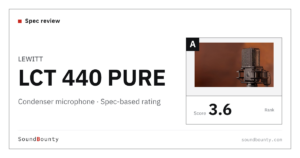
| LEWITTLCT 440 PURE | A 3.6 | 7 | 27.4 | 140 | 310 | ● | — | — | Not disclosed |
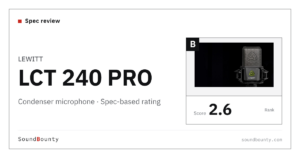
| LEWITTLCT 240 PRO | B 2.6 | 19 | 16.7 | 142 | 310 | — | — | — | Not disclosed |
| LEWITTLCT 540 S | A 3.8 | 4 | 41 | 136 | 371 | ● | ● | ● | Not disclosed |
| Aston MicrophonesAston Origin | B 2.8 | 18 | 23.7 | 127 | Not disclosed | — | ● | ● | Not disclosed |
| Austrian AudioOC18 | A 3.8 | 9 | 13 | 148 | 335 | — | ● | ● | Not disclosed |
| Austrian AudioOC818 | A 3.8 | 9 | 13 | 148 | 360 | — | ● | ● | Not disclosed |
| SennheiserMK 4 | B 2.8 | 10 | 25 | 140 | 485 | — | — | — | Not disclosed |
| NeumannTLM 107 | B 3.2 | 10 | 11 | 141 | 445 | — | ● | ● | Not disclosed |
Specifications are the manufacturer's published values (checked September 25, 2026). The AT2035 self-noise is converted from the signal-to-noise ratio, the maximum SPL is the value without the pad, and the AKG P120 and P220 do not publish a value without the pad. The AT5040 sensitivity is converted from the published dB value. The Aston Origin does not publish its weight. USB microphones are compared separately in the USB microphone comparison.
Before you buy
- It needs phantom power (+48 V). This is an XLR condenser microphone, so connect it to an audio interface or mixer that can supply phantom power.
- Check what comes in the box. The manufacturer lists: The Studio Set includes a carrying case, spider mount OCS8, windshield OCW8 and microphone clip OCH8 (an XLR cable is not included). Anything not on that list (a shock mount, a pop filter, cables and so on) you need to prepare separately.
- It has a pad and low-cut switch. When loud sound would distort, or when you want to reduce low noise (such as an air conditioner), you can adjust it on the microphone itself.
Read next
- NT1 5th Gen: features and rating (rank A)
- AT4040: features and rating (rank A)
- C414 XLII: features and rating (rank S)
- C414 XLS: features and rating (rank S)

Comments