
reFX’s Nexus 5 is a synthesizer and sound source known for its large number of ready-to-use presets (ready-made settings). The standard edition has 5,454 presets, and there are many genre-specific expansions for EDM, house, hip-hop, lo-fi and more.
A synthesizer is an instrument that makes sound electronically. You use it for the melodies, accompaniment and sound effects of a song.
In this article we compare Nexus 5 with 13 synthesizers and rate how well it serves its purpose on three criteria. The basis is official manufacturer information.
Disclosure: This article contains affiliate links. If you buy through them, SoundBounty may earn a commission at no extra cost to you. Prices and sale information are as of the date we checked them and can change.
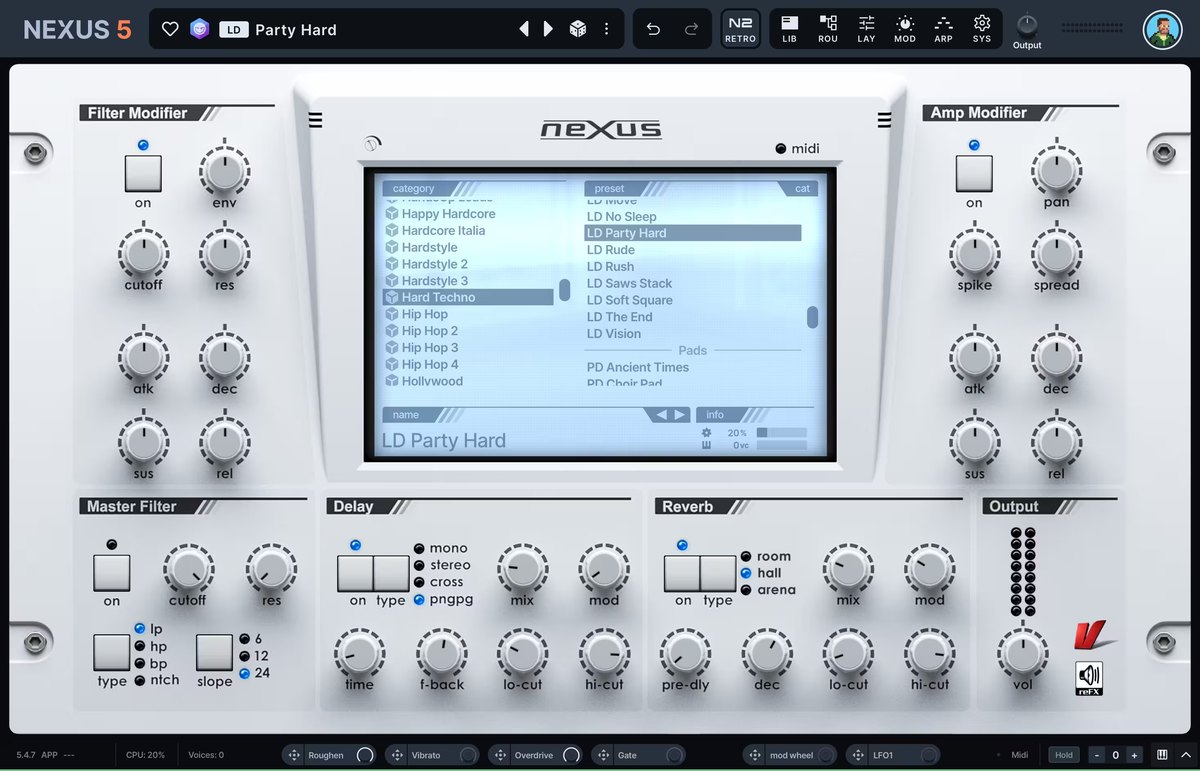
Score 4.8 / 5 (average of the 13 products compared: 3.6)
- Specs last checked
- 2026/09/25
- Ready-to-use sounds
- 5,454
- Range of sound design
- 8 methods
- Help with sound design
- 4 macros + main-knob screen
- Price (store, date)
- $179 (sale; regular $249) [Official, checked Oct 26]
Image: from the reFX official website (product image)
Summary
Among the 13 synthesizers, Nexus 5 is rank S. The ranks run S, A, B and C, and S is the top. Averaging the scores for each criterion (out of 5, with the one criterion that matters most for the purpose counted double) gives 4.8.
Strengths
- Ready-to-use sounds (5 points): it comes with many sounds, so you can use them just by choosing.
- Range of sound design (5 points): you can make sound in several ways, which covers a wide range of tones.
- Help with sound design (4 points): you can change a sound with simple controls even without detailed knowledge.
Who it suits: people who want to quickly pick a sound that fits their song from presets rather than make one themselves.
Main features of Nexus 5
5,454 presets
The standard Starter edition has 5,454 presets, including more than 1,100 new sounds added in Nexus 5, and 47 GB of samples. It has the sounds of today’s genres, such as EDM, melodic techno, house, hip-hop and lo-fi. There are 206 genre-specific expansions, and the Complete edition that includes all of them has 33,352 presets.
Eight sound-generation methods
The methods are virtual analog, sampler, wavetable, time-stretch, retro sampler, grain, cloud and FM: eight in all. That is the largest number among the 9 products we compared. You can also load your own samples and have them sliced or looped automatically.
Four macros and fast preset loading
You can assign the parameters you move most often to the four macros at the bottom of the screen. The manufacturer lists fast preset loading and a light load on the computer as strengths of Nexus. A dice button loads presets at random so you can listen to them.
Where it is useful
- Using a preset that fits the genre right away in an EDM or house song
- Switching through presets one after another to quickly find a sound that fits the song
- Loading your own samples and slicing them to make a phrase
Rating by criterion
Ready-to-use sounds: 5 / 5
We look at the number of presets (ready-made sounds) included from the start.
The standard Starter edition has 5,454 presets and 47 GB of samples (the Complete edition with all expansions has 33,352).
Range of sound design: 5 / 5
We look at how many sound-generation methods (ways of making sound) you can use.
It has eight sound-generation methods: virtual analog, sampler, wavetable, time-stretch, retro sampler, grain, cloud and FM.
Help with sound design: 4 / 5
We look at whether there are features (big knobs, randomization and so on) that let you change a sound without detailed knowledge.
It has four macros that move several knobs together, and a main screen that gathers the main knobs.
How we score (Synthesizers)
| Criterion | Basis | 5 pt | 4 pt | 3 pt | 2 pt | 1 pt |
|---|---|---|---|---|---|---|
| Ready-to-use sounds | Number of presets (ready-made sounds) stated on the official page | Thousands or more | 700 or more | 400 or more | Fewer than 400, or no number stated | — |
| Range of sound design | Number of sound-generation methods (ways of making sound) you can use | 5 or more methods | 3 to 4 methods | 1 to 2 methods, with highly flexible routing and modulation | One method, such as analog-style | — |
| Help with sound design | Features that let you change a sound without detailed knowledge | Both a feature that changes sounds automatically and knobs that adjust many things at once | One of them, plus another aid | Either one, or a simplified screen | Not mentioned on the official page | — |
Each criterion is scored from 1 to 5 on how well the product serves one goal: quickly preparing sounds that suit your own songs or cover-song backing tracks in a home studio. Scores follow the conditions in the table above, and the rank is based on an average in which "Ready-to-use sounds" counts double. The basis is official manufacturer information, and the number of presets is the number written on the official page (products that do not state it get a lower score). Sound quality and CPU load are not measured, so they are not scored; reviews from trade magazines are introduced in the articles for reference. Price is not part of the score. Features that cannot be confirmed from the manufacturer's or a retailer's description are scored as if absent.
Nexus 5 screens and images
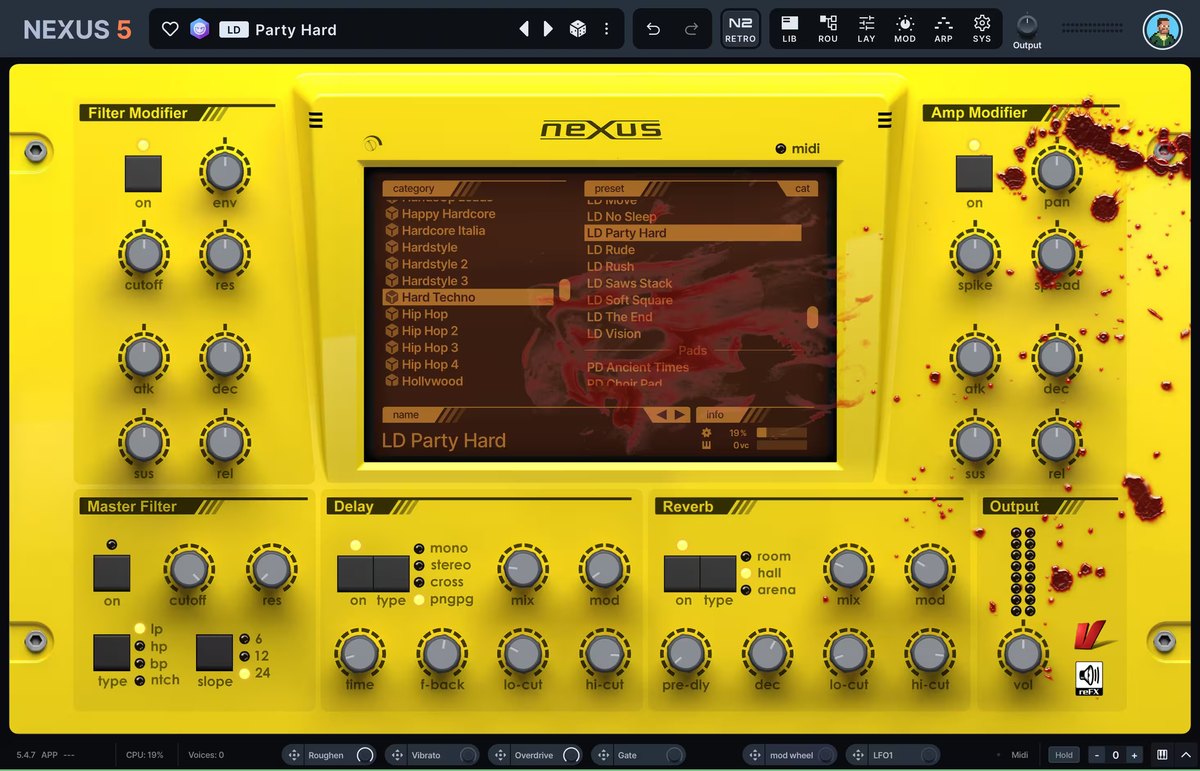
Image: from the reFX official website (product image)
Nexus 5 system requirements and getting started
| Operating system | Windows (64-bit) / Mac (macOS 10.13 or later) |
|---|---|
| Plug-in formats | Windows: VST, VST3, AAX / Mac: AU, VST, VST3, AAX |
| Other | 8 GB or more of memory (16 GB or more strongly recommended). After you authorize online, you can use it offline |
Checked on the manufacturer’s official pages on September 27, 2026.
Compared with other synthesizers
Click a heading to sort. On a phone, the table scrolls sideways.
| Product | RankAvg. score | Ready-to-use sounds | Range of sound design | Help with sound design | Free | Price (store, date) |
|---|---|---|---|---|---|---|
| SpectrasonicsOmnisphere 3 | S 5.0 | Thousands, 18 libraries | 5+ methods | Variations + auto-adjust | — | $499 [Official, checked Oct 26] |
| ArturiaPigments | S 4.3 | 1,700+ | 6 methods | 4 macros + Play View | — | $199 [Official, checked Oct 26] |
| Native InstrumentsMassive X | A 4.0 | 780 | Wavetable + free routing | Morpher, Randomize + macros | — | $199 [PB, checked Oct 26] |
| Xfer RecordsSerum 2 | A 3.8 | 626+ | 5 oscillator types | 8 macros + Hybridize | — | $249 [Official, checked Oct 26] |
| u-heDiva | B 3.0 | 1,200+ | Analog-style (5 models) | Detailed, hands-on | — | $179 (sale; regular $198.89) [PB, checked Oct 26] |
| KiloheartsPhase Plant | B 3.0 | Number not stated | 5 types + FM | 8 macro knobs | — | $199 (sale; regular $218) [PB, checked Oct 26] |
| FabFilterTwin 3 | C 2.5 | Number not stated | Analog-style | Clear screen + master knobs | — | $149 [PB, checked Oct 26] |
| Vital AudioVital | C 2.5 | 75 (free version) | Wavetable + morphing | Sounds from text | Free | Not listed |
| reFXNexus 5 | S 4.8 | 5,454 | 8 methods | 4 macros + main-knob screen | — | $179 (sale; regular $249) [Official, checked Oct 26] |
| LennarDigitalSylenth1 | B 3.0 | 2,500+ | Analog-style (1 method) | Arpeggiator | — | ≈$155.81 [Official, checked Oct 26] |
| u-heHive 2 | A 3.5 | 2,400+ | Standard waveforms + wavetable | 4 XY pads + panel presets | — | ≈$167.02 [Official, checked Oct 26] |
| UVIFalcon | S 4.3 | 1,700 | 28 oscillator types | Macros + per-preset screens | — | $149 (sale; regular $299) [Official, checked Oct 26] |
| Reveal SoundSpire | A 3.8 | 1,000+ | Several oscillator modes + free routing | RS AI + 4 macros | — | Not listed |
Features checked on each manufacturer's official website on September 25, 2026. Check the store page behind the buy button for the price.
Read next
- Omnisphere 3: features and rating (rank S)
- Pigments: features and rating (rank S)
- Massive X: features and rating (rank A)
- Serum 2: features and rating (rank A)

Comments