
Disclosure: This page may contain affiliate links. Prices were checked on the date shown and may change.
An introduction to AIR Music Technology Fabric Vintage Matrix, based on information from the maker and distributors: what it does, how to use it and who it may suit. It is not scored.
Fabric Vintage Matrix is a playable, modern take on classic Matrix-style modulation, designed to capture the depth, complexity, and evolving character of the original 1980s hardware polysynth it honors.
— AIR Music Technology official site
What is Fabric Vintage Matrix?
Fabric Vintage Matrix is a 12-voice polysynth built on AIR Music Technology's Fabric sound engine. It takes its design cues from a 1980s analog polysynth and aims to bring that instrument's modulation depth and evolving character into today's workflow.
The official description points to lush pads, layered textures and expressive modulation. It combines deep layering with modern effects and performance-focused controls, so that moving, evolving sounds are available without building every patch from scratch.
The interface follows the shared Fabric layout. Anyone who has used other AIR Fabric instruments will find the arrangement familiar, and the same screen works both for browsing presets and for digging into individual parameters.
It runs on MPC standalone, MPC desktop and major DAWs. Rock and electronic music, film scoring, ambient production and sound design are the uses named by the maker.
The shared Fabric engine means instruments in the Fabric Vintage Synths collection use a common GUI and layout, according to the maker. Once you are used to one, others follow the same flow, which may reduce friction when switching between instruments.
The edit page gives access to every parameter across oscillators, modulation, envelopes and effects. For expression, the maker lists MPE support and assignable mod wheel, aftertouch, expression and footswitch controls, which suits use with external controllers.
Key features
Two main oscillators plus a percussive layer
Two multi-sample oscillator layers sit alongside one percussive layer. Each layer has its own filter, envelope and LFO, so each can be given a different movement.
Oscillator drift and pitch randomization
The two main oscillators offer categorized selectors, volume, pan and formant controls, plus octave, coarse and fine tuning. Pitch randomization and drift add analog-style looseness, and each oscillator has a BPM-syncable LFO.
Noise generator and sub oscillator
The noise section has volume, pan, filter, decay and release offset controls with its own LFO for rhythmic modulation. The sub oscillator offers four wave shapes and could be used to add body to the low end.
Amp and filter envelopes
Dedicated ADSR amp and filter envelopes include velocity sensitivity and velocity-to-attack mapping. The filter envelope supports bipolar depth, and there is a separate ADSR pitch envelope.
Arpeggiator
It provides multiple arpeggio shapes, note order and maximum note options, swing and detailed timing controls. Momentary freeze, repeat, ratchet, octave randomization and pause are listed by the maker, and the arpeggiator is MPE compatible.
Five fixed effect modules
The effects section is a fixed layout of five modules with mix controls. Distortion has 12 models, reverb has 12 models and 16 early-reflection models, and the delay offers BPM-synced single, dual and cross modes.
Macros and a global LFO
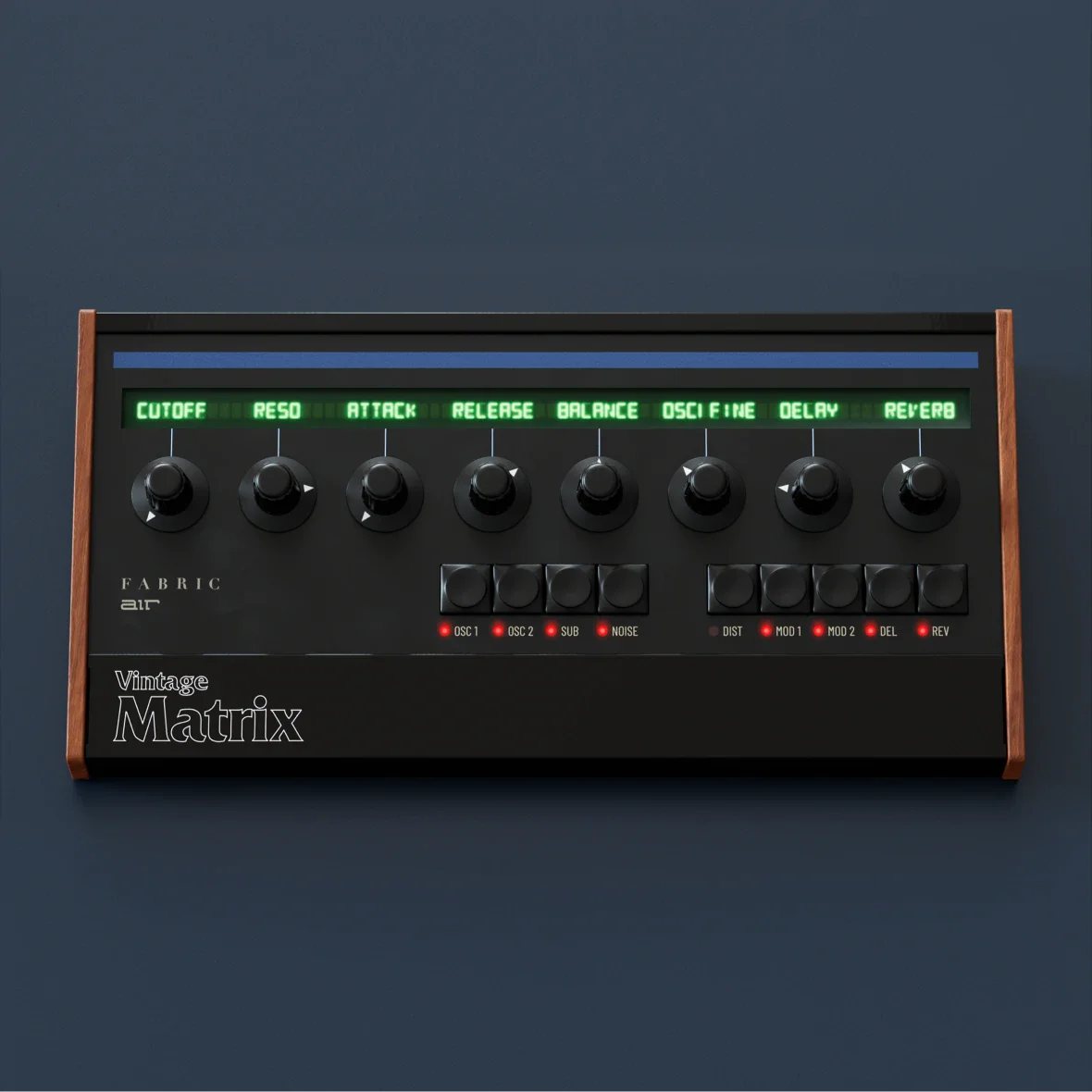
The front panel offers eight macro controls, four oscillator toggles and five FX toggles. A global LFO with eight shapes and BPM sync can modulate several parameters at once.
Specifications
| Item | Details |
|---|---|
| Type | Polysynth (Fabric engine) |
| Voices | 12 |
| Architecture | Two multi-sample oscillators plus one percussive layer, noise, sub oscillator |
| Effects | Five modules including distortion, delay and reverb |
| Plugin formats | VST2/VST3, AU, AAX, standalone |
| OS | Windows 10/11, macOS 14/15/26 |
| Requirements | 4GB RAM (8GB recommended), dual-core 2.5GHz CPU |
| MPC | MPC/Force standalone supported |
What is included and system requirements
- Plugin (VST2/VST3, AU, AAX, standalone)
- Presets covering basses, pads, leads, sequences and cinematic textures
- A 10-day trial of the desktop VST, AU or AAX version is offered on the AIR site
- Works in MPC Standalone, MPC Desktop and major DAWs
How to use it
- Buy from a store such as Plugin Boutique and download the installer from your account.
- Open the .pkg on Mac or the .zip on Windows and run the installer.
- Open your DAW and load Fabric Vintage Matrix as an instrument.
- Enter the serial number from your purchase to activate it.
- Start from the preset browser and pick a pad or lead that is close to what you want.
- Move the eight macro controls to hear how the sound changes.
- When you find a sound you like, fine-tune oscillators and filters on the edit page.
- Add the arpeggiator and effects to finish.
Where it may come in handy
Pads and ambient beds
Slowly moving sounds are the maker's stated strength, so this could be a candidate for pads that sit behind a track. Macros and LFOs may add further motion.
Eighties-flavored synth-pop and rock
Because it is modeled on a 1980s polysynth, it might suit chords and sustained sounds in tracks aiming for that era.
Film scoring and sound design
Presets with cinematic textures are included, so it might serve as a layering source for sound design.
Making tracks on an MPC
It also runs on MPC standalone, so it might suit people who want to build tracks on hardware without a computer.
Who it may suit
- People who want an easy way to bring 1980s polysynth sounds into their tracks
- Producers who often make pads and ambient sounds
- People who build tracks mainly on an MPC or Force
- Users who prefer starting from presets and adjusting only what they need
Good to know before you buy
- The Fabric series also includes bundles of several instruments, so check what each bundle contains before buying to avoid overlap.
- A host supporting VST2/VST3, AU or AAX is required, or use the standalone app.
- The AIR site offers a 10-day trial, so you can try it before buying.
How it differs from similar products
We do not pick a winner; the official figures are placed side by side.
AIR Music Technology Vacuum Pro
Fabric Vintage Matrix has 12 voices and uses two multi-sample oscillators plus a percussive layer on the Fabric engine. Vacuum Pro is a four-oscillator analog design that models vacuum tube circuits, can stack two parts, and ships with 350+ patches.
Price
$99 (Plugin Boutique, checked 2026-10-27). Prices can vary by region and promotion, so check the official page before buying.
See Fabric Vintage Matrix on the product page
More of the same kind
We have introduced 178 synthesizers. Here are some of the others.
- D16 Group LuSH-2
- Native Instruments FORM
- Tracktion Dawesome MYTH
- Cherry Audio Elka-X
- Krotos Simple Concept
- Moog Music Moog Mariana
We have introduced 21 other products from AIR Music Technology.
- AIR Music Technology Loom II
- AIR Music Technology Odyssey
- AIR Music Technology OPx-4
- AIR Music Technology Vacuum Vintage
- AIR Music Technology Hype
For a side-by-side comparison scored on the same criteria, see our comparison of synthesizers.
See the full list in Product database: Instruments.
Sources: airmusictech.com pluginboutique.com (checked 2026-10-27)










Comments