
Disclosure: This page may contain affiliate links. Prices were checked on the date shown and may change.
An introduction to Arturia Memory V, based on information from the maker and distributors: what it does, how to use it and who it may suit. It is not scored.
Memory V is a premium software emulation of the iconic Memorymoog, combining triple-oscillator analog tone, authentic ladder-filter character, advanced modulation, sequencing, and studio-grade effects in one modern instrument.
— Arturia official site
What is Memory V?
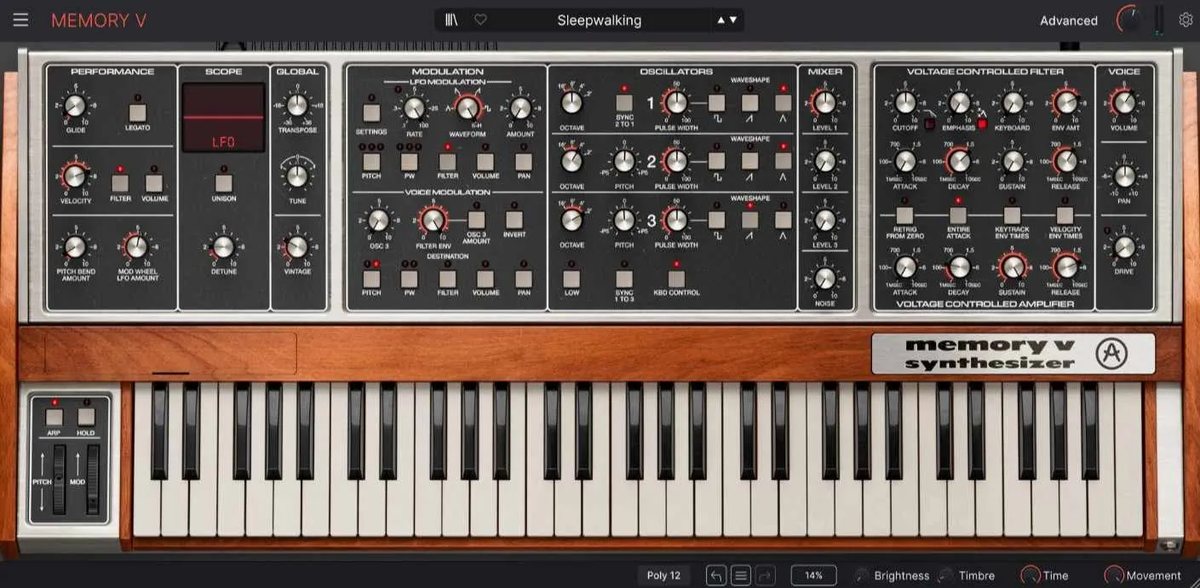
Arturia Memory V is a software instrument modeled on the early-1980s polyphonic analog synth Memorymoog. It recreates the three-oscillator voice and ladder filter as a plugin.
Arturia says the oscillators, mixer, filter, envelopes, drive and analog non-linearities are modeled with its TAE technology. On top of that it adds features the original lacked, such as unison, stereo spread, advanced modulation and a multi-arpeggiator.
The interface has a skeuomorphic main view and an advanced panel for sequencing, modulation and effects. You can shape sounds from the main view first, then move to drag-and-drop modulation and other deeper tools when needed.
It supports MPE, Arturia controller integration, NKS and MTS-ESP, and ships with presets. It runs as stand-alone, VST, AAX and Audio Unit.
Key features
Three-oscillator polyphony
Each voice has three oscillators plus noise, with Poly 6 and Poly 12 modes. Ramp, triangle and square waves can be stacked for thick pads or brass.
Ladder filter
Each voice has a low-pass ladder filter with a 24 dB mode and an optional 12 dB mode. Cutoff, emphasis and keyboard tracking set the brightness and body.
Controls for analog character
The Vintage knob and Dispersion controls vary pitch, pulse width, levels, cutoff and more, helping avoid perfectly identical voices.
Unison and stereo spread
Unison with detune and a variable voice count, plus pan and stereo spread, helps thicken leads and widen sounds.
Advanced panel
A multi-arpeggiator, poly sequencer, three modulator slots, keyboard and macro modulators, a 4-slot FX rack and an oscilloscope view are included.
MPE, NKS and MTS-ESP support
Use MPE controllers for expression, call sounds from NKS hardware, and share microtonal tuning through MTS-ESP.
Specifications
| Item | Details |
|---|---|
| Type | Polyphonic analog synth emulation (Memorymoog) |
| Voice modes | Poly 6 / Poly 12 / Mono (retrig, legato) |
| Oscillators | 3 per voice plus noise |
| Filter | Low-pass ladder (24 dB, optional 12 dB) |
| FX | 4-slot FX rack |
| Formats | Stand-alone / VST / AAX / Audio Unit / NKS (64-bit only) |
| Windows | Windows 10+ (64-bit); ARM not supported |
| macOS | macOS 11+ |
| RAM | 4 GB |
| CPU | 4 cores 3.4 GHz, or M1 |
| Disk space | 3 GB |
| GPU | OpenGL 2.0 compatible |
What is included and system requirements
- Memory V instrument
- A high-quality preset library
- Arturia Software Center for installation, activation and updates
How to use it
- Create an Arturia account and install the Arturia Software Center.
- Register your serial number and install Memory V.
- Load Memory V on an instrument track in your DAW.
- Pick a preset to hear which direction it goes.
- Move cutoff and emphasis on the main view to set brightness.
- Add thickness and width with unison and stereo spread.
- Open the advanced panel to add the arpeggiator or modulation.
- Add space in the FX rack and set the overall level.
Where it may come in handy
1980s-style pads and brass
The thick three-oscillator voice might be used for pads and brass with an early-1980s feel.
Ambient and R&B chords
Unison and stereo spread could be used to stack wide chords.
Leads and basses
The ladder filter movement might help you find leads and basses with presence.
Sequences and arpeggios
The sequencer and arpeggiator on the advanced panel might provide pattern ideas to build phrases from.
Who it may suit
- People looking for a Memorymoog-style polysynth
- Those who want thick pads and brass
- Players with MPE controllers
- Existing Arturia users
Good to know before you buy
- Installation and activation require the Arturia Software Center.
- The Windows version does not support ARM processors.
- About 3 GB of free disk space is required.
- The price shown is the regular price at Plugin Boutique.
How it differs from similar products
We do not pick a winner; the official figures are placed side by side.
Arturia Analog Lab Pro
Memory V is a standalone synth centered on one Memorymoog model. Analog Lab Pro is a preset-centered instrument for browsing over 2,000 sounds drawn from many instruments of the V Collection.
Price
$149 (Plugin Boutique, checked 2026-10-27). Prices can vary by region and promotion, so check the official page before buying.
See Memory V on the product page
More of the same kind
We have introduced 178 synthesizers. Here are some of the others.
- GForce Software impOSCar3
- Native Instruments Kontour
- Waves Codex Wavetable Synth
- Stagecraft Software Theremin
- AIR Music Technology Vacuum Vintage
- Cherry Audio Atomika
We have introduced 45 other products from Arturia.
For a side-by-side comparison scored on the same criteria, see our comparison of synthesizers.
See the full list in Product database: Instruments.
Sources: arturia.com pluginboutique.com (checked 2026-10-27)










Comments