
Disclosure: This page may contain affiliate links. Prices were checked on the date shown and may change.
An introduction to Cherry Audio Mercury-6, based on information from the maker and distributors: what it does, how to use it and who it may suit. It is not scored.
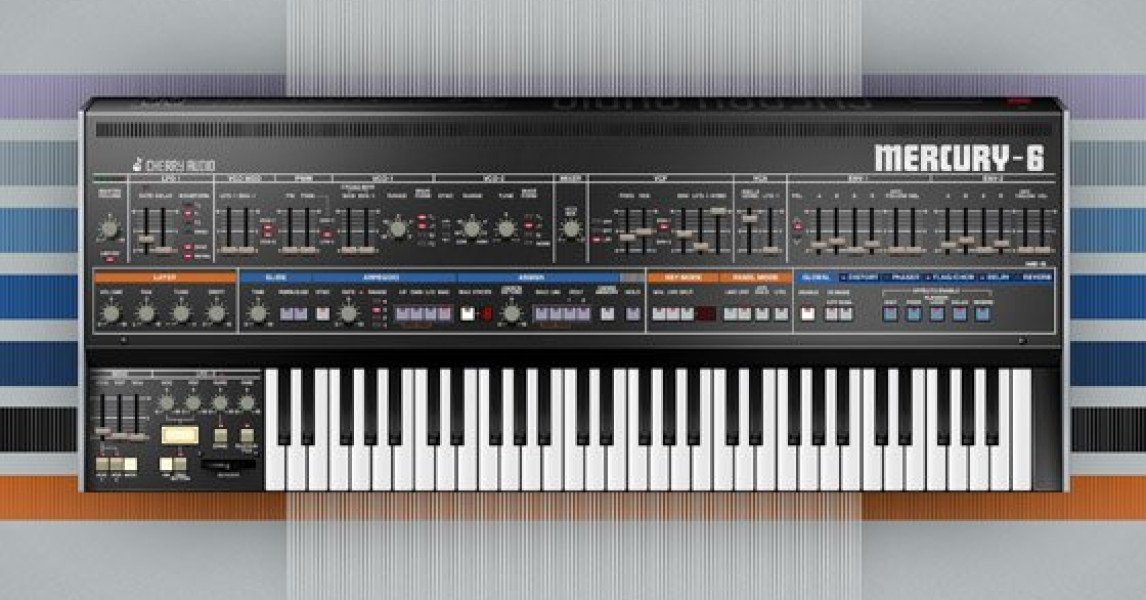
Mercury-6 captures all that is exceptional in this treasured polyphonic classic, boosts its extraordinary feature set for today's DAW production and workflow
— Cherry Audio official site
What is Mercury-6?
Mercury-6 is a software synthesizer from Cherry Audio modeled on the Roland JP-6, an analog synth released in 1983. It is available as AU, VST, VST3, AAX and standalone.
The original JP-6 had six voices and a true multimode filter with 24 dB/oct lowpass, 24 dB/oct highpass and 12 dB/oct bandpass modes. Mercury-6 recreates this and adds velocity sensitivity, an improved split mode and a layer mode that stacks two sounds.
Polyphony is extended to 16 voices per layer. The arpeggiator reproduces the original hidden Down/Up mode and adds a Random mode and tempo sync, and a chord memory mode plays stored notes from a single key.
It also has built-in effects (distortion, phaser, flanger/chorus, delay and reverb), 500+ presets and MIDI learn mapping. A free 30-day demo is available.
Key features
Two-layer architecture
Two layers can be played as a split or a stack, with parameters and effects set per layer. This is useful for building two parts from one instrument.
Multimode filter
It switches between 24 dB/oct lowpass, 24 dB/oct highpass and 12 dB/oct bandpass. The shape can be changed to keep low end or to trim highs.
VCO-2 to VCO-1 FM cross-modulation
The original VCO-2 to VCO-1 FM cross-modulation is reproduced. It is the control to use when building sharp, harmonically rich tones.
Arpeggiator and chord memory
The arpeggiator has tempo sync and a Random mode. Chord memory stores several notes for playback from one key, which can help when adding chords beneath a single-note line.
Built-in effects and drift
Distortion, phaser (4/8/12 stage), flanger/chorus, three delay types and four reverb types are built in. Drift can be set per layer to add analog-style instability.
500+ presets
A team of sound designers created the presets, which can be searched in the preset browser. You can start from a close match and adjust it instead of building from scratch.
Specifications
| Item | Details |
|---|---|
| Formats | AU / VST / VST3 / AAX / Standalone |
| Polyphony | 16 voices per layer |
| Presets | 500+ |
| Filter | 24 dB/oct lowpass and highpass, 12 dB/oct bandpass |
| Oscillators | Two VCOs per voice (triangle, ramp, noise, square/variable pulse) |
| LFO | Two, tempo syncable |
| Effects | Distortion, phaser, flanger/chorus, three delays, four reverbs |
| Demo | 30 days |
What is included and system requirements
- The synthesizer (AU, VST, VST3, AAX, standalone)
- 500+ presets
- Online documentation, also available as a PDF
- macOS 10.13 or later (64-bit required, native Apple Silicon); 3.4 GHz quad-core or M1 and 8 GB RAM recommended
- Windows 7 or later including Windows 11 (64-bit required); quad-core and 8 GB RAM recommended
- Internet connection is required for activation
How to use it
- Download the demo or purchased version from Cherry Audio and install it.
- Activate the product while online.
- Open it as an instrument in your DAW.
- Pick a close sound in the preset browser.
- Switch the filter mode (lowpass, highpass, bandpass) to shape the tone.
- If needed, use layer mode to stack a second sound and set effects per layer.
- Use the arpeggiator or chord memory to build playing patterns.
- Assign frequently used controls to a controller with MIDI learn.
Where it may come in handy
Building basses and leads
The solo and poly unison modes may suit thick basses and leads, and the highpass mode may help tidy low end.
Arpeggiated phrases
Tempo-synced arpeggios with the Random mode may offer a base for repeating phrases.
Two-sound parts
Layer mode may let one instrument supply a part such as pad and bell together.
Who it may suit
- Those interested in the JP-6 layout
- Producers who want analog-style polysynth sounds in a DAW
- Users who want one instrument to cover several parts through layers or splits
Good to know before you buy
- Internet connection is required for activation.
How it differs from similar products
We do not pick a winner; the official figures are placed side by side.
Cherry Audio Eight Voice
Mercury-6 has 16 voices per layer in two layers and 500+ presets. Eight Voice has eight dual-oscillator voice modules and 330+ presets.
Price
$59 (Cherry Audio official site, checked 2026-10-27). Prices can vary by region and promotion, so check the official page before buying.
See Mercury-6 on the product page
More of the same kind
We have introduced 178 synthesizers. Here are some of the others.
- Tracktion Dawesome MYTH
- AIR Music Technology OPx-4
- Arturia MiniBrute V
- GForce Software AXXESS
- Arturia Arturia Synthx V
- GForce Software Halogen FM
We have introduced 31 other products from Cherry Audio.
- Cherry Audio Cherry Audio Memorymode 2
- Cherry Audio Harmonia
- Cherry Audio Crumar Spirit
- Cherry Audio Eight Voice
- Cherry Audio Surrealistic MG-1 Plus
For a side-by-side comparison scored on the same criteria, see our comparison of synthesizers.
See the full list in Product database: Instruments.
Sources: cherryaudio.com pluginboutique.com (checked 2026-10-27)










Comments