
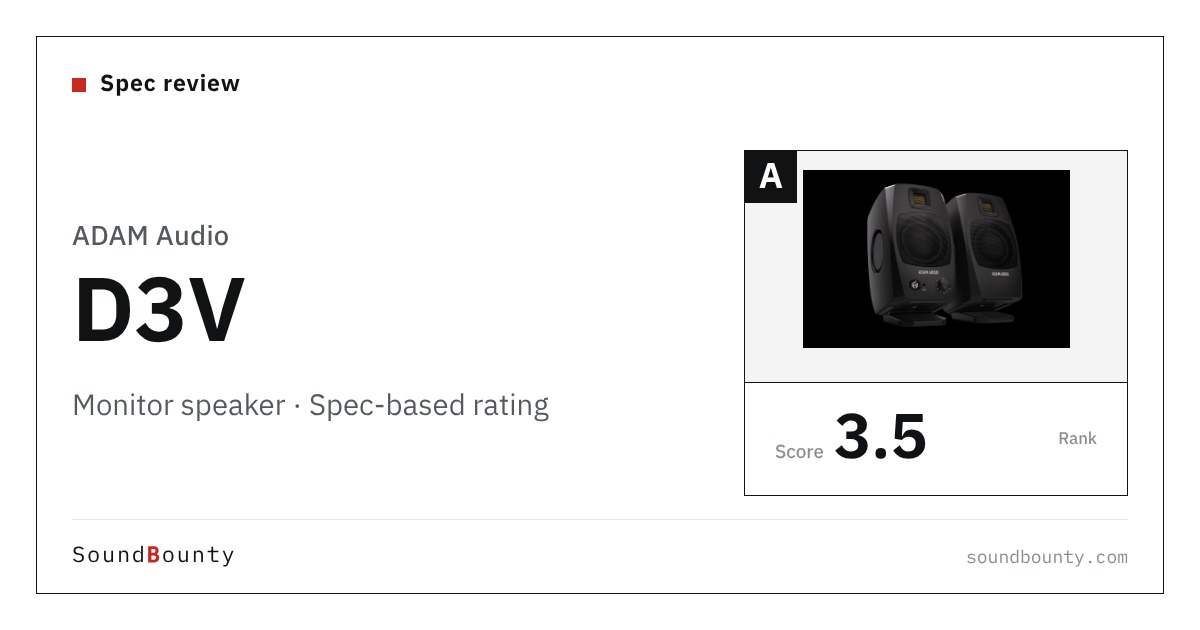
ADAM Audio’s D3V is a monitor speaker with a 3.5-inch woofer (sold as a pair).
Monitor speakers are speakers for hearing sound exactly as it is when you record or mix.
In this article we rate it on 4 criteria using only the specifications the manufacturer publishes, and show how it ranks among the 18 monitor speakers we compare.
Disclosure: This site takes part in affiliate programs. Specifications are as of the date we checked them and can change.
Score 3.5 / 5 (average of the 18 models compared: 3.2)
- Specs last checked
- 2026/10/19
- Sold as
- Sold as a pair
- Woofer
- 3.5in
- Power (each)
- 100W
- Width
- 115mm
- Price (store, date)
- Not disclosed
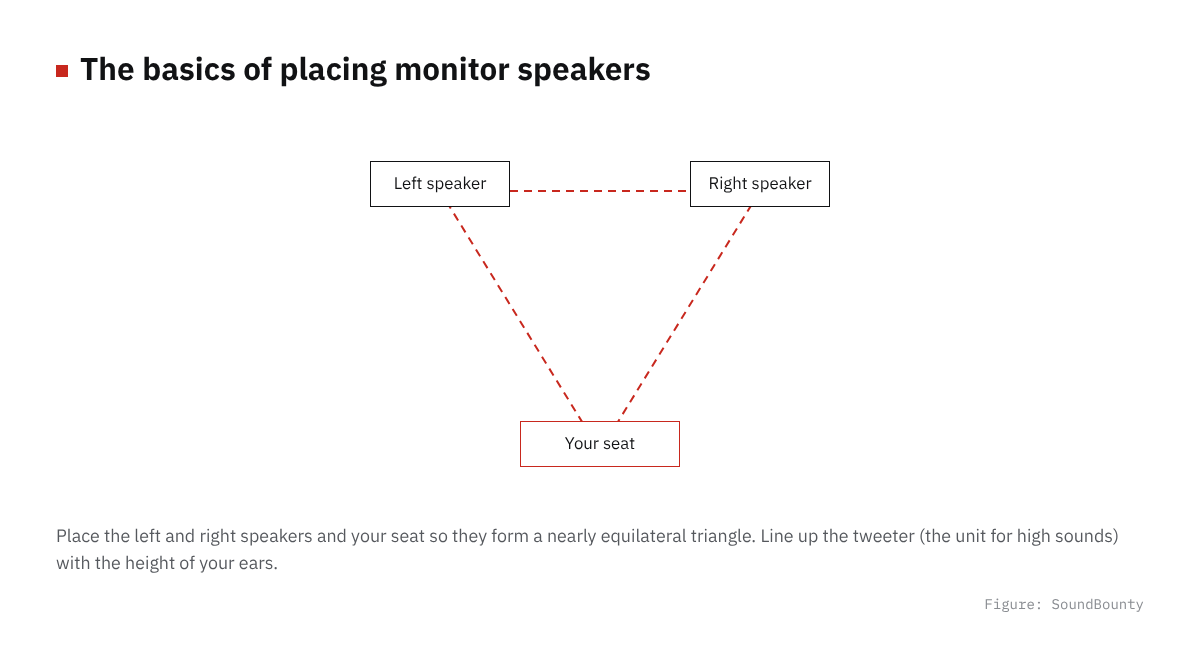
Figure: SoundBounty
Summary
Among the 18 monitor speakers, D3V is rank A. The ranks run S, A, B and C, and A is second from the top. Averaging the scores for each criterion (out of 5) gives 3.5.
Strengths
- Adjusting to the room (3 of 3, 5 points): You can adjust the sound to where you place them and to the room.
- Ease of placement (115 mm, 5 points): It is small and easy to place on a desk.
Things to keep in mind
- Room for low frequencies (3.5-inch, 1 point): The woofer is small, so checking the low end is modest.
Who it suits: judging from the specifications, it suits people who want to adjust the sound to where they place the speakers and to the room; people who want to place them in limited space on a desk.
Main features of D3V
Straight to a computer or smartphone by USB-C
Over USB-C (class compliant, so no driver is needed) you can connect directly to a computer, smartphone or tablet. You can play sound on a desk right away without an audio interface. A TRS (balanced) input is also provided.
D-ART tweeter and passive radiators
With ADAM’s D-ART tweeter, a 3.5-inch aluminum woofer and passive radiators on both sides (diaphragms that add to the bass), it is said to reproduce down to 45 Hz (-6 dB) even in a small cabinet.
DSP adjustment for where you place it
Switches on the back let the DSP correct for placement (lows: 0 / -3 / -6 dB), reflections from the desk (low-mids and mids) and room acoustics (highs: 0 / -1.5 / -3 dB).
A front knob and a headphone jack
A knob on the front changes the volume, and pressing it mutes, puts the speakers in standby, switches the input and swaps left and right. There is also a 3.5 mm headphone jack, and the same knob adjusts its volume.
Video: “The ALL NEW ADAM Audio D3V Desktop Monitors | At a Glance” (official ADAM Audio YouTube channel; narration in English) Watch on YouTube
Where it is useful
- Connecting to a computer directly by USB without an audio interface
- Using small monitor speakers in a room with a narrow desk
- Switching between headphones and speakers with a single knob
Rating by criterion
Room for low frequencies: 1 / 5
The size of the woofer (the speaker that makes low sounds). The bigger it is, the more room there is for the low end.
D3V: 3.5-inch. That is a modest rating among the products we compared. The woofer is small, so checking the low end is modest.
Adjusting to the room: 5 / 5
Whether you can adjust the lows and highs to where you place them and to the room.
D3V: 3 of 3. That is a high rating among the products we compared. You can adjust the sound to where you place them and to the room.
Ease of connecting: 3 / 5
How many kinds of jacks it has for connecting equipment.
D3V: 3 of 7. That is a standard rating among the products we compared.
Ease of placement: 5 / 5
The width of one speaker. The smaller it is, the easier to place on a desk.
D3V: 115 mm. That is a high rating among the products we compared. It is small and easy to place on a desk.
The gray marks in the figure below (the dotted line on the pentagon) show the average of the 18 products we compared. Price is not part of the score.
How we score (Monitor speakers)
| Criterion | Basis | 5 pt | 4 pt | 3 pt | 2 pt | 1 pt |
|---|---|---|---|---|---|---|
| Room for low frequencies | Woofer size | ≥8 | ≥6.5 | ≥5 | ≥4 | <4 |
| Adjusting to the room | High and low frequency controls, DSP or app adjustment | All 3 | 2 | 1 | — | None |
| Ease of connecting | Types of input and output jacks | 5 to 7 | 4 | 3 | 2 | 1 or fewer |
| Ease of placement | Width (one speaker) | ≤140 | ≤160 | ≤190 | ≤220 | >220 |
Scored only on the body specifications published by the manufacturer. Price is not part of the score. Manufacturers measure low-frequency response under different conditions (-3 dB, -6 dB, -10 dB and so on), so it is hard to compare side by side. The score therefore uses the size of the woofer (the speaker for low sounds), and the published low-frequency limit is shown in the table together with its condition. Amplifier power is also written differently (rated, RMS and so on), so treat it as a rough guide; it is shown in the table for reference and is not part of the score. Ease of placement is decided by width, with a desktop in mind.
D3V connection and getting started
| Connection | USB-C (directly to a computer, smartphone or tablet), TRS (balanced) and a 3.5 mm headphone jack |
|---|---|
| Power | Mains power (power adapter) |
| In the box | Main and sub speakers, USB-C cable (with a USB-A adapter), connection cable (2 m), power cable, power adapter and quick start guide |
| Other | Sold as a pair |
Checked on the manufacturer’s official pages on September 27, 2026.
Compared with other monitor speakers
Click a heading to sort. On a phone, the table scrolls sideways.
| Product | RankAvg. score | Sold as | Wooferin | Power (each)W | Low-frequency limit | Widthmm | Price (store, date) |
|---|---|---|---|---|---|---|---|
| YamahaHS3 | A 3.8 | Sold as a pair | 3.5 | 26 | 70Hz (-10 dB) | 132 | Not disclosed |
| YamahaHS4 | A 3.8 | Sold as a pair | 4.5 | 26 | 60Hz (-10 dB) | 150 | Not disclosed |
| YamahaHS5 | B 3.0 | Sold individually | 5 | 70 | 54Hz (-10 dB) | 170 | Not disclosed |
| YamahaHS7 | B 3.0 | Sold individually | 6.5 | 95 | 43Hz (-10 dB) | 210 | Not disclosed |
| YamahaHS8 | B 3.0 | Sold individually | 8 | 120 | 38Hz (-10 dB) | 250 | Not disclosed |
| JBL305P MkII | B 3.0 | Sold individually | 5 | 82 | 43Hz (-10 dB) | 185 | Not disclosed |
| JBL104-BT | B 3.0 | Sold as a pair | 4.5 | 30 | 60Hz (±3 dB) | 153 | Not disclosed |
| KRKROKIT 5 G4 | B 3.3 | Sold individually | 5 | 55 | 43Hz (no condition stated) | 190 | Not disclosed |
| KRKROKIT 7 G4 | B 3.0 | Sold individually | 7 | 145 | 42Hz (no condition stated) | 225 | Not disclosed |
| EdifierMR4 | B 3.0 | Sold as a pair | 4 | 21 | 60Hz (no condition stated) | 140 | Not disclosed |
| EdifierMR5 | S 4.3 | Sold as a pair | 5 | 55 | 46Hz (no condition stated) | 159 | Not disclosed |
| ADAM AudioT5V | B 3.0 | Sold individually | 5 | 70 | 45Hz (-6 dB) | 179 | Not disclosed |
| ADAM AudioD3V | A 3.5 | Sold as a pair | 3.5 | 100 | 45Hz (-6 dB) | 115 | Not disclosed |
| JBL306P MkII | B 2.8 | Sold individually | 6.5 | 112 | 39Hz (-10 dB) | 224 | Not disclosed |
| JBL308P MkII | B 3.0 | Sold individually | 8 | 112 | 37Hz (-10 dB) | 254 | Not disclosed |
| PreSonusEris E5 | A 3.8 | Sold individually | 5.25 | 80 | Not disclosed | 178 | Not disclosed |
| NeumannKH 80 DSP | B 3.0 | Sold individually | 4 | 190 | 57Hz (±3 dB) | 154 | Not disclosed |
| ADAM AudioT7V | B 3.0 | Sold individually | 7 | 70 | 39Hz (-6 dB) | 210 | Not disclosed |
Specifications are the manufacturer's published values (checked October 19, 2026). The ADAM Audio D3V publishes only peak power, so its power is not scored.
Before you buy
- It is sold as a left-and-right pair. One purchase gives you stereo.
- The inputs are TRS (phone jack), USB. Check the shape of the cable that connects to the output of your audio interface (most use TRS phone jacks).
- The width is 115 mm. Besides room for two speakers, check that you can leave a little space between the speakers and the wall.
Read next
- Eris E5: features and rating (rank A)
- 305P MkII: features and rating (rank B)
- 104-BT: features and rating (rank B)
- T5V: features and rating (rank B)

Comments