
For people doing DTM or home recording in an environment where they cannot play speakers loudly, monitor headphones are the center of production. This article sorts out how to choose, centered on the difference between closed-back and open-back, and compares eight standard models. We do not give prices; check the current price at the store you buy from.
Disclosure: This article contains affiliate links. If you buy through them, SoundBounty may earn a commission at no extra cost to you. Information is as of the date we checked it and can change.
Points for choosing monitor headphones
1. Closed-back vs open-back
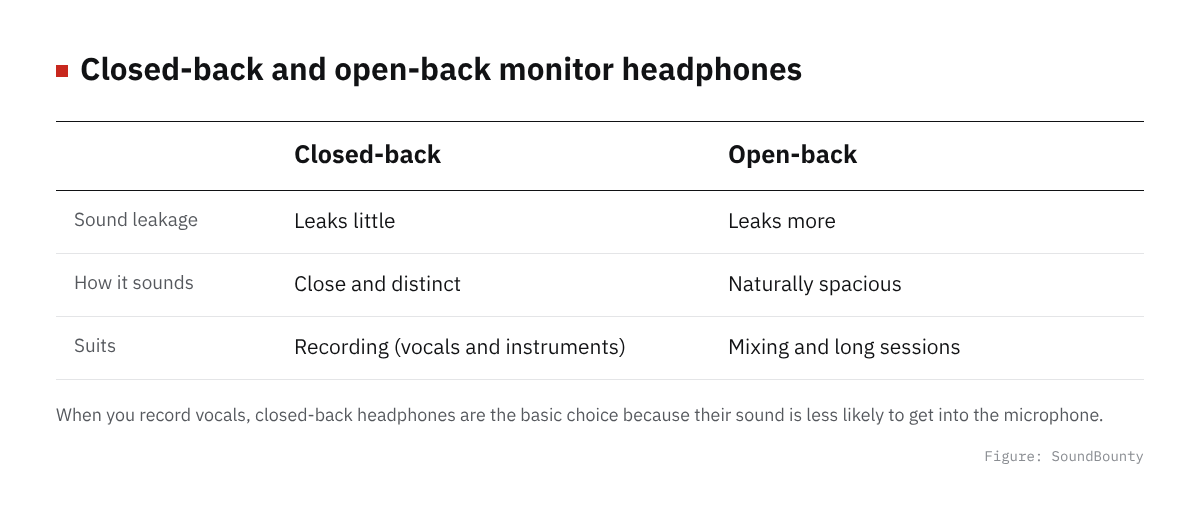
Figure: SoundBounty
The first thing to decide when choosing monitor headphones is the structure of the housing (the part that covers your ear).
- Closed-back: the housing is closed, so little sound leaks and outside sound gets in less. Its big advantage is that the headphone sound is less likely to get into the microphone when you record vocals or instruments, so closed-back is the basic choice for recording.
- Open-back: the back of the housing is open. In general the width of the sound (the soundstage) is natural and they are said to be less stuffy over long sessions. On the other hand, a lot of sound leaks, so they do not suit monitoring while recording. They suit mixing and long programming sessions.
- Semi-open: a structure between the two. The AKG K240 MKII is a representative example.
When you want “recording and mixing with one pair”, choose closed-back, and when your budget allows, adding open-back headphones for mixing is the usual order.
2. Impedance and the playback device
The higher the impedance (Ω), the more a headphone amplifier with larger output tends to be needed to get enough volume. Among those introduced here, the Sennheiser HD 600 (300 Ω) is on the high side. If you assume use with an audio interface’s headphone output, it is unlikely to be a big problem, but if you often plug straight into a smartphone or laptop, a model of a few tens of ohms is easier to handle.
3. Detachable cable and length
A cable is a consumable that breaks easily. With a detachable one, you can replace only the cable if it breaks. Also, a longer cable of about 2.5 to 3 m is easy to handle if you use them while playing an instrument, and a short cable of about 1.2 m if you mainly work at a desk.
4. Comfort and weight
In production, you often wear them for hours, so weight and clamping force matter too. Many of the models introduced here are published at 200 to just under 300 g. If you wear glasses or work long hours, it is reassuring to try them on at a shop if you can.
A comparison of eight standard monitor headphones
| Model | Features | Who it suits |
|---|---|---|
| AKG K240 MKII | Semi-open, 55 Ω, two detachable cables (3 m straight and 5 m coiled) | People looking for programming and mixing headphones at an entry-level price |
| SONY MDR-CD900ST | Closed-back, 63 Ω, a 2.5 m cable (fixed). A standard of Japanese studios released in 1989 | For monitoring while recording, and people who want to hear with the same reference as Japanese studios |
| audio-technica ATH-M50x | Closed-back, 38 Ω, 45 mm driver, detachable cable | People who want one pair for everything from recording to listening |
| audio-technica ATH-R50x | Open-back, 50 Ω, about 207 g, comes with 1.2 m and 3 m cables. Released February 2025 | A first open-back, or a second pair for mixing |
| beyerdynamic DT 770 PRO/80 Ohm | Closed-back, 80 Ω, a 3 m cable. Made in Germany, with replaceable ear pads | Long recording and programming sessions |
| SONY MDR-M1 | Closed-back, 50 Ω, 5 Hz to 80 kHz, about 216 g, detachable cable | People who want a recent closed-back design that does both recording and mixing |
| SONY MDR-MV1 | Open-back, 24 Ω, 5 Hz to 80 kHz, about 223 g, detachable cable | People who put mixing and spatial audio production first |
| Sennheiser HD 600 | Open-back, 300 Ω, a 3 m detachable cable. A long-standing reference | Intermediate users who want more accurate mixing on headphones |
On this site we also rate them by official specifications. See our monitor headphone comparison; reviews we have are Sennheiser HD 280 PRO, Audio-Technica ATH-R70x and SONY MDR-CD900ST.
How to choose by use
If recording (vocals and instruments) is the main use, closed-back
The SONY MDR-CD900ST, long used in Japanese recording studios, is a standard that people often call “if unsure, this one”. Its cable is fixed and 2.5 m long, a specification that is easy to handle even when recording while playing an instrument.
The same maker’s MDR-M1 is a newly designed closed-back model that advertises a frequency response of 5 Hz to 80 kHz, with a detachable cable. It costs more than the 900ST, but it is a candidate for people who want one pair to do both recording and mixing. The ATH-M50x has a relatively low impedance (38 Ω) even among closed-back models, so it is easy to use for listening on a smartphone and similar devices. The DT 770 PRO/80 Ohm is known for comfort and is chosen by people who work long hours.
If mixing and programming are the main use, also consider open-back
Open-back headphones are said to make the width of sound and its placement (left-right and depth positions) easier to grasp, and are popular for mixing. For a start, the ATH-R50x released in 2025; if you raise the budget, the SONY MDR-MV1 and Sennheiser HD 600 are standards. Audio-Technica also has the higher-end ATH-R70xa (open-back, 470 Ω).
Frequently asked questions
Q. Are listening headphones not good enough?
You can use them, but many listening headphones are flavored to emphasize the lows and highs, and if you mix by that sound, the balance can fall apart in other playback environments. Monitor headphones are designed not to emphasize particular bands excessively, so they are easy to use as a production reference.
Q. Can I not use open-back headphones for recording?
The leaked sound gets into the microphone, so they basically do not suit recording vocals. For line recording (recording where you plug an electric guitar or synthesizer straight into the interface), open-back headphones are fine.
Q. Can I produce with Bluetooth wireless headphones?
Bluetooth has a large delay in sound and does not suit timing for recording and programming. For production, choose a wired model.
Q. Can an audio interface drive the high-impedance HD 600?
With many interfaces sound comes out, but on some models the volume may have no headroom. If you are worried, check the headphone output specifications the maker publishes, or consider adding a headphone amplifier.
Summary
As a basic rule, closed-back (MDR-CD900ST, MDR-M1, ATH-M50x, DT 770 PRO) if recording is the main use, and open-back (ATH-R50x, MDR-MV1, HD 600) if mixing and programming are. Making your first pair closed-back and adding open-back when you get used to it lets you use both to suit the purpose. Prices change daily, so check the latest price before you buy.


Comments