
Disclosure: This page may contain affiliate links. Prices were checked on the date shown and may change.
An introduction to Audio-Technica AT875R, based on information from the maker and distributors: what it does, how to use it and who it may suit. It is not scored.
Audio-Technica's AT875R is designed for video production and broadcast (ENG/EFP) audio acquisition.
— Audio-Technica official site
What is AT875R?
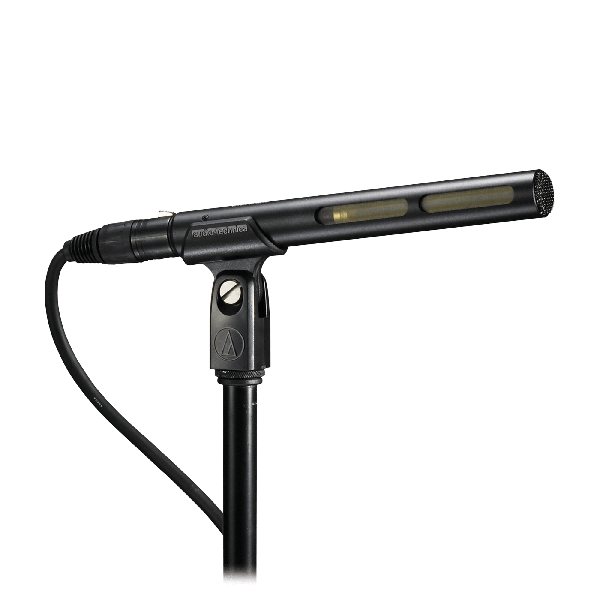
The AT875R is a shotgun microphone from Audio-Technica, designed for video production and broadcast (ENG/EFP) audio capture. The company describes it as its shortest shotgun, built so that it can sit on a camcorder or a compact digital camera without adding noticeable bulk.
It uses a line + gradient design, which has a narrow acceptance angle at the front and reduces sound arriving from the sides and rear. It is intended for situations where you want to pick up a voice or sound from a certain direction while standing at some distance. Audio-Technica also says it aims for smooth, natural on-axis sound.
The body is about 175 mm long, 21 mm in diameter and weighs 80 g, with a 3-pin XLR male output. It is a condenser microphone that needs phantom power (11 to 52 V DC) and has no internal battery. A stand clamp, windscreen and other items are included, so it is ready to mount out of the box.
In short, this is a microphone for putting on a camera or aiming at a speaker for video work rather than a studio vocal microphone. If you already record at home or stream, it may be worth considering as an extra microphone for shooting video.
Key features
Narrow line + gradient pickup
The pattern is strongly directional and focuses on a narrow angle in front of the mic. Audio-Technica lists this as desirable for long-distance pickup. It may help when you want to aim at a speaker in a noisy place.
Rejection from the sides and rear
Audio-Technica says the microphone gives excellent rejection of sound arriving from the sides and rear. This design direction is meant to keep the target source easier to hear when the location is noisy.
Short enough to sit on a camera
It is about 175 mm (under 7 inches) long and weighs 80 g. The company has camcorders and compact digital cameras in mind. A shorter body can be easier to handle than a long shotgun that gets in the frame.
Response tailored against camera and handling noise
The company says the frequency response is tailored to minimise camera and handling noise. The listed range is 90 to 20,000 Hz, so the low end is kept modest. This is useful to know if body noise is a worry when mounted on a camera.
Simple phantom-power-only operation
It runs on 11 to 52 V DC phantom power with a typical draw of 2 mA, and has no battery. You do not need to charge or replace batteries, but you do need a device that supplies phantom power and an XLR cable.
Published specifications
Audio-Technica lists sensitivity of -30 dB (31.6 mV re 1 V at 1 Pa), maximum input level of 127 dB SPL (1 kHz at 1% THD), dynamic range of 107 dB and signal-to-noise ratio of 74 dB. These numbers are useful when comparing it with other microphones.
Mounting parts included
The box includes an AT8405a stand clamp for 5/8-inch-27 stands, a 5/8-inch to 3/8-inch thread adapter, a windscreen, two O-rings and a soft pouch. These cover stand mounting and camera-holder mounting.
Specifications
| Item | Details |
|---|---|
| Element | Fixed-charge back plate, permanently polarized condenser |
| Polar pattern | Line + gradient |
| Frequency response | 90 to 20,000 Hz |
| Open-circuit sensitivity | -30 dB (31.6 mV) re 1 V at 1 Pa |
| Maximum input sound level | 127 dB SPL (1 kHz at 1% THD) |
| Dynamic range | 107 dB (1 kHz at max SPL) |
| Signal-to-noise ratio | 74 dB (1 kHz at 1 Pa) |
| Phantom power | 11 to 52 V DC, 2 mA typical |
| Weight | 80 g (2.8 oz) |
| Dimensions | 175.0 mm long, 21.0 mm diameter |
| Output connector | Integral 3-pin XLRM-type |
What is included and system requirements
- AT8405a stand clamp for 5/8-inch-27 threaded stands
- 5/8-inch-27 to 3/8-inch-16 threaded adapter
- Windscreen
- Two O-rings
- Soft protective pouch
- 3-pin XLR output; requires phantom power (no battery)
How to use it
- Fix the microphone in the supplied stand clamp and use the thread adapter if your stand needs a 3/8-inch thread.
- For camera use, secure the mic in a camera mic holder using the supplied O-rings.
- Connect an XLR-to-XLR cable from the mic to a device that supplies phantom power, such as a mixer, recorder or interface.
- Turn on phantom power (11 to 52 V) on that device. Check the connection before powering it up.
- Point the tip of the mic toward the person or source you want to record. Because the pickup is narrow, adjust the aim a little to find a good position.
- Fit the supplied windscreen when you are outdoors in wind.
- Set the input gain while a person speaks in the real setting.
- When finished, switch phantom power off, unplug the cable and store the mic in its pouch.
Where it may come in handy
On-camera video shooting
Its short body suits mounting on a mirrorless camera or camcorder. It may make it easier to capture a voice from a certain direction than the camera's built-in mic. This assumes a device that can supply phantom power, such as an external mixer or an XLR-capable recorder.
Interviews and reporting
When you aim the mic at the person talking, its rejection of side and rear sound may be useful. Because it works from a bit of distance, it may be an option when you do not want to get too close to the speaker.
Streaming and video narration
If you record your voice from a little way off rather than right at your mouth, a short shotgun that stays out of the frame may be handy. It connects to the phantom power of a mixer or interface.
Outdoor ambience and sound effects
With the supplied windscreen, you could aim it at sounds in a particular direction. The listed response starts at 90 Hz, so for recording a strong low end another microphone may suit better.
Who it may suit
- People looking for a short shotgun mic to mount on a camera
- People who already own a device with phantom power, such as a mixer or recorder
- People recording interviews or reporting who need to aim at a voice
- People who want a small, light extra mic for shooting video
Good to know before you buy
- It is not a USB microphone. It uses a standard analog XLR connection and needs an XLR-to-XLR cable.
- It needs phantom power of 11 to 52 V DC and does not run on batteries.
- The frequency response is 90 to 20,000 Hz, so it may not suit vocal or instrument recording where a strong low end matters.
- The official US page lists $189. Check an authorized dealer for local availability.
How it differs from similar products
We do not pick a winner; the official figures are placed side by side.
Shure MoveMic
The AT875R is a wired shotgun, about 175 mm long and 80 g, using XLR with phantom power. Each Shure MoveMic is a wireless clip-on that measures 46 x 22 x 15 mm and weighs 8.2 g, and it pairs directly with a smartphone app. Both are aimed at video work, but the connection and use differ.
Price
$189 (Audio-Technica official site, checked 2026-10-27). Prices can vary by region and promotion, so check the official page before buying.
See AT875R on the product page
More of the same kind
We have introduced 100 microphones. Here are some of the others.
- Heil Sound PR 40
- Elgato Wave DX
- LEWITT LCT 140 AIR
- Austrian Audio CC8-SC
- Shure Nexadyne 8
- Earthworks ICON
We have introduced 4 other products from Audio-Technica.
- Audio-Technica AT2020USB-X
- Audio-Technica AT4060a
- Audio-Technica ATH-R70xa
- Audio-Technica ATH-M20xSTS
For a side-by-side comparison scored on the same criteria, see our comparison of microphones.
See the full list in Product database: Microphones and accessories.
Sources: audio-technica.com shure.com (checked 2026-10-27)









Comments