
Disclosure: This page may contain affiliate links. Prices were checked on the date shown and may change.
An introduction to MAAT LINpro, based on information from the maker and distributors: what it does, how to use it and who it may suit. It is not scored.
The LIN family is our rethinking of redithering.
— MAAT official site
What is LINpro?
LINpro is a stereo dithering plug-in from MAAT. At export time, when bit depth is reduced, it adds a very small amount of noise so that quantisation distortion is less noticeable. It is meant to sit at the very end of the master chain.
MAAT says it re-examined its earlier LINearise engine and moved to a more accurate approach. Four newly developed psychoacoustic noise-shaping choices (5th, 8th and 9th order) are added alongside TPDF and high-passed TPDF.
Output word length can be set to 8, 16 or 24 bits. It is built so the setting can follow the delivery format, such as a 16-bit CD master, a 24-bit 88.2 kHz hi-res file or multichannel stems for video. The 8-bit choice also lets you hear how a given setting behaves.
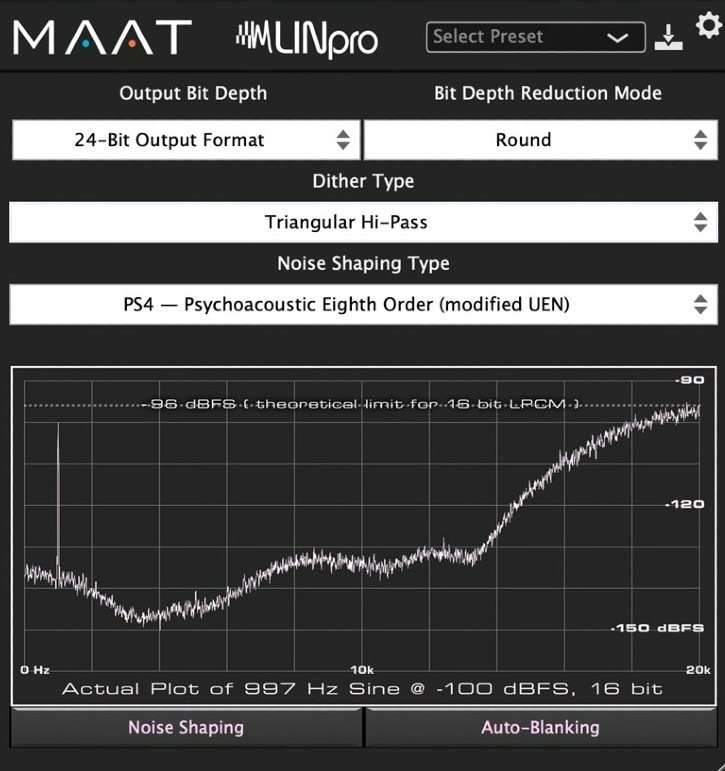
The interface shows built-in plots of each noise shape. MAAT states that these are actual plots generated by the plug-in's dither engine rather than MATLAB simulations.
Key features
Seven noise shapes
Choose from 1st, 2nd and 3rd order, plus 5th (improved E-weighting), 8th (modified ITU 486, modified UEN) and 9th (F-weighting). The choice can follow the delivery format.
Dither types
Triangular (TPDF), high-passed triangular and rectangular are available. MAAT describes rectangular as intended for educational or experimental use.
8, 16 and 24-bit output
Significant bits can be set to 24, 16 or 8. The 8-bit option is useful for hearing at once how the current choice behaves.
Round or truncate
Rounding or truncation can be chosen. MAAT describes it as one of the few dithering products that offer this choice.
Real plots of each noise shape
Real measured plots are built in. MAAT uses the example of a -100 dBFS input remaining after reduction to 16 bits.
Auto-blanking
Auto-blanking mutes on silence to prevent background contamination, helping avoid leftover noise.
Four factory presets
Four factory presets speed up choosing, and settings can still be customised.
Specifications
| Item | Details |
|---|---|
| Maker | MAAT |
| Type | Dithering (mono or stereo) |
| Noise shaping | 1st, 2nd, 3rd, 5th, 8th (two types), 9th order |
| Dither | TPDF, high-passed TPDF, rectangular |
| Bit depth | 8 / 16 / 24 |
| Round / truncate | Selectable |
| Presets | 4 |
| Formats | AAX Native (Pro Tools 10.3.10 or later), AU, VST 2, VST 3 |
| Operating systems | macOS 10.9 or later (Universal Binary 2, 64-bit only), Windows 7 or later (32 / 64-bit) |
| Sample rates | 44.1 to 384 kHz |
What is included and system requirements
- LINpro (the stereo plug-in)
- AAX Native, AU, VST 2, VST 3
- macOS 10.9 or later, Windows 7 or later
- A free trial is offered on the official site (Try Them Now)
How to use it
- Buy from the MAAT site or obtain the trial.
- After installing, insert LINpro at the very end of the master track in your DAW.
- Make sure no other dither is applied.
- Set output bit depth to 16 or 24 to match the delivery format.
- Choose the dither type and noise shaping.
- Check the round or truncate setting.
- Switch to 8-bit to hear how different settings behave.
- Before exporting, confirm LINpro is still last in the chain.
Where it may come in handy
16-bit masters for CD
It may be used as the final stage when reducing bit depth for a 16-bit Red Book master.
24-bit files for streaming
It may be placed last when delivering high-resolution files such as 88.2 kHz.
Comparing export settings
The 8-bit option may be used to hear how each noise shape behaves.
Home-studio mastering
When finishing your own master in a DAW, it may be worth comparing against the DAW's built-in dither.
Who it may suit
- People who want to choose the dither type in detail before export
- People who deliver both 16-bit and 24-bit files
- People who want to see the noise shape while choosing
- People who mainly work in stereo
Good to know before you buy
- MAAT says dither must be the very last plug-in, just before conversion to the final fixed-point format.
- For multichannel work, LINSurround is the version to look at (up to 128 channels).
- A simpler first-order version, LINone, exists in the same family (listed on the official page).
How it differs from similar products
We do not pick a winner; the official figures are placed side by side.
LINSurround
LINSurround handles up to 128 channels and is listed at $59.The dither features are shared.
Price
$39 (MAAT official site, checked 2026-10-27). Prices can vary by region and promotion, so check the official page before buying.
See LINpro on the product page
More of the same kind
Other introduction articles of the same kind.
- MeldaProduction MMatcher
- United Plugins BassRift
- Sugar Bytes Looperator
- McDSP SA-3 Spectral Processor
- W. A. Production ChopBeast 2
- Waves TRACT SPL Meter
We have introduced 9 other products from MAAT.
See the full list in Product database: Effects.
Sources: maat.digital pluginboutique.com (checked 2026-10-27)










Comments