
Disclosure: This page may contain affiliate links. Prices were checked on the date shown and may change.
An introduction to AudioThing SX1000, based on information from the maker and distributors: what it does, how to use it and who it may suit. It is not scored.
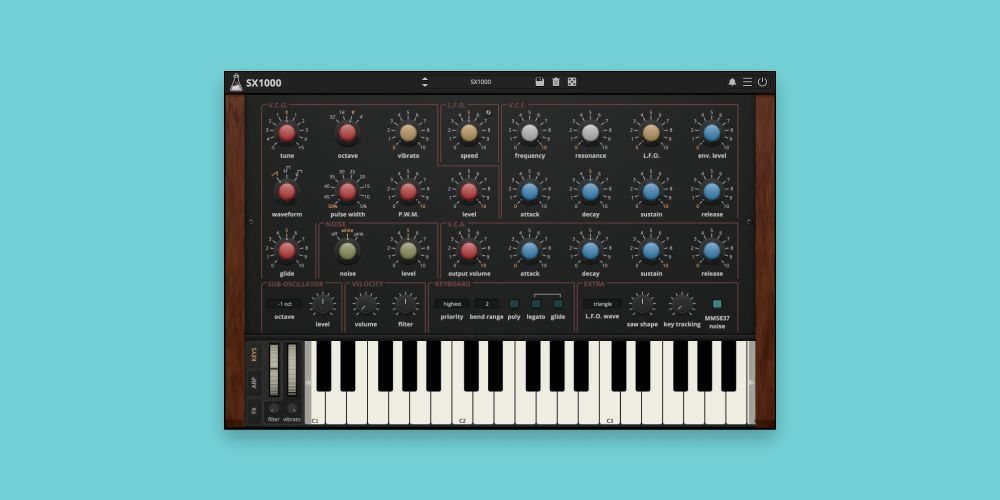
SX1000 is a faithful emulation of the JEN SX1000, a vintage Italian synth released in 1978.
— AudioThing official site
What is SX1000?
SX1000 is AudioThing's emulation of the JEN SX1000 Synthetone, a vintage Italian synth released in 1978. The maker describes the original as one of the first affordable analog synths widely available in Europe.
The original is a monophonic single-oscillator synth with sawtooth, square and pulse waves plus white and pink noise. This version emulates the M110 chip and adds a polyphonic mode, a sub oscillator down to -3 octaves and legato controls.
The filter is a 24 dB/oct resonant low-pass with self-oscillation. The LFO handles vibrato, tremolo and filter modulation, with added waveforms and sync, and there are two ADSR envelopes for volume and filter.
The arpeggiator is borrowed and expanded from the Roland Juno-60, and four effects are included. It runs on Windows, macOS and Linux as VST2, VST3, AU, AAX, CLAP and standalone.
Key features
M110 chip emulation with poly mode
The original's M110 chip is carefully emulated, with added polyphonic mode and legato options, extending it to play chords.
Sub oscillator down to -3 octaves
The original was easy to modify and AudioThing added a flip-flop sub oscillator to its own unit some 20 years ago. This version reproduces that idea down to -3 octaves.
MM5837 noise emulation
The MM5837 digital noise source found in the Prophet-5 and others is emulated. Its short 17-bit LFSR repeats every few seconds, so it can be disabled.
24 dB/oct filter and LFO
A 24 dB/oct resonant low-pass filter with self-oscillation; the LFO covers vibrato, tremolo, filter and PWM modulation with added waveforms and sync.
Juno-60 derived arpeggiator
Modes include up, up and down, down and random over 4 octaves, with rate and sync, hold/latch, note order and chord mode. The original had no arpeggiator.
Four effects in any order
Tape echo, spring reverb, wave folder and BBD flanger can be reordered by drag and drop. The tape echo is based on AudioThing's Space Echo emulation.
Resizable window and display controls
The window can be resized and brightness and contrast adjusted, which helps fine knob work in different studio setups.
Specifications
| Item | Details |
|---|---|
| Oscillator | 1 (saw, square, pulse) + sub (down to -3 octaves) |
| Filter | 24 dB/oct resonant low-pass |
| LFO | 1 (vibrato, filter, PWM) |
| Envelopes | 2 (volume, filter) |
| Effects | 4 (tape echo, spring reverb, wave folder, flanger) |
| Other | Arpeggiator, oversampling, resizable window, preset randomizer |
| Windows | Windows 7-11, 2 GHz CPU, 4 GB RAM / VST2, VST3, AAX, CLAP, Standalone |
| macOS | macOS 10.13-15, Universal 2 / VST2, VST3, AU, AAX, CLAP, Standalone |
| Linux | Ubuntu 20.04 LTS / VST2, VST3, CLAP, Standalone |
What is included and system requirements
- SX1000 instrument
- Preset system and randomizer
- Windows 7-11, macOS 10.13-15 (Universal 2), Ubuntu 20.04 LTS
- VST2, VST3, AU (Mac), AAX, CLAP and standalone
- Resizable window with brightness and contrast controls
How to use it
- Buy from the official site or a store and obtain the license.
- Run the installer and choose the format for your DAW.
- Rescan plugins in the DAW and load SX1000.
- Pick a preset and play to hear the basic tone.
- Choose an oscillator waveform and add the sub oscillator to balance the low end.
- Move filter cutoff and resonance, and try self-oscillation if you like.
- Choose arpeggiator mode and rate, and try hold/latch.
- Reorder the four effects to set the texture.
Where it may come in handy
Bass and lead sounds
Combining the sub oscillator and 24 dB/oct filter may help build thick basses and leads.
Vintage-style synth material
Since it recreates an old analog synth, it may suit late-70s style material.
Arpeggio-based writing
The Juno-60-derived arpeggiator and effects may be combined for pattern writing.
Thick chords with poly mode
The original was monophonic, but poly mode may allow chord playing.
Who it may suit
- People who want to try a vintage Italian analog synth in software
- Those learning synthesis on a simple one-oscillator design
- Linux users looking for a synth plugin
- People interested in the history and design of vintage synths
Good to know before you buy
- Polyphony, sub oscillator, arpeggiator and effects are additions that the original lacked.
- The MM5837 noise repeats every few seconds, so it can be turned off.
- The official macOS requirement is listed as 10.13 to 15.
- AudioThing's site sometimes advertises multi-product discounts.
- The official requirements list a 2 GHz CPU and 4 GB RAM, and oversampling is available.
How it differs from similar products
We do not pick a winner; the official figures are placed side by side.
miniBit
SX1000 has one oscillator (saw, square, pulse), a 24 dB/oct filter and four effects, while miniBit has an 18-waveform oscillator, a 2-pole filter and 128 presets. SX1000 recreates an analog synth, and miniBit is modelled on 8-bit game consoles.
Price
$69 (AudioThing official site, checked 2026-10-27). Prices can vary by region and promotion, so check the official page before buying.
See SX1000 on the product page
More of the same kind
We have introduced 178 synthesizers. Here are some of the others.
- Sugar Bytes Obscurium
- Eventide Generate
- Rob Papen Albino-3 Legend
- Dawesome Tracktion Dawesome Abyss II
- UJAM Usynth DUST
- FabFilter FabFilter One
We have introduced 34 other products from AudioThing.
- AudioThing RES-09
- AudioThing Materia
- AudioThing miniBit
- AudioThing Things – Bubbles
- AudioThing Things – Fold
For a side-by-side comparison scored on the same criteria, see our comparison of synthesizers.
See the full list in Product database: Instruments.
Sources: audiothing.net pluginboutique.com (checked 2026-10-27)










Comments