
Arturia’s Pigments is a synthesizer with six sound-generation methods: Modal, Granular, Wavetable, Sample, Harmonic and Virtual Analog. It has 68 kinds of filters, 20 kinds of effects and more than 1,700 presets (ready-made settings). There is also a free version with 100 presets, “Pigments Play”.
A synthesizer is an instrument that makes sound electronically. You use it for the melodies, accompaniment and sound effects of a song.
In this article we compare Pigments with 13 synthesizers and rate how well it serves its purpose on three criteria. The basis is official manufacturer information.
Disclosure: This article contains affiliate links. If you buy through them, SoundBounty may earn a commission at no extra cost to you. Prices and sale information are as of the date we checked them and can change.
Score 4.3 / 5 (average of the 13 products compared: 3.6)
- Specs last checked
- 2026/09/25
- Ready-to-use sounds
- 1,700+
- Range of sound design
- 6 methods
- Help with sound design
- 4 macros + Play View
- Price (store, date)
- $199 [Official, checked Oct 26]
Summary
Among the 13 synthesizers, Pigments is rank S. The ranks run S, A, B and C, and S is the top. Averaging the scores for each criterion (out of 5, with the one criterion that matters most for the purpose counted double) gives 4.3.
Strengths
- Ready-to-use sounds (4 points): it comes with many sounds, so you can use them just by choosing.
- Range of sound design (5 points): you can make sound in several ways, which covers a wide range of tones.
- Help with sound design (4 points): you can change a sound with simple controls even without detailed knowledge.
Who it suits: people who want to design sound with several methods in one instrument, and people who want to try a free version before deciding.
Main features of Pigments
Six sound-generation methods
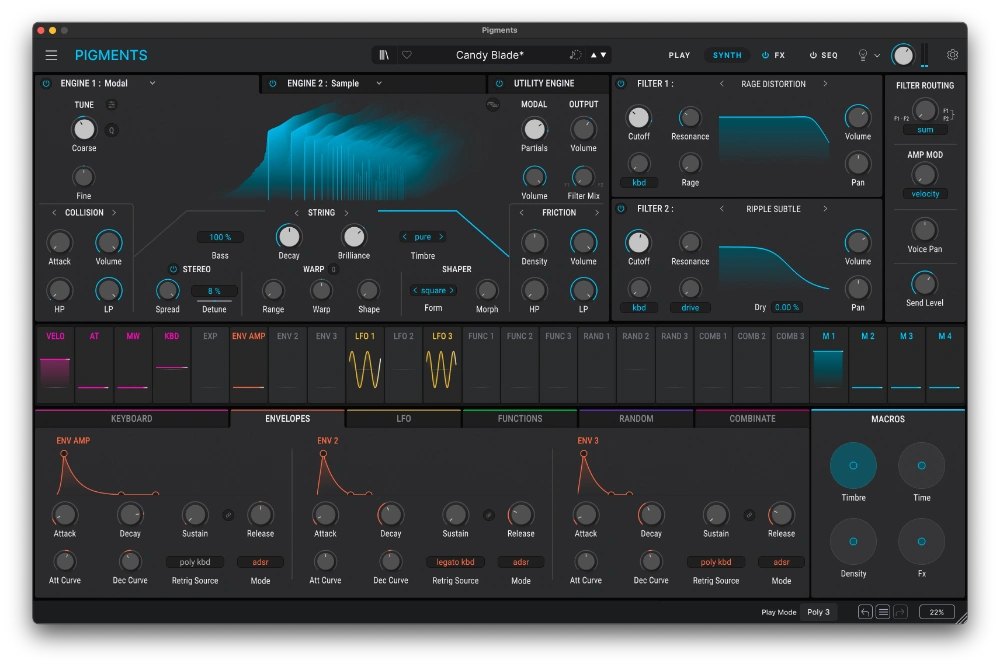
Pigments has six methods: Virtual Analog, Wavetable, Granular, Sample, Harmonic and Modal. Modal makes sounds close to acoustic instruments, like the ring of a struck object. Its strength is that just by switching methods you can make everything from bass to sound effects in one instrument.
Four macros and Play View
You can assign several parameters freely to each of the four macros and move them together with one knob. Play View is a screen with simplified controls for playing and choosing presets, and it has displays that react to the sound. You can make big changes without going into the detailed screens.
Modulation you can connect freely
Envelopes, LFOs, random signals and more can be connected to any parameter to give the sound movement. The connected movements are color-coded, so you can follow them by eye on the screen. There are also a sequencer and an arpeggiator that make phrases randomly, so you can work on sound design and composing on the same screen.
Free version Pigments Play
The free Pigments Play lets you use the six sound-generation methods, filters, effects and Play View in the same way. The differences are that there are 100 presets (more than 1,700 in the full version) and the parameters you can operate are limited. You can try sounds in Play first and then choose the full version.
Video: “Pigments 7 | Sound Design Synthesizer | ARTURIA” (official Arturia YouTube channel; narration in English) Watch on YouTube
Where it is useful
- Using the free Pigments Play to find a sound that fits a song among the presets
- Brightening the sound toward the chorus with a single macro knob
- Using the Modal method to make percussive or bell-like tones
Rating by criterion
Ready-to-use sounds: 4 / 5
We look at the number of presets (ready-made sounds) included from the start.
It includes more than 1,700 presets.
Range of sound design: 5 / 5
We look at how many sound-generation methods (ways of making sound) you can use.
It has six sound-generation methods: Modal, Granular, Wavetable, Sample, Harmonic and Virtual Analog.
Help with sound design: 4 / 5
We look at whether there are features (big knobs, randomization and so on) that let you change a sound without detailed knowledge.
It has four macros that move several knobs together, and a simplified screen (Play View) that reacts to the sound.
How we score (Synthesizers)
| Criterion | Basis | 5 pt | 4 pt | 3 pt | 2 pt | 1 pt |
|---|---|---|---|---|---|---|
| Ready-to-use sounds | Number of presets (ready-made sounds) stated on the official page | Thousands or more | 700 or more | 400 or more | Fewer than 400, or no number stated | — |
| Range of sound design | Number of sound-generation methods (ways of making sound) you can use | 5 or more methods | 3 to 4 methods | 1 to 2 methods, with highly flexible routing and modulation | One method, such as analog-style | — |
| Help with sound design | Features that let you change a sound without detailed knowledge | Both a feature that changes sounds automatically and knobs that adjust many things at once | One of them, plus another aid | Either one, or a simplified screen | Not mentioned on the official page | — |
Each criterion is scored from 1 to 5 on how well the product serves one goal: quickly preparing sounds that suit your own songs or cover-song backing tracks in a home studio. Scores follow the conditions in the table above, and the rank is based on an average in which "Ready-to-use sounds" counts double. The basis is official manufacturer information, and the number of presets is the number written on the official page (products that do not state it get a lower score). Sound quality and CPU load are not measured, so they are not scored; reviews from trade magazines are introduced in the articles for reference. Price is not part of the score. Features that cannot be confirmed from the manufacturer's or a retailer's description are scored as if absent.
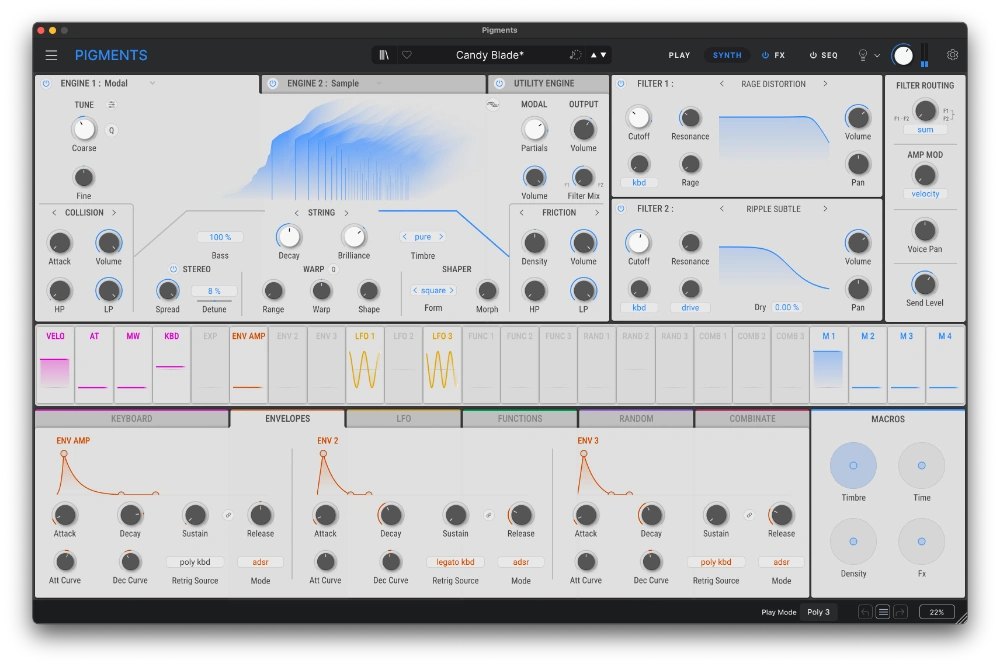
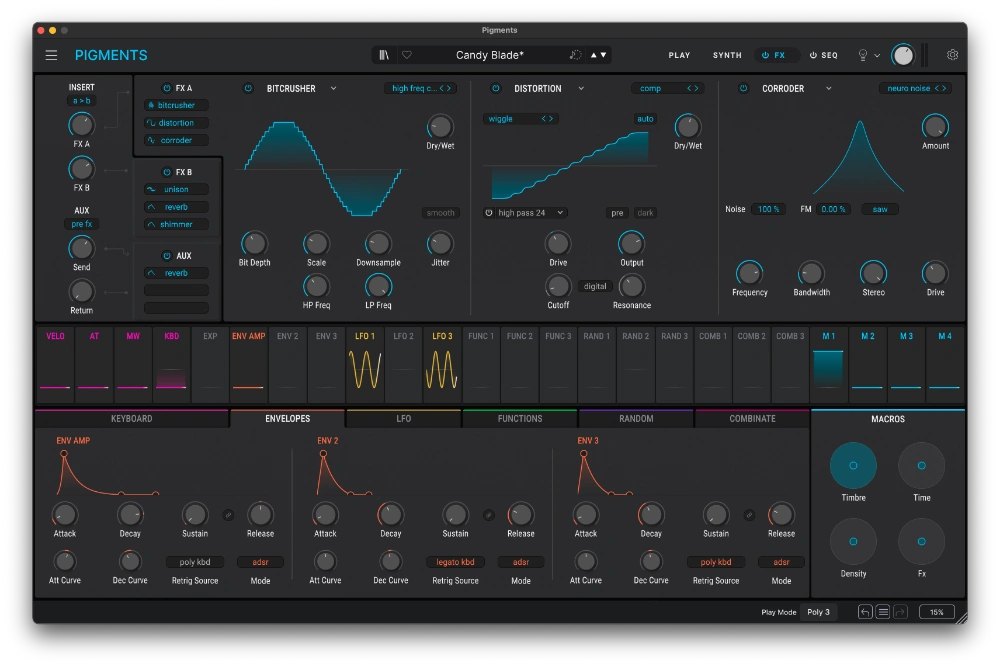
Pigments screens and images
Trade-magazine review (for reference, not part of the score)
We summarized the main points from a review in an overseas music-production magazine.
Sound On Sound (June 2025, Pigments 6)
- Praised the new Modal engine
- Praised the improved granular and filters and the stronger modulation
- Pointed out as a drawback that they would like preset management for each engine
Source: Sound On Sound review
Pigments system requirements and getting started
| Operating system | Windows 10 or later (64-bit; Windows on ARM is not supported) / Mac (macOS 11 or later) |
|---|---|
| Plug-in formats | VST, AU, AAX |
| Standalone | Yes |
| Free version | The free Pigments Play is available (100 presets, limited parameters you can operate) |
Checked on the manufacturer’s official pages on September 27, 2026.
Compared with other synthesizers
Click a heading to sort. On a phone, the table scrolls sideways.
| Product | RankAvg. score | Ready-to-use sounds | Range of sound design | Help with sound design | Free | Price (store, date) |
|---|---|---|---|---|---|---|
| SpectrasonicsOmnisphere 3 | S 5.0 | Thousands, 18 libraries | 5+ methods | Variations + auto-adjust | — | $499 [Official, checked Oct 26] |
| ArturiaPigments | S 4.3 | 1,700+ | 6 methods | 4 macros + Play View | — | $199 [Official, checked Oct 26] |
| Native InstrumentsMassive X | A 4.0 | 780 | Wavetable + free routing | Morpher, Randomize + macros | — | $199 [PB, checked Oct 26] |
| Xfer RecordsSerum 2 | A 3.8 | 626+ | 5 oscillator types | 8 macros + Hybridize | — | $249 [Official, checked Oct 26] |
| u-heDiva | B 3.0 | 1,200+ | Analog-style (5 models) | Detailed, hands-on | — | $179 (sale; regular $198.89) [PB, checked Oct 26] |
| KiloheartsPhase Plant | B 3.0 | Number not stated | 5 types + FM | 8 macro knobs | — | $199 (sale; regular $218) [PB, checked Oct 26] |
| FabFilterTwin 3 | C 2.5 | Number not stated | Analog-style | Clear screen + master knobs | — | $149 [PB, checked Oct 26] |
| Vital AudioVital | C 2.5 | 75 (free version) | Wavetable + morphing | Sounds from text | Free | Not listed |
| reFXNexus 5 | S 4.8 | 5,454 | 8 methods | 4 macros + main-knob screen | — | $179 (sale; regular $249) [Official, checked Oct 26] |
| LennarDigitalSylenth1 | B 3.0 | 2,500+ | Analog-style (1 method) | Arpeggiator | — | ≈$155.81 [Official, checked Oct 26] |
| u-heHive 2 | A 3.5 | 2,400+ | Standard waveforms + wavetable | 4 XY pads + panel presets | — | ≈$167.02 [Official, checked Oct 26] |
| UVIFalcon | S 4.3 | 1,700 | 28 oscillator types | Macros + per-preset screens | — | $149 (sale; regular $299) [Official, checked Oct 26] |
| Reveal SoundSpire | A 3.8 | 1,000+ | Several oscillator modes + free routing | RS AI + 4 macros | — | Not listed |
Features checked on each manufacturer's official website on September 25, 2026. Check the store page behind the buy button for the price.
Read next
- Omnisphere 3: features and rating (rank S)
- Nexus 5: features and rating (rank S)
- Massive X: features and rating (rank A)
- Serum 2: features and rating (rank A)

Comments