
Disclosure: This page may contain affiliate links. Prices were checked on the date shown and may change.
An introduction to BLEASS BLEASS Voices, based on information from the maker and distributors: what it does, how to use it and who it may suit. It is not scored.
BLEASS Voices is a flexible and powerful audio plugin dedicated to pitching, transforming, doubling and harmonizing vocals and other monophonic sources.
— BLEASS official site
What is BLEASS Voices?
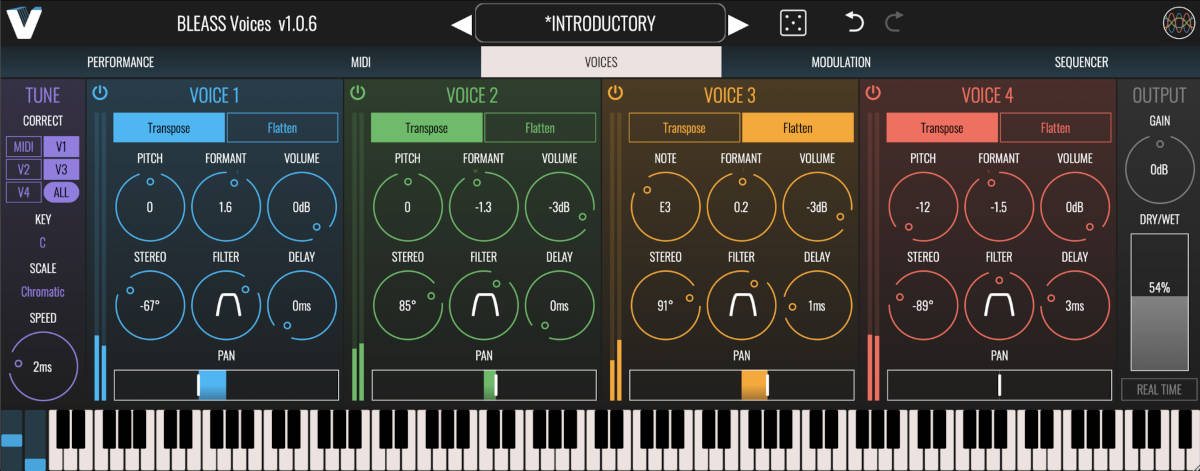
BLEASS Voices is a plug-in for pitching, transforming, doubling and harmonizing vocals and other monophonic sources. From the input voice it creates up to 12 pitch-shifted voices, each with control over pitch, formant, tone, stereo width and placement.
Four of the 12 voices can be transposed independently by up to an octave up or down, or flattened to a chosen pitch. The other eight are triggered by MIDI and transpose the input to match incoming notes. With deep MPE support, expressive chords and solos with glides and trills can be played.
Modulation comes from two LFOs, an envelope follower and a pattern sequencer. All voices can use the pitch correction that forces them into a selected key and scale, and each voice has its own output bus, so if the host DAW supports multiple outputs the voices can be mixed like separate recordings.
It handles fundamental frequencies from about 66 Hz (around C1) to 5.2 kHz (around E7). A real-time mode with low latency is offered for live use. It is available for Windows, Mac and iOS, and as a plug-in it needs a host application.
Key features
12-voice harmonizer
Up to 12 pitch-shifted voices can be created from a vocal, which may be useful for choir-like layers or doubling.
Four follow voices and eight MIDI voices
Four voices shift independently up to an octave from the input, while eight MIDI voices follow played notes so chords can be performed.
MPE support
With an MPE controller, slide and pressure can be used per note. It suits solos that need glides and trills.
LFOs, envelope follower and pattern sequencer
Two LFOs, an envelope follower and a pattern sequencer add movement. The Performance tab routes controls such as the mod wheel, velocity and pressure to parameters.
Key and scale correction
Voice pitch can be quantized to a chosen key and scale. The Speed control sets how fast notes come into tune and can create a portamento-like effect.
Per-voice outputs and arpeggiator
Each voice has an independent output bus for separate effects, and the MIDI tab has an arpeggiator that sends held notes in a rhythmic sequence.
Specifications
| Item | Details |
|---|---|
| Type | Vocal harmonizer / pitch transformer |
| Voices | 12 (4 follow + 8 MIDI) |
| Frequency range | About 66 Hz to 5.2 kHz |
| Modulation | 2 LFOs, envelope follower, pattern sequencer |
| Formats (Windows) | VST3 (64-bit), AAX |
| Formats (Mac) | VST3 (64-bit), AU, AAX |
| OS | Windows 8+ / macOS 10.9+ (64-bit, Apple M1 supported) |
| Other | Requires a host; an iOS version is available |
What is included and system requirements
- BLEASS Voices plug-in
- Formats: VST3, AAX on Windows; VST3, AU, AAX on Mac
- Requirements: Windows 8+ / macOS 10.9+ (64-bit)
- An iOS version is offered separately
How to use it
- Get BLEASS Voices from the BLEASS site or a retailer and install it.
- Load it on a vocal track in the DAW.
- Select a key and scale in the Tune panel and decide which voices to correct.
- Adjust pitch, formant, pan and stereo for the four follow voices.
- To play chords by MIDI, route a MIDI track to BLEASS Voices.
- If using the arpeggiator, set Rate, Octave and other options.
- Add movement with the LFOs and envelope follower.
- To process voices separately, set up individual outputs in the DAW.
Where it may come in handy
Choir-like layers
It may be tried to build stacked voices from a single vocal.
Playing a voice from a keyboard
MIDI voices could be used to perform vocal chords and solos.
Shaping doubling textures
Formant and stereo controls may help create a wide double.
Processing monophonic instruments
The maker says it works on monophonic sources, so guitar or synth lines may be tried.
Who it may suit
- Users who want harmonies or layers from one vocal
- Users who want to play a voice from a keyboard or MPE controller
- Users who want to process each voice separately
- Users who want synth-style movement on vocals
Good to know before you buy
- It is not a standalone product and requires a host application.
- Per-voice outputs require a DAW that supports multiple plug-in outputs.
- The official product page did not list a price.
Price
Please check the official page for the price.
See BLEASS Voices on the product page
More of the same kind
We have introduced 35 vocal processors. Here are some of the others.
- Resonant Cavity Voloco Producer
- Waves Manny Marroquin Triple D
- Bogren Digital A-Class Vocal
- Synchro Arts VocAlign 7
- Sonnox VoxDoubler
- DOTEC-AUDIO DeeField
We have introduced 16 other products from BLEASS.
- BLEASS BLEASS Vox
- BLEASS BLEASS Multiband Compressor
- BLEASS BLEASS Sidekick
- BLEASS BLEASS Tides
- BLEASS BLEASS Delay
For a side-by-side comparison scored on the same criteria, see our comparison of vocal processors.
See the full list in Product database: Effects.
Sources: bleass.com pluginboutique.com (checked 2026-10-27)










Comments