
A de-esser is a plug-in that reduces the sounds that hurt the ear, such as “s” and “sh” (sibilance). In a cover-song mix it is essential for tidying the sibilance that stands out when you brighten the voice with an EQ or compressor. The way it works differs a lot by product, from the old method of lowering the volume of a fixed band to ones where AI tells consonants apart one by one.
This list compares 12 de-essers on 3 criteria: natural reduction, speed, breadth of uses. Scores are decided by how well each product serves its purpose, using the conditions for each criterion, and the basis is official manufacturer information. Price is not part of the score.
Disclosure: This page contains affiliate links. If you buy through them, SoundBounty may earn a commission at no extra cost to you. Prices are as of the date checked and can change.
Picks by purpose
- If you want it natural without fiddling with settings: smart:deess (rank S). AI tells consonants apart one by one and sets itself automatically.
- If you also want to reduce the harsh ring of the voice: Soothe3 (rank S). It automatically reduces not just sibilance but harsh resonance in general.
- If you want to decide the details yourself: Pro-DS (rank A). You can decide how it reduces in detail, with split band, M/S and more.
- If you want to try one at a reasonable price: pure:deess (rank A). An AI de-esser you can use with one knob.
Picks by budget
The highest-scoring product in each price range. Prices are the regular prices in US dollars shown on Plugin Boutique on October 10, 2026; sale prices change often, so check the store page. Price is not part of the score.
- Under $50: pure:deess (rank A, $39). The highest-scoring product in this price range.
- $50 to $149: smart:deess (rank S, $129). The highest-scoring product in this price range.
- $150 and over: Oxford SuprEsser (rank A, $244). The highest-scoring product in this price range.
Tier list by rank
Ranks are based on the manufacturer's official features and specifications, not on sound quality. Within a row, products are ordered by score. The basis is explained in How we rate specifications.
Tier table by criterion
Products with the same overall rank can have different strengths. Click a column heading to sort by the rank on that criterion, and use it when you choose by the feature you want.
| Product | Overall | Natural reductionA mechanism that reduces only the sibilance (harsh "S" sounds) without changing the voice quality | SpeedHow quickly you can reach a good setting | Breadth of usesPlosives, harsh resonances, stereo and use while recording |
|---|---|---|---|---|
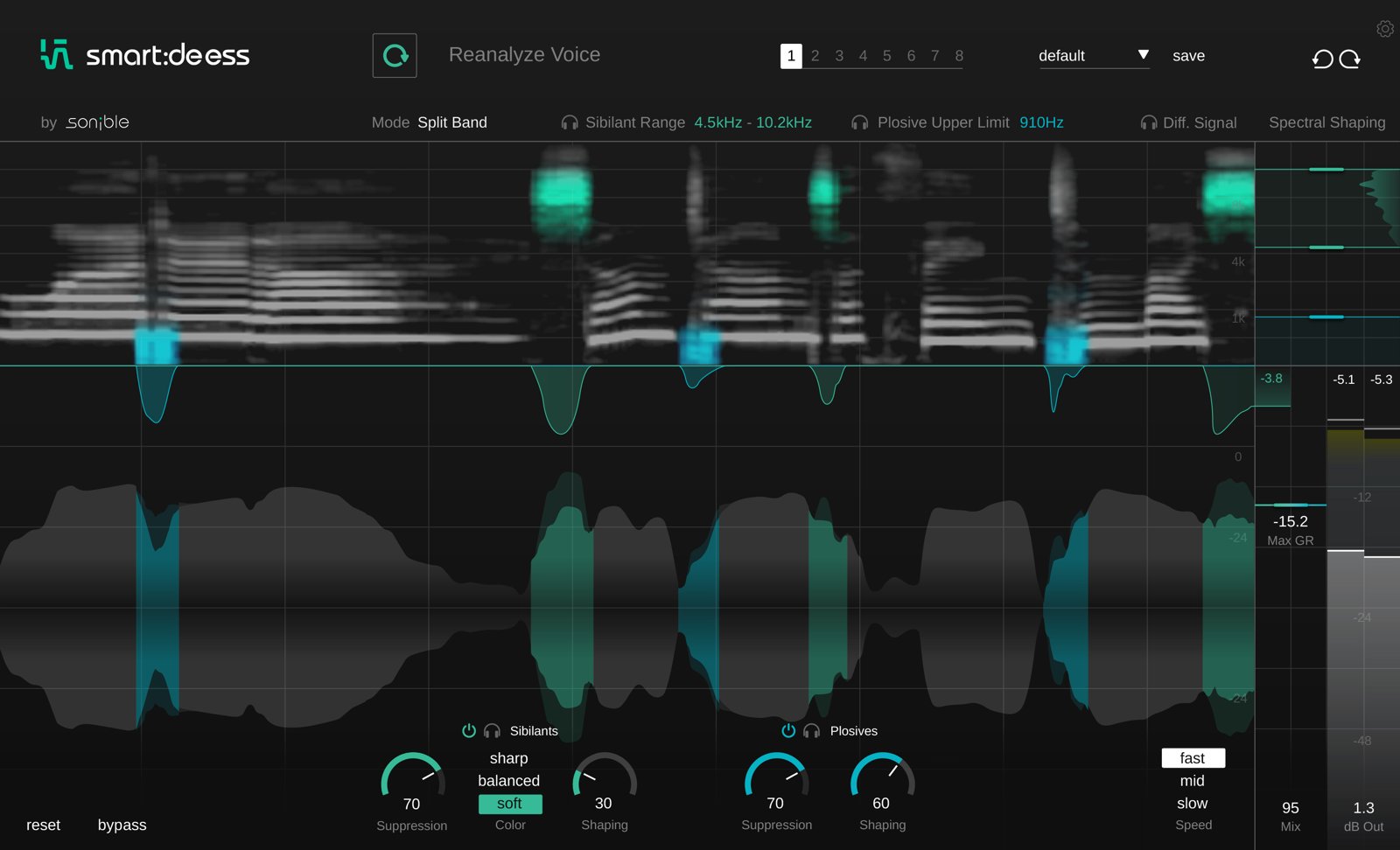 soniblesmart:deess | S4.5 | SPer consonant + spectral | SAI auto-setting | BPlosives too |
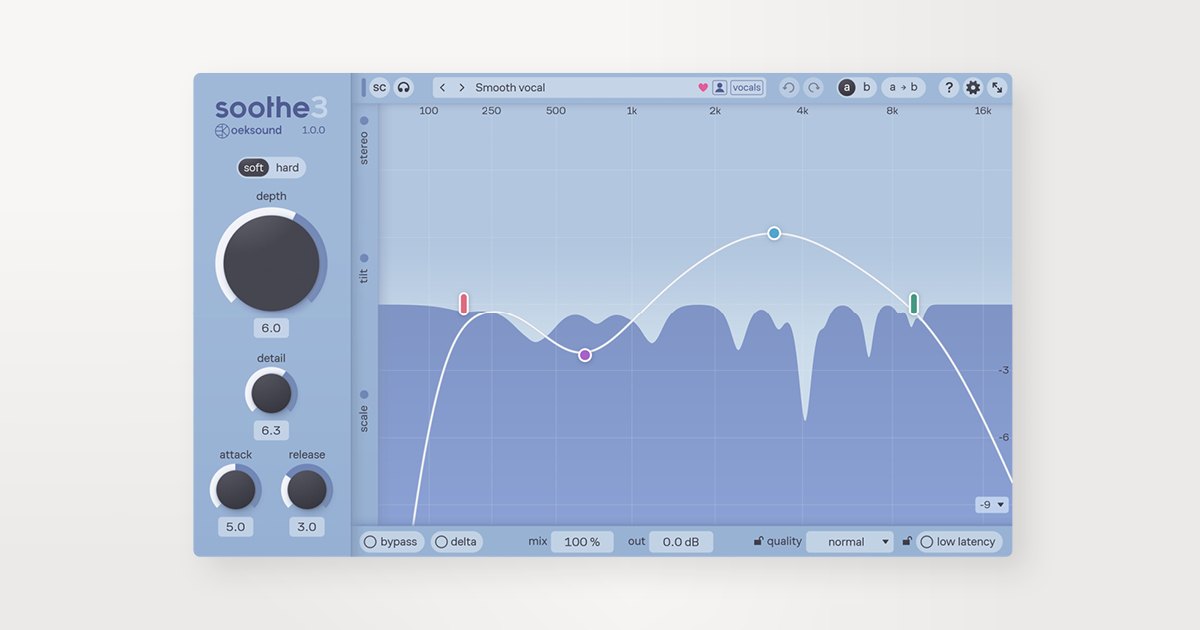 oeksoundSoothe3 | S4.3 | AAuto resonance suppression | ASoft mode | SResonances, no delay |
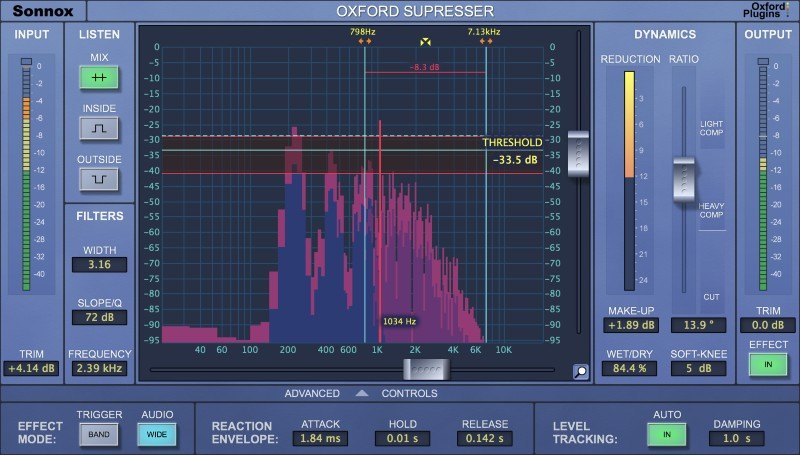 SonnoxOxford SuprEsser | A4.0 | ADynamic EQ | AAuto-follow | ASC listen, low latency |
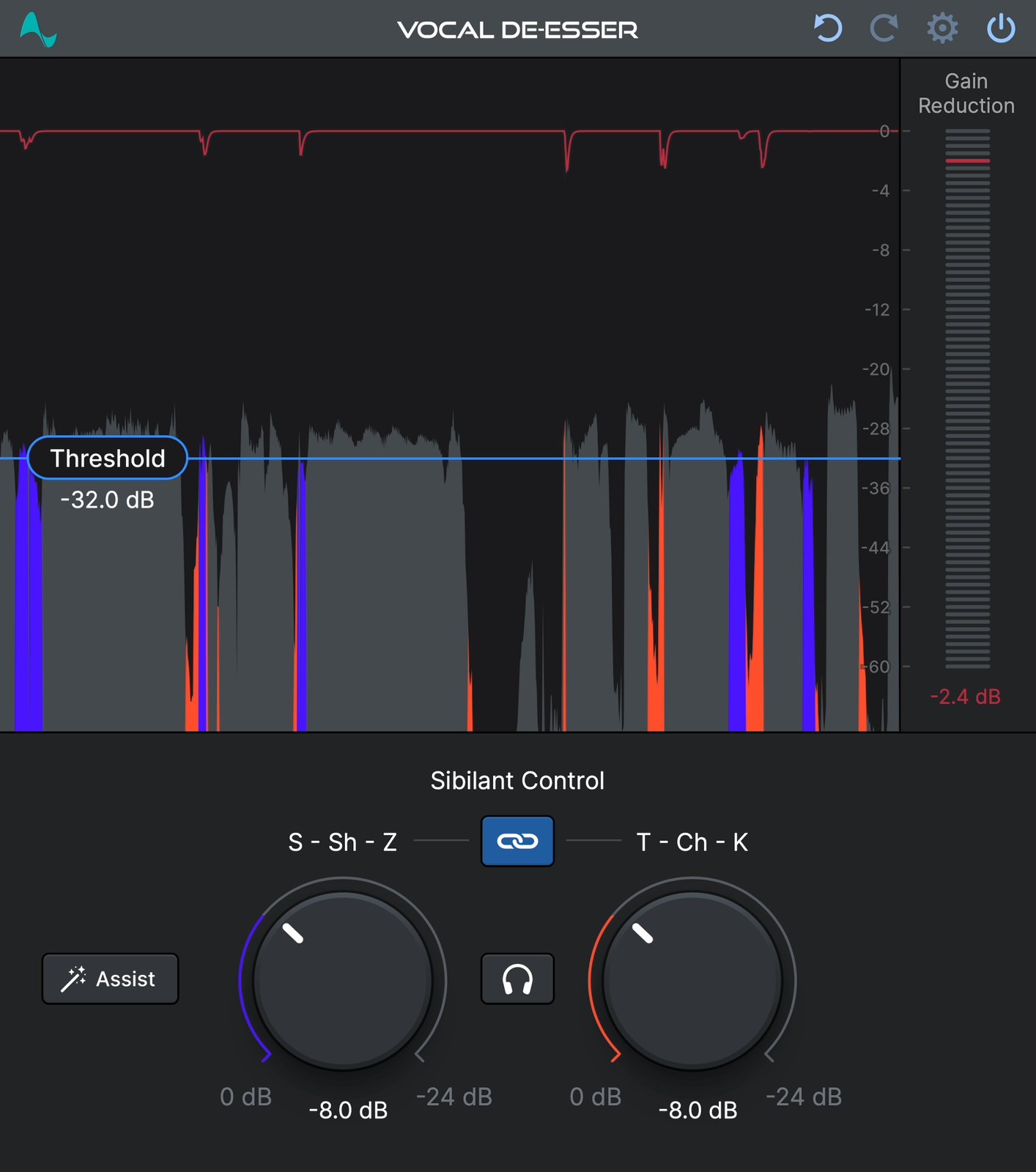 AntaresVocal De-Esser | A4.0 | AAI identifies | SButton processing | BLive, speech too |
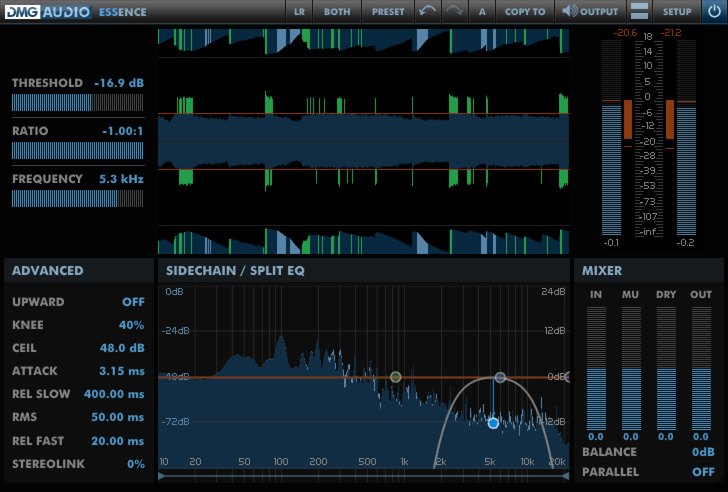 DMG AudioEssence | A4.0 | ASplit EQ + 2 releases | A3 knobs + auto detection | AM/S, zero latency, whole mix |
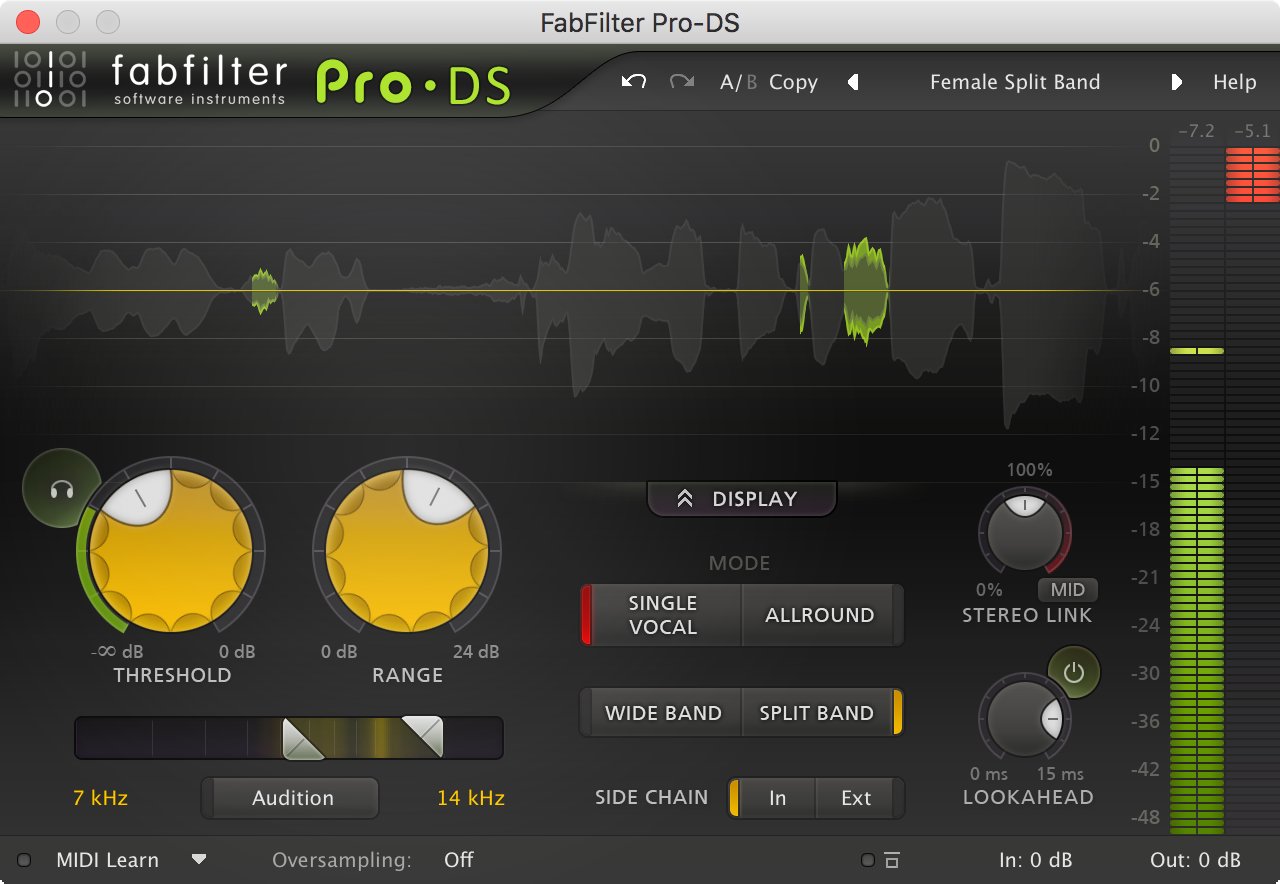 FabFilterPro-DS | A3.8 | ASplit band | BVocal mode | AM/S, other material |
 soniblepure:deess | A3.8 | AAI learns the voice | SAuto + one knob | CSibilance only |
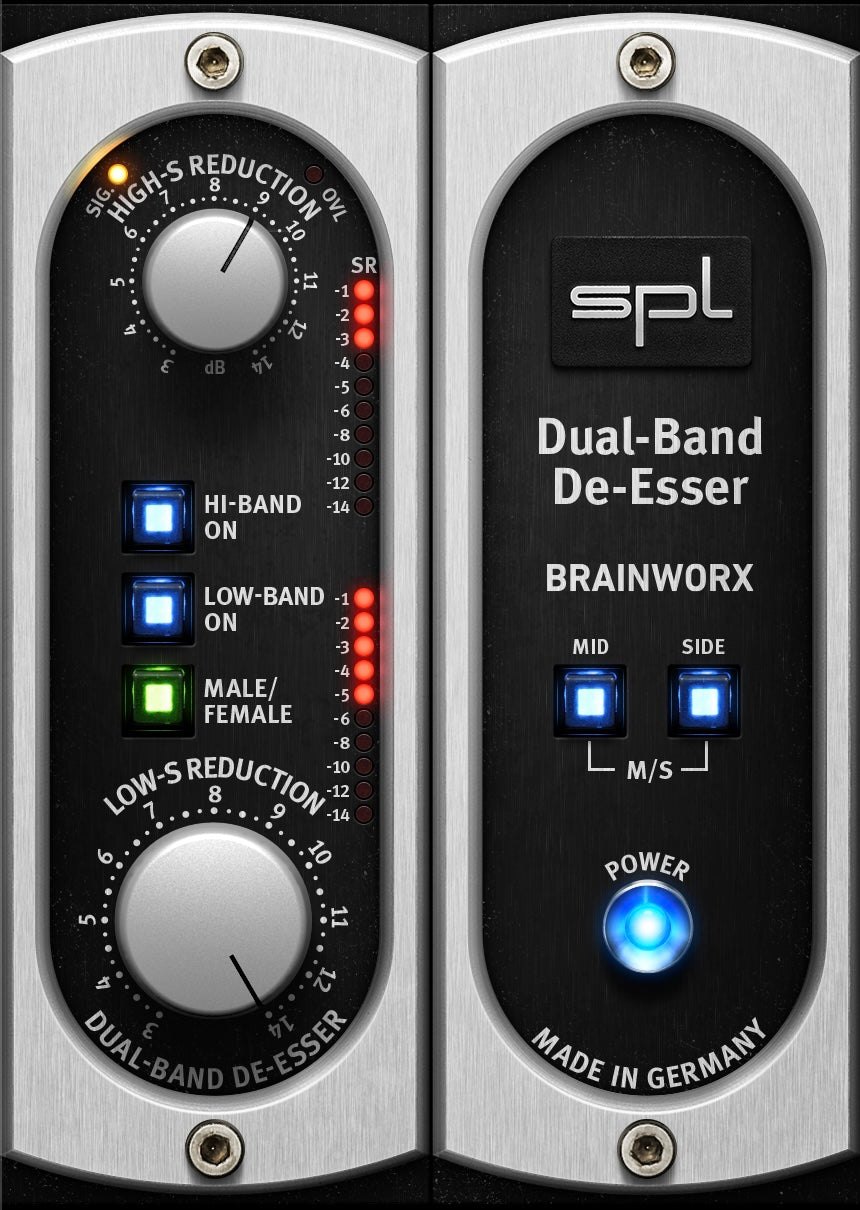 Plugin Alliance(SPL)SPL De-Esser Collection | A3.8 | ACancels only the sibilance band | AAuto-Threshold + auto detection | BM/S mode |
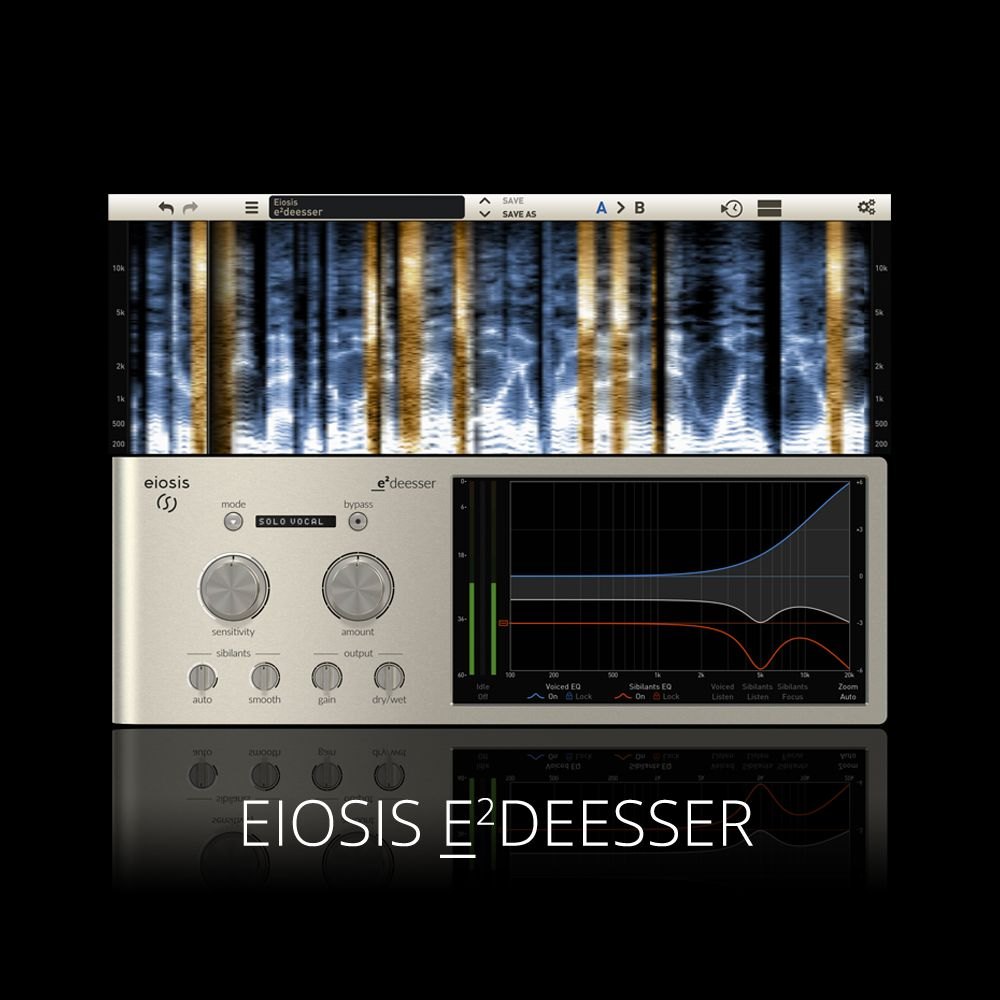 Slate Digitale2deesser | A3.8 | AAuto-detects sibilance frequency | A2 knobs + auto detection | BPercussion too |
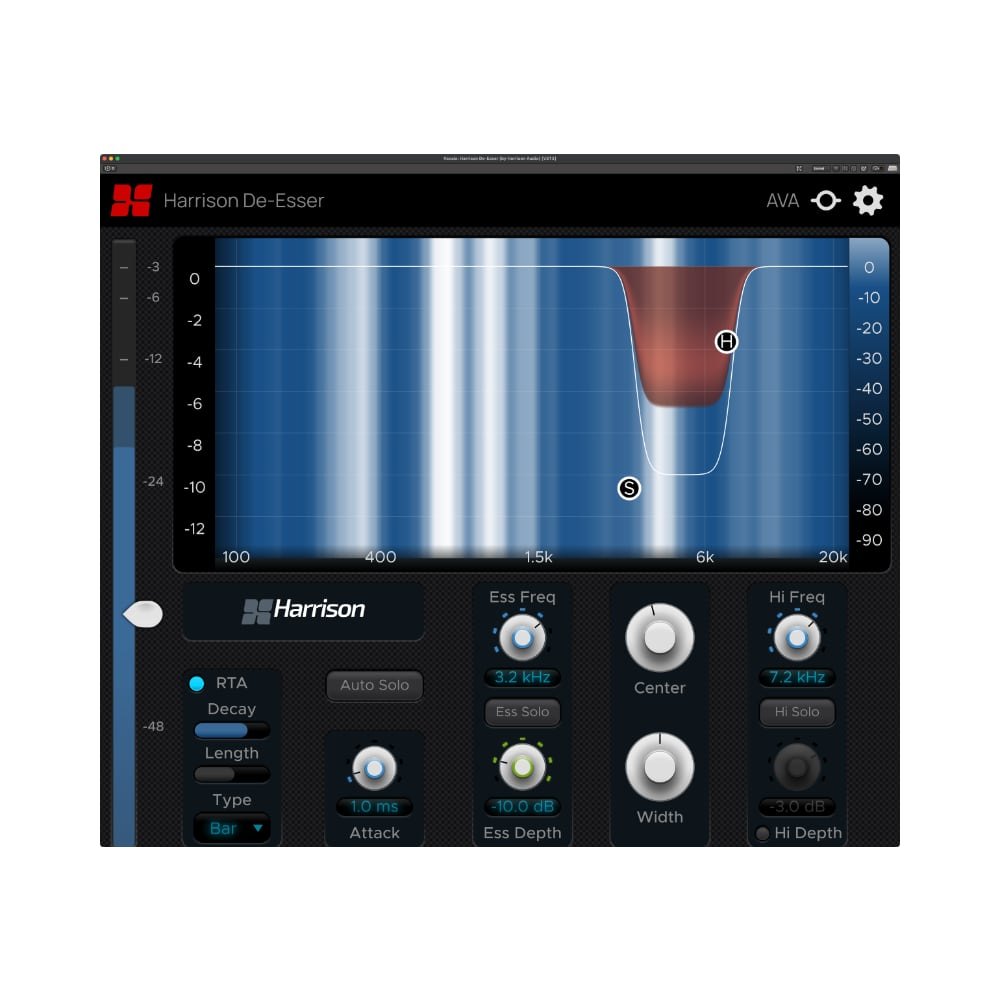 Harrison ConsolesHarrison De-Esser | A3.5 | ASibilance band only | CStandard | AZero latency + band solo |
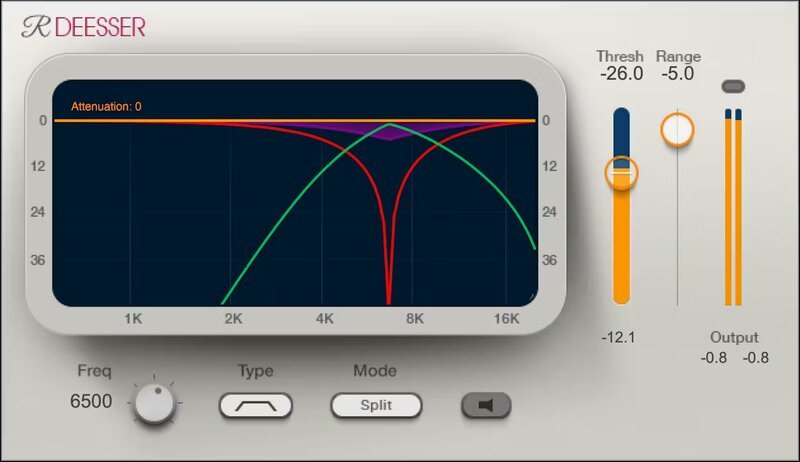 WavesRenaissance DeEsser | B3.3 | ASplit band | CStandard | BSidechain listening |
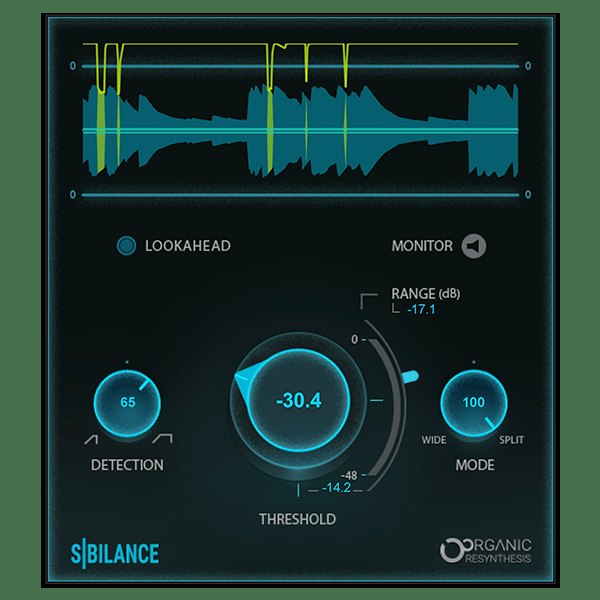 WavesSibilance | B3.3 | APer-component resynthesis | CStandard | BZero-latency version |
Click a column heading to sort by that criterion (click again to reverse). Each cell shows the score (1 to 5) on that criterion as 5 = S, 4 = A, 3 = B, 2 or lower = C. A dash means the criterion is not scored. This is a rating of the manufacturer's official features and specifications, not of sound quality. See How we rate specifications.
Top-scoring products
 smart:deessRank S
- Soothe3Rank S
- Oxford SuprEsserRank A
- Vocal De-EsserRank A
- Pro-DSRank A
- pure:deessRank A
- Renaissance DeEsserRank B
Up to 9 products in order of score. Images are the manufacturers’ official press images or Plugin Boutique images. The overall order and the basis for each rank are in the tier tables above and on each product’s page.
How to choose a de-esser
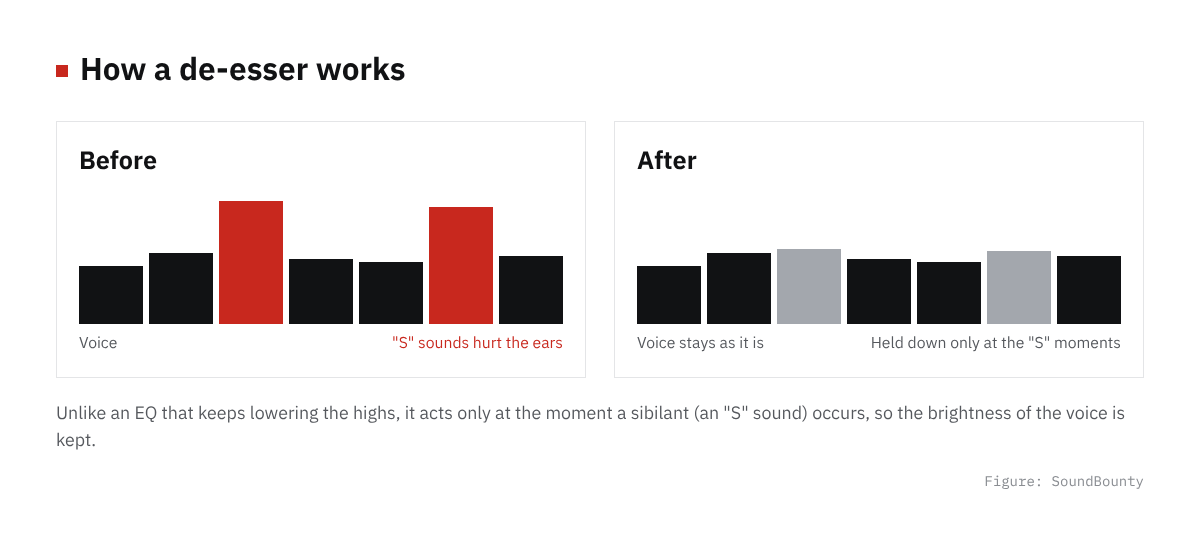
Figure: SoundBounty
Leave it to automation, or decide yourself?
Some de-essers use AI to tell consonants apart and reduce them automatically, and others let you decide the band and amount. If you are not used to settings, an automatic one suits you; if you want to decide the result in detail, one you can adjust by hand.
How natural the reduction is
The more precisely it targets only sibilance, the less muffled the whole voice gets. Look for mechanisms that keep it natural, such as processing by splitting bands or acting in step with changes in the sound.
Will you use it for more than sibilance?
A type that reduces harsh resonance in general can be used not only on sibilance but also on the tinny ring of a voice and the grating sound of cymbals. If you want to use one for many things, check this point too.
A word on each product
Prices in the headings are regular prices in US dollars shown on Plugin Boutique on October 10, 2026. They are not part of the score.
smart:deess (rank S, $129)
sonible’s smart:deess is a de-esser in which AI identifies consonants such as S, Z, Sh, Ch, T and P one by one in real time and reduces sibilance and plosives (popping sounds). It does not only lower the volume: spectral processing also shapes the harsh sound.
Soothe3 (rank S)
oeksound’s Soothe3 is a plug-in that finds harsh resonances (muddiness and a tinny ring) on the spot and reduces them automatically. It also works on sibilance, and with no delay (zero latency) it can be used while recording.
Oxford SuprEsser (rank A, $244)
Sonnox’s Oxford SuprEsser is a de-esser that uses a dynamic EQ (an EQ that works only when the sound gets loud) to reduce only the problem frequencies, only when needed. It has a Floating Threshold that moves with changes in the voice’s level, a sidechain EQ with listening, and three modes: low latency, standard and high resolution.
Vocal De-Esser (rank A)
Antares’ Vocal De-Esser is a de-esser for vocals that uses AI to identify sibilance. You can adjust soft sibilants (S, Sh, Z) and hard sibilants (T, Ch, K) separately.
Essence (rank A)
DMG Audio’s Essence is a de-esser that naturally reduces the sibilance in a mix by splitting the bands. The manufacturer explains that it can be used not only on vocals but also on a whole mix. It has M/S and L/R processing, a sidechain EQ, and a zero-latency mode.
Pro-DS (rank A, $199)
FabFilter’s Pro-DS is a de-esser whose “Single Vocal” detection identifies the sibilance in a vocal and reduces it unobtrusively. You can choose wide-band or linear-phase (a method that does not shift the timing of the sound) split-band processing, and an “Allround” mode reduces the highs of drums and a whole mix.
pure:deess (rank A, $39)
sonible’s pure:deess is a simple de-esser in which AI learns the characteristics of a voice’s sibilance (a voiceprint) in a few seconds and sets itself automatically. You adjust it with the Suppression knob and a choice of Soft, Balanced or Sharp tone.
SPL De-Esser Collection (rank A)
The SPL De-Esser Collection from Plugin Alliance is a collection that recreates two of SPL’s analog hardware de-essers (a single-band and a dual-band). It has the Auto Dynamic De-Esser method, which automatically finds the sibilance frequency, Auto-Threshold, which adjusts automatically, algorithms for male and female voices, and an M/S mode.
e2deesser (rank A)
Slate Digital’s Eiosis e2deesser is a de-esser built around two knobs that automatically finds the sibilance frequency and lowers it. It has a spectrum display of the detected sibilance and many presets, from vocals to drum overheads.
Harrison De-Esser (rank A)
Harrison’s De-Esser is a de-esser that uses Harrison’s fourth-generation de-essing algorithm. You can operate the “S” band and a high-frequency shelf together on a graph on the screen, and it runs with zero latency.
Renaissance DeEsser (rank B, $99)
Waves’ Renaissance DeEsser is a Waves de-esser that reduces the harsh “S” sounds. It has a mode that lowers the whole band, a split mode that lowers only the sibilance band, and sidechain (a function that moves the effect in time with another track) listening.
Sibilance (rank B)
Waves’ Sibilance is a de-esser that splits the sound into its basic components before processing. It aims to lower only the “S” components and leave the brightness of the highs. A zero-latency version is included.
Frequently asked questions
Q. When do I use a de-esser?
When you brighten the voice with an EQ or even it out with a compressor, “s” sounds tend to stand out. You use it after such processing when sibilance sounds harsh.
Q. What happens if I overdo it?
If you reduce sibilance too much, the voice can sound lispy and the words hard to understand. Compare with the original voice and stop where the harshness is gone.
Q. How is it different from lowering the highs with an EQ?
An EQ lowers the highs by the same amount all the time, but a de-esser works only at the moment sibilance appears. So it can reduce the harshness while keeping the brightness of the voice.
How we score
How we score (De-esser plug-ins)
| Criterion | Basis | 5 pt | 4 pt | 3 pt | 2 pt | 1 pt |
|---|---|---|---|---|---|---|
| Natural reduction | A mechanism that reduces only the sibilance (harsh "S" sounds) without changing the voice quality | AI identifies each consonant one by one and shapes it by spectrum, not only by volume | A mechanism that acts only on the problem band (split band, dynamic EQ, resonance suppression, AI learning and so on) | A general method that sets a band and lowers the overall volume | — | — |
| Speed | How quickly you can reach a good setting | AI sets everything automatically just by loading it | It follows changes in the voice's level automatically, or almost everything takes a few operations | A vocal mode makes it easy to set | Standard controls | — |
| Breadth of uses | Plosives, harsh resonances, stereo and use while recording | Works on harsh resonances in general, and supports M/S processing and operation with no delay | Two or more of M/S, sidechain listening, low latency and use on other material | One use besides sibilance, such as plosives | Sibilance only | — |
Each criterion is scored from 1 to 5 on how well the product serves one goal: naturally reducing the sibilance of a vocal. Scores follow the conditions in the table above, and the rank is based on an average in which "Natural reduction" counts double. The basis is official manufacturer information. Sound quality and CPU load are not measured, so they are not scored; reviews from trade magazines are introduced in the articles for reference. Price is not part of the score. Features that cannot be confirmed from the manufacturer's or a retailer's description are scored as if absent. The "OBS (streaming)" column in the table shows whether the official page lists the VST2 format that the streaming software OBS Studio can use (○). OBS does not support the VST3 format. It is not part of the score.
The thinking behind scores and ranks is summarized in How we rate specifications. We add products in order.