
Sonnox’s Oxford SuprEsser is a de-esser that uses a dynamic EQ (an EQ that works only when the sound gets loud) to reduce only the problem frequencies, only when needed. It has a Floating Threshold that moves with changes in the voice’s level, a sidechain EQ with listening, and three modes: low latency, standard and high resolution.
A de-esser reduces only the harsh sounds that stand out on “S” and similar sounds in singing (sibilance).
In this article we compare Oxford SuprEsser with 12 de-esser plug-ins and rate how well it serves its purpose on three criteria. The basis is official manufacturer information.
Disclosure: This article contains affiliate links. If you buy through them, SoundBounty may earn a commission at no extra cost to you. Prices and sale information are as of the date we checked them and can change.
Score 4.0 / 5 (average of the 12 products compared: 3.8)
- Specs last checked
- 2026/09/25
- Natural reduction
- Dynamic EQ
- Speed
- Auto-follow
- Breadth of uses
- SC listen, low latency
- Price (store, date)
- $244 [PB, checked Oct 26]
Summary
Among the 12 de-esser plug-ins, Oxford SuprEsser is rank A. The ranks run S, A, B and C, and A is second from the top. Averaging the scores for each criterion (out of 5, with the one criterion that matters most for the purpose counted double) gives 4.0.
Strengths
- Natural reduction (4 points): it reduces only the harsh sounds naturally, without changing the voice quality.
- Speed (4 points): automatic settings or few knobs let you start right away.
- Breadth of uses (4 points): it does more than reduce sibilance, so its uses are wide.
Who it suits: people who want to handle singing with a large range of loudness, from whispers to shouts, naturally.
Main features of Oxford SuprEsser
A de-esser built on a dynamic EQ
Oxford SuprEsser reduces sibilance with a dynamic EQ that lowers only the problem frequencies, only when needed. Because it can target any band from 20 Hz to 20 kHz, it can be used not only on sibilance but also on boominess in the low end. Split-band acts only on the targeted band; Full-band lightly reduces the whole sound while keeping phase aligned.
Floating Threshold keeps up with the loudness of the voice
When the volume of a song changes greatly, from a whisper to a belted voice, a fixed threshold causes over-reduction or under-reduction. Floating Threshold is a function that moves the threshold automatically to match the loudness of the voice. You can keep a similar effect without moving the threshold by hand.
Three versions, and listening to the sidechain
There are three versions, Low Latency, Standard and High Resolution, so you can use them from recording to finishing. You can set it up while listening to the band that triggers it, so it is easier to match the consonant you are targeting. The manufacturer says it also suits podcasts and the finishing of video.
Where it is useful
- Using Floating Threshold to reduce the “S” sounds of a song with big changes in loudness
- Using the low-latency version for monitoring while recording or streaming
- Lowering the boominess of the low end of a vocal or acoustic guitar only when needed
Rating by criterion
Natural reduction: 4 / 5
We check whether it has a mechanism that reduces only the harsh “S” sounds that hurt the ears, without changing the voice quality.
A dynamic EQ mechanism reduces only the problem frequencies, only when needed.
Speed: 4 / 5
We check whether it has features that get you to a good setting quickly (automatic settings, a single knob and so on).
Floating Threshold moves the threshold automatically to follow changes in the voice’s level.
Breadth of uses: 4 / 5
We check whether it also handles problems other than sibilance (plosives, harsh ringing) and can be used while recording.
It has a sidechain EQ with listening and a low-latency mode, and can also be used on low-end muddiness.
How we score (De-esser plug-ins)
| Criterion | Basis | 5 pt | 4 pt | 3 pt | 2 pt | 1 pt |
|---|---|---|---|---|---|---|
| Natural reduction | A mechanism that reduces only the sibilance (harsh "S" sounds) without changing the voice quality | AI identifies each consonant one by one and shapes it by spectrum, not only by volume | A mechanism that acts only on the problem band (split band, dynamic EQ, resonance suppression, AI learning and so on) | A general method that sets a band and lowers the overall volume | — | — |
| Speed | How quickly you can reach a good setting | AI sets everything automatically just by loading it | It follows changes in the voice's level automatically, or almost everything takes a few operations | A vocal mode makes it easy to set | Standard controls | — |
| Breadth of uses | Plosives, harsh resonances, stereo and use while recording | Works on harsh resonances in general, and supports M/S processing and operation with no delay | Two or more of M/S, sidechain listening, low latency and use on other material | One use besides sibilance, such as plosives | Sibilance only | — |
Each criterion is scored from 1 to 5 on how well the product serves one goal: naturally reducing the sibilance of a vocal. Scores follow the conditions in the table above, and the rank is based on an average in which "Natural reduction" counts double. The basis is official manufacturer information. Sound quality and CPU load are not measured, so they are not scored; reviews from trade magazines are introduced in the articles for reference. Price is not part of the score. Features that cannot be confirmed from the manufacturer's or a retailer's description are scored as if absent. The "OBS (streaming)" column in the table shows whether the official page lists the VST2 format that the streaming software OBS Studio can use (○). OBS does not support the VST3 format. It is not part of the score.
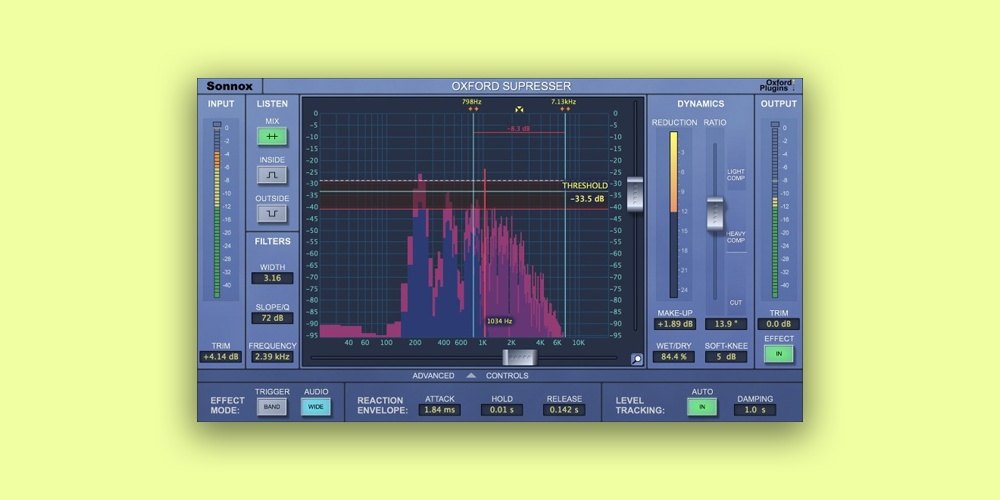
Oxford SuprEsser screens and images
Trade-magazine review (for reference, not part of the score)
We summarized the main points from a review in an overseas music-production magazine.
Sound On Sound (review at launch) (September 2008)
This is a review of the version at launch.
- Praised it for giving excellent results with almost no side effects
- Praised its flexibility: besides de-essing it can be used against plosives and as a dynamic EQ
- Pointed out that its latency is large, so it suits mixing more than recording
Source: Sound On Sound review
Oxford SuprEsser system requirements and getting started
| Operating system | Windows / Mac |
|---|---|
| Plug-in formats | AU, VST3, AAX (Native and DSP) |
| Other | Activation with an iLok account (free) |
| Trial | Free trial available |
| OBS (streaming) | Does not work as it is (VST3 only). It can be loaded through a bridge plug-in |
Checked on the manufacturer’s official pages on September 27, 2026.
Compared with other de-esser plug-ins
Click a heading to sort. On a phone, the table scrolls sideways.
| Product | RankAvg. score | Natural reduction | Speed | Breadth of uses | OBS (streaming) | Price (store, date) |
|---|---|---|---|---|---|---|
| FabFilterPro-DS | A 3.8 | Split band | Vocal mode | M/S, other material | ○ | $199 [PB, checked Oct 26] |
| soniblesmart:deess | S 4.5 | Per consonant + spectral | AI auto-setting | Plosives too | ○ | $129 [PB, checked Oct 26] |
| soniblepure:deess | A 3.8 | AI learns the voice | Auto + one knob | Sibilance only | ○ | $39 [PB, checked Oct 26] |
| oeksoundSoothe3 | S 4.3 | Auto resonance suppression | Soft mode | Resonances, no delay | × (VST3 only) | $249 [Official, checked Oct 26] |
| SonnoxOxford SuprEsser | A 4.0 | Dynamic EQ | Auto-follow | SC listen, low latency | × (VST3 only) | $244 [PB, checked Oct 26] |
| AntaresVocal De-Esser | A 4.0 | AI identifies | Button processing | Live, speech too | × (VST3 only) | $50 [Official, checked Oct 26] |
| WavesRenaissance DeEsser | B 3.3 | Split band | Standard | Sidechain listening | △ (via Waves StudioRack) | $34.99 (sale; regular $99) [PB, checked Oct 26] |
| DMG AudioEssence | A 4.0 | Split EQ + 2 releases | 3 knobs + auto detection | M/S, zero latency, whole mix | ○ | Not listed |
| Plugin Alliance(SPL)SPL De-Esser Collection | A 3.8 | Cancels only the sibilance band | Auto-Threshold + auto detection | M/S mode | Not confirmed | $75 [Official, checked Oct 26] |
| WavesSibilance | B 3.3 | Per-component resynthesis | Standard | Zero-latency version | △ (via Waves StudioRack) | Not listed |
| Slate Digitale2deesser | A 3.8 | Auto-detects sibilance frequency | 2 knobs + auto detection | Percussion too | ○ | $99 [Official, checked Oct 26] |
| Harrison ConsolesHarrison De-Esser | A 3.5 | Sibilance band only | Standard | Zero latency + band solo | ○ | $49 [Official, checked Oct 26] |
Features checked on each manufacturer's official website on September 25, 2026. Check the store page behind the buy button for the price.
Read next
- Pro-DS: features and rating (rank A)
- pure:deess: features and rating (rank A)
- smart:deess: features and rating (rank S)
- Soothe3: features and rating (rank S)

Comments