
Disclosure: This page may contain affiliate links. Prices were checked on the date shown and may change.
An introduction to iZotope Cascadia, based on information from the maker and distributors: what it does, how to use it and who it may suit. It is not scored.
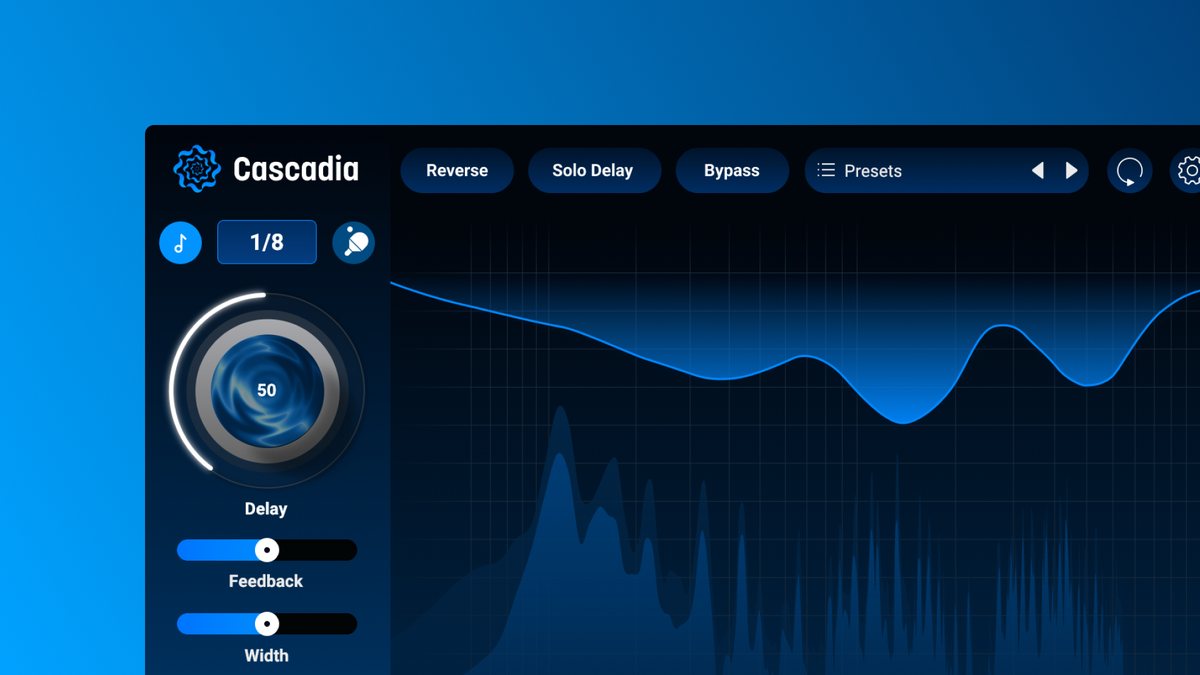
Cascadia reacts to your audio and dynamically creates space in the delay signal, keeping your instruments and vocals present in the mix without complex routing and long plugin chains.
— iZotope official site
What is Cascadia?
Cascadia is a tape-style delay plugin in iZotope's Catalyst Series. It is built around adaptive unmasking, which automatically makes room so the delay does not get in the way of the source.
It responds to the incoming audio and dynamically carves space into the delay signal. The idea is to keep vocals and instruments upfront while repeats are layered behind them, with less sidechain and EQ setup.
The delay offers beat-synced or time-based repeats, ping-pong and reverse modes, vintage pitch drift and width control. More than 50 presets are included, spanning spatial, textural and creative sounds.
The Catalyst Series is described as purpose-built, easy-to-use plugins for solving mix problems quickly, and Cascadia follows that approach with a small set of controls.
Besides Cascadia, the Catalyst Series includes FXEQ (five creative effects in one EQ workflow), Plasma (dynamic saturation), Aurora (reverb) and Velvet (de-esser). All aim to solve mix problems quickly.
Key features
Adaptive unmasking
It listens to the input and automatically reduces the matching part of the delay signal, so repeats can stay low while a vocal is active and come forward in the gaps.
Beat-synced or time-based delays
Delay time can follow note values tied to the beat or be set in time directly, whether you want the repeats locked to the rhythm or at a free spacing.
Ping-pong and reverse
Ping-pong alternates repeats between left and right, and reverse produces backwards repeats, adding motion to what can otherwise be a static delay.
Vintage pitch drift
Modulation controls add a drift in pitch like uneven tape speed. A little may give a natural warmth, and more makes the effect obvious.
Width control
The stereo width of the repeats can be narrowed or widened. Narrow repeats stay near the centre, while wide ones make the space feel larger.
Over 50 presets
Presets are grouped as spatial, textural and creative. You can start from one and adjust items such as the amount of unmasking.
Combining with the Catalyst Series
Used with Aurora from the same series, both reverb and delay apply the same unmasking approach, an option for building the space behind a vocal consistently.
Specifications
| Item | Details |
|---|---|
| Maker | iZotope |
| Series | Catalyst |
| Type | Delay (tape-style) |
| Formats | AAX, AU, VST3 (64-bit only; VST2 not supported) |
| Mac | macOS Ventura 13.6, Sonoma 14.4, Sequoia 15.0 or later (Intel / Apple silicon) |
| Windows | Windows 10 (22H2), Windows 11 (23H2) |
| Presets | Over 50 |
| Trial | Available (Try for free) |
What is included and system requirements
- Cascadia plugin (AAX / AU / VST3)
- Over 50 presets
- Listed hosts include Logic Pro, Pro Tools, Ableton Live, Cubase, Nuendo, Studio One, REAPER, FL Studio, Reason, Maschine and Cakewalk
How to use it
- Insert Cascadia on a track or a send bus in your DAW.
- Pick a preset that is close to what you want: spatial, textural or creative.
- Choose whether the delay time is beat-synced or time-based.
- Select ping-pong or reverse mode if needed.
- Raise the unmasking amount and check whether vocals or instruments stay upfront.
- Use the pitch drift and width controls to refine texture and spread.
- If using it on a send, set the wet level last.
Where it may come in handy
Repeats behind a vocal
A beat-synced delay on a vocal with unmasking raised may let repeats come forward in the gaps between phrases, adding depth without covering the lyrics.
Slapback on guitar or keys
A short time-based delay as slapback with the width narrowed may add thickness without clouding centred sounds.
Voice for podcasts or streams
For a very light repeat on a voice, the unmasking may make it easier to use without crowding the speech.
Programmed synths and leads
When repeats on a lead clash with other instruments in the same range, unmasking may help tidy them up.
Who it may suit
- People whose vocals get buried when a delay is added
- People who want quick setup with few controls
- People collecting iZotope's Catalyst Series
Good to know before you buy
- VST2 is not supported (AAX, AU and VST3 only, 64-bit).
- Supported OS versions are the minimums listed by iZotope; check the host list before use.
- A trial is available from iZotope (Try for free).
How it differs from similar products
We do not pick a winner; the official figures are placed side by side.
iZotope Equinox
Both use iZotope's unmasking. Cascadia is a delay with over 50 presets at $49; Equinox is a reverb with over 1250 presets and surround support at $249.
Price
$49 (iZotope official site, checked 2026-10-27). Prices can vary by region and promotion, so check the official page before buying.
See Cascadia on the product page
More of the same kind
We have introduced 62 delays. Here are some of the others.
- Eventide MicroPitch Immersive
- AudioThing Echo Cube
- Antelope Audio Halo
- Rob Papen RP-Delay
- Slate Digital Stellar Echo SD-201
- W. A. Production Mutant Delay
We have introduced 15 other products from iZotope.
- iZotope RX Post Production Suite 9
- iZotope Plasma
- iZotope Equinox
- iZotope Aurora
- iZotope Tonal Balance Control 3
For a side-by-side comparison scored on the same criteria, see our comparison of delays.
See the full list in Product database: Effects.
Sources: izotope.com pluginboutique.com (checked 2026-10-27)










Comments