
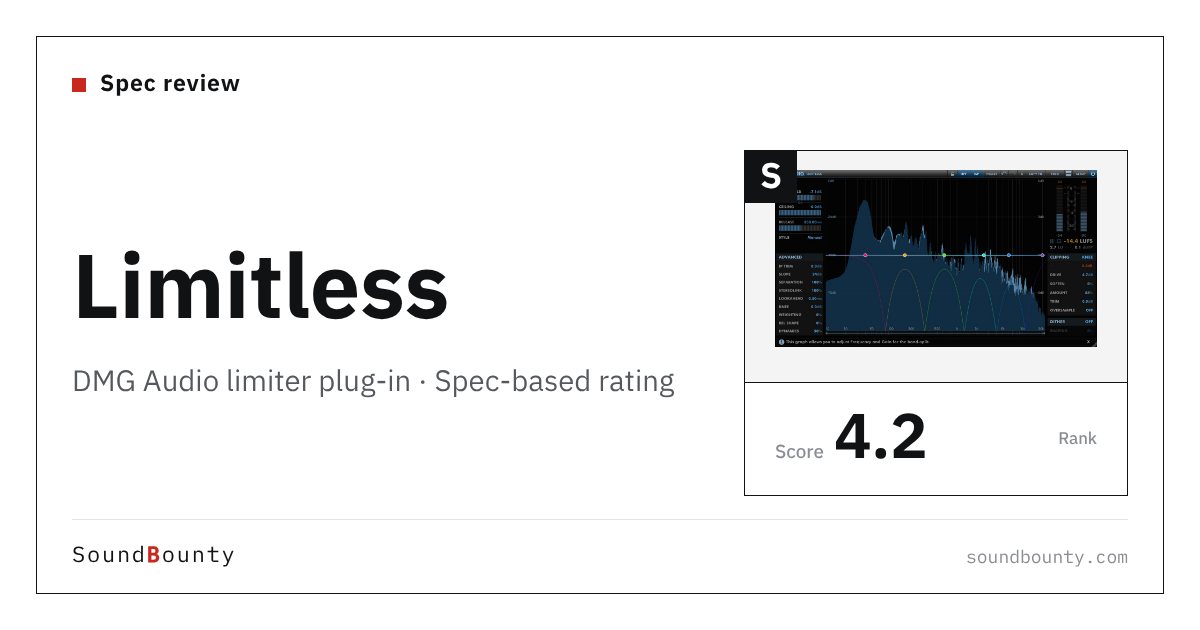
DMG Audio’s Limitless is a limiter for mastering that processes dynamics and transients (the sharp start of a sound) separately, using a six-band linear-phase crossover. It has intersample (true) peak reduction and a loudness meter that follows EBU R128.
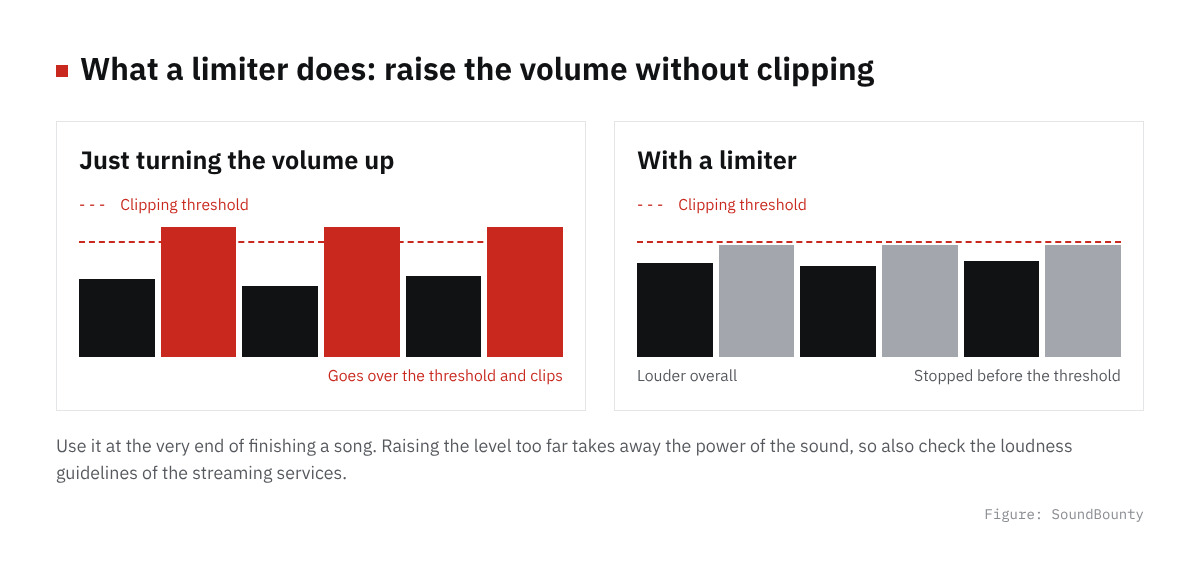
A limiter raises the overall volume of a song while preventing clipping (distortion). You use it at the last stage of finishing a song.
In this article we compare Limitless with 13 limiter plug-ins and rate how well it serves its purpose on three criteria. The basis is official manufacturer information.
Disclosure: This article contains affiliate links. If you buy through them, SoundBounty may earn a commission at no extra cost to you. Prices and sale information are as of the date we checked them and can change.
Score 4.3 / 5 (average of the 13 products compared: 3.4)
- Specs last checked
- 2026/09/25
- Raising volume safely
- TP, LUFS, 64x clipper
- Speed
- Simple, Gain-lock
- Choice of sound character
- Style + loudness weighting
- Price (store, date)
- Not listed
Summary
Among the 13 limiter plug-ins, Limitless is rank S. The ranks run S, A, B and C, and S is the top. Averaging the scores for each criterion (out of 5, with the one criterion that matters most for the purpose counted double) gives 4.3.
Strengths
- Raising volume safely (5 points): it has what you need to prevent clipping and match the volume of streaming services.
- Choice of sound character (4 points): you can choose the character of the sound when raising the volume to suit the song.
Who it suits: people who want to build the finishing volume and texture in fine detail.
Main features of Limitless
A two-stage design that separates dynamics and transients
Limitless is a two-stage limiter that processes dynamics (the flow of volume) and transients (the sharp start of a sound) separately. The manufacturer explains that it uses iterative calculation to build the smoothest possible gain-reduction (the amount the volume is lowered) curve.
A six-band linear-phase crossover
You can process in six bands and also change the slope of the crossover. The release can be adjusted for the whole signal and for each band. A Style menu lets you quickly choose the character of the limiting.
A loudness meter and true-peak protection
It has a loudness meter that follows EBU R128 with a history display, and intersample (true) peak reduction built in. There are also a clipper with 64x oversampling that shaves the tips of the waveform, and dither with noise shaping.
Video: “Limitless Tutorial 1” (official DMGAudio YouTube channel; narration in English) Watch on YouTube
Where it is useful
- Raising the volume for streaming while holding down the true peak
- Using the Simple mode to quickly set a volume for export
- Changing the release for each band to avoid squashing the low end
Rating by criterion
Raising volume safely: 5 / 5
We check whether it has features that prevent clipping and match the loudness standards of streaming services.
It has intersample (true) peak reduction, an EBU R128 loudness meter, and a clipper with 64x oversampling.
Speed: 3 / 5
We check whether it has features that get you to a good setting quickly (automatic settings, easy-to-read meters and so on).
It has a Simple mode that is just “click and export”, and Gain-lock, which keeps the gain fixed while you compare presets (settings prepared in advance). There is no AI automatic setting.
Choice of sound character: 4 / 5
We check whether you can choose the character of the sound when raising the volume (keeping the punch, keeping it transparent and so on).
The Style menu lets you choose the character of the limiting. There is loudness weighting that leans toward the low end or toward how the sound is heard, and a two-stage design that separates dynamics and transients.
How we score (Limiter plug-ins)
| Criterion | Basis | 5 pt | 4 pt | 3 pt | 2 pt | 1 pt |
|---|---|---|---|---|---|---|
| Raising volume safely | Features that prevent clipping and match the loudness standards of streaming services | True-peak limiting, loudness metering and oversampling are all included | Two of those | One of those | — | Not mentioned on the official page |
| Speed | How quickly you can reach a good setting | AI analyzes the song and sets everything automatically | — | Presets, or a function for comparing at matched loudness | Standard controls | — |
| Choice of sound character | The range of ways the limiter can act and shape the sound | Choose from eight or more algorithms | Besides a choice of styles, features that shape loudness feel or attack | A choice of styles | One type | — |
Each criterion is scored from 1 to 5 on how well the product serves one goal: safely finishing a song at a volume suited to streaming. Scores follow the conditions in the table above, and the rank is based on an average in which "Raising volume safely" counts double. The basis is official manufacturer information. Sound quality and CPU load are not measured, so they are not scored; reviews from trade magazines are introduced in the articles for reference. Price is not part of the score. Features that cannot be confirmed from the manufacturer's or a retailer's description are scored as if absent. The "OBS (streaming)" column in the table shows whether the official page lists the VST2 format that the streaming software OBS Studio can use (○). OBS does not support the VST3 format. It is not part of the score.
Limitless system requirements and getting started
| Operating system | Windows / Mac |
|---|---|
| Plug-in formats | Windows: VST, VST3, AAX / Mac: VST, VST3, AU, AAX |
| Trial | Demo version available |
| OBS (streaming) | Works as it is (VST2 is listed) |
Checked on the manufacturer’s official pages on October 17, 2026.
Compared with other limiter plug-ins
Click a heading to sort. On a phone, the table scrolls sideways.
| Product | RankAvg. score | Raising volume safely | Speed | Choice of sound character | OBS (streaming) | Price (store, date) |
|---|---|---|---|---|---|---|
| FabFilterPro-L 2 | S 4.5 | TP, LUFS, 32x | Compare at matched level | 8 algorithms | ○ | $199 [PB, checked Oct 26] |
| soniblesmart:limit | S 4.5 | TP, LUFS, multi-stage | AI auto-setting | Soft/Hard | ○ | $129 [PB, checked Oct 26] |
| soniblepure:limit | A 3.8 | True peak | AI auto-setting | Style + Inflate | ○ | $39 [PB, checked Oct 26] |
| SonnoxOxford Limiter | B 3.0 | True peak | Standard | Enhance + attack | × (VST3 only) | $264 [PB, checked Oct 26] |
| Tokyo Dawn RecordsTDR Limiter 6 GE | S 4.3 | TP, LUFS, processing accuracy | Compare at matched level | 6 modules | ○ | ≈$67.25 [Official, checked Oct 26] |
| IK MultimediaStealth Limiter | B 2.8 | Intersample protection | Standard | 4 modes | × (VST3 only) | $99.99 [PB, checked Oct 26] |
| EventideElevate | B 3.3 | True peak | Compare at matched level | Attack, clipper | ○ | $199 [PB, checked Oct 26] |
| WavesL2 Ultramaximizer | C 1.5 | Look-ahead peak limiting | Auto release | 1 type | △ (via Waves StudioRack) | $34.99 (sale; regular $129) [PB, checked Oct 26] |
| Plugin Alliancebx_limiter True Peak | A 4.0 | TP, LUFS, oversampling | Standard | 2 styles + XL | ○ | Not listed |
| DMG AudioLimitless | S 4.3 | TP, LUFS, 64x clipper | Simple, Gain-lock | Style + loudness weighting | ○ | Not listed |
| VoxengoElephant | A 3.8 | TP, LUFS, oversampling | Standard | Multiple modes | ○ | ≈$110.00 [Official, checked Oct 26] |
| Slate DigitalFG-X 2 | C 2.0 | Not listed | Easy view, auto decision | 4 modes | ○ | $149 [Official, checked Oct 26] |
| WavesL1 Ultramaximizer | C 2.5 | True peak | Auto release | 1 type | △ (via Waves StudioRack) | Not listed |
Features checked on each manufacturer's official website on September 25, 2026. Check the store page behind the buy button for the price.
Read next
- Pro-L 2: features and rating (rank S)
- smart:limit: features and rating (rank S)
- pure:limit: features and rating (rank A)
- Oxford Limiter: features and rating (rank B)

Comments