
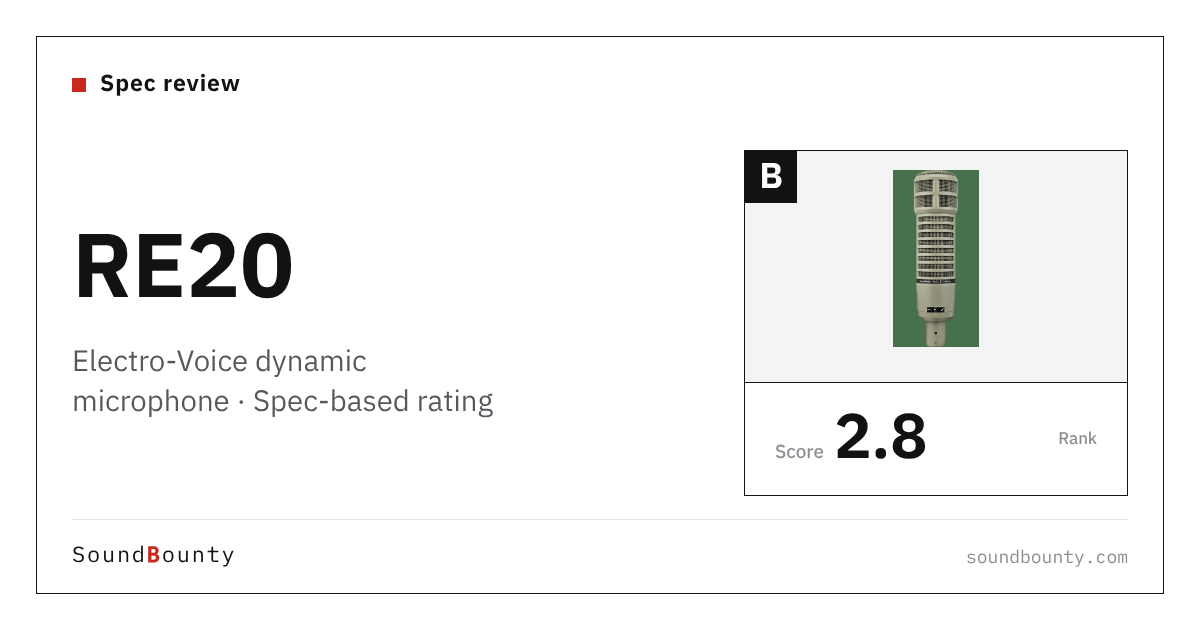
Electro-Voice’s RE20 is a cardioid dynamic microphone with XLR connection.
A dynamic microphone is tough and picks up little surrounding sound. It suits streaming and recording vocals at home in a room whose echo is a problem.
In this article we rate it on 4 criteria using only the specifications the manufacturer publishes, and show how it ranks among the 17 dynamic microphones we compare.
Disclosure: This site takes part in affiliate programs. Specifications are as of the date we checked them and can change.
Score 2.8 / 5 (average of the 17 models compared: 3.5)
- Specs last checked
- 2026/10/19
- Connection
- XLR
- Pickup pattern
- Cardioid
- Sensitivity
- 1.5mV/Pa
- Weight
- Not disclosed
- Price (store, date)
- Not disclosed
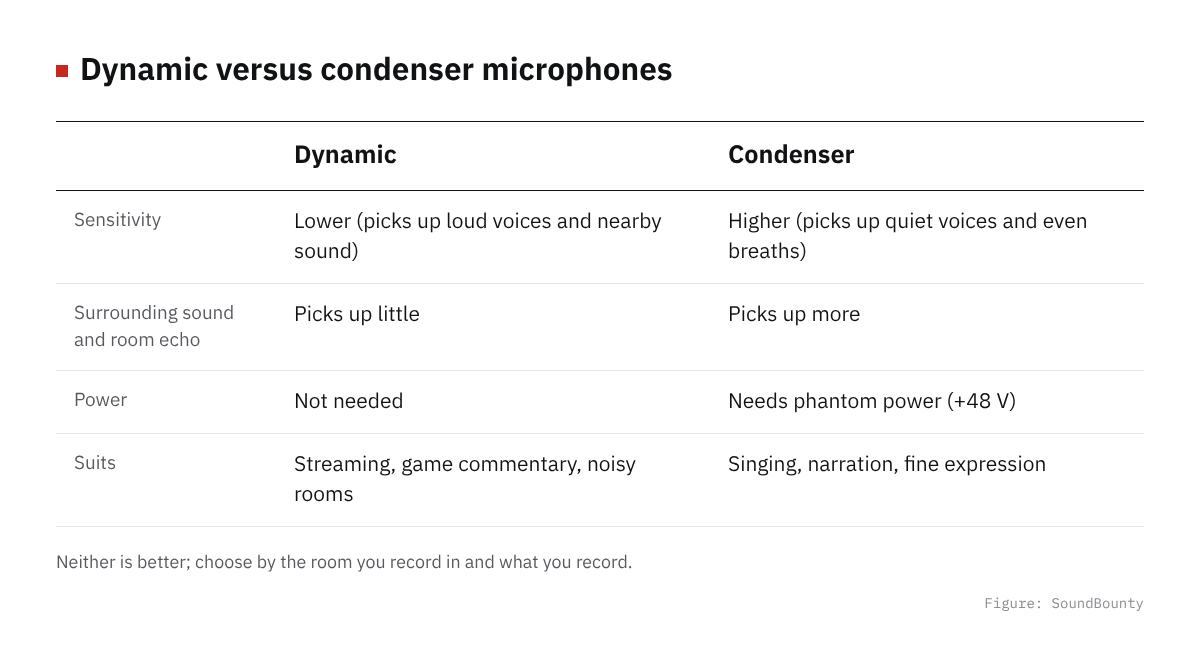
Figure: SoundBounty
Summary
Among the 17 dynamic microphones, RE20 is rank B. The ranks run S, A, B and C, and B is third from the top. Averaging the scores for each criterion (out of 5) gives 2.8.
Strengths
- High-frequency range (18,000 Hz, 4 points): It records the high end of the voice clearly.
Things to keep in mind
- Ease of getting enough gain (1.5 mV/Pa, 2 points): The output level is low, so you need an audio interface with plenty of gain.
- Features (1 of 5, 2 points): The features of the body are simple.
Who it suits: judging from the specifications, it suits people who want to record the high end of the voice solidly.
Main features of RE20
Variable-D design that keeps the tone steady as the distance changes
The manufacturer describes a design that reduces the bass buildup when you move close (the proximity effect). It has a built-in blast and wind filter, and a coil that cancels hum.
Basic specifications
The frequency response is 45 to 18,000 Hz, the sensitivity is 1.5 mV/Pa and the pickup pattern is cardioid. It has a switch that changes the tilt of the low end.
Video: “Demo of Electro-Voice RE Broadcast Mics: RE20, RE320, RE27ND, and RE20 Black” (official Electro-Voice Official YouTube channel; narration in English) Watch on YouTube
Where it is useful
- Keeping the tone steady as the distance changes, in narration or streaming
Rating by criterion
Ease of getting enough gain: 2 / 5
Whether you can get a good level without turning the gain knob of the audio interface up too far. USB models raise the level inside the microphone and get full marks.
RE20: 1.5 mV/Pa. That is a modest rating among the products we compared. The output level is low, so you need an audio interface with plenty of gain.
High-frequency range: 4 / 5
How high a sound it can record (the upper limit of the frequency response).
RE20: 18,000 Hz. That is a high rating among the products we compared. It records the high end of the voice clearly.
Rejection of surrounding sound: 3 / 5
How little it picks up sound from outside the front of the microphone (everyday noise and room echo), decided by the pickup pattern.
RE20: Cardioid. That is a standard rating among the products we compared.
Features: 2 / 5
How many features of the body it has, such as USB and XLR connections, a low-cut and a headphone jack.
RE20: 1 of 5. That is a modest rating among the products we compared. The features of the body are simple.
The gray marks in the figure below (the dotted line on the pentagon) show the average of the 17 products we compared. Price is not part of the score.
How we score (Dynamic microphones)
| Criterion | Basis | 5 pt | 4 pt | 3 pt | 2 pt | 1 pt |
|---|---|---|---|---|---|---|
| Ease of getting enough gain | Sensitivity at the XLR output (USB models have a built-in preamp and get full marks) | ≥2.5 | ≥2 | ≥1.6 | ≥1.3 | <1.3 |
| High-frequency range | Upper limit of the frequency response | ≥20000 | ≥18000 | ≥16000 | ≥15000 | <15000 |
| Rejection of surrounding sound | Pickup pattern | Supercardioid / hypercardioid | — | Cardioid (unidirectional) | — | — |
| Features | USB, XLR, low-cut, presence, headphone jack | 4 to 5 | 3 | 2 | 1 | None |
Scored only on the body specifications published by the manufacturer. Price and accessories are not part of the score. "Ease of getting enough gain" answers the common question "do I need a preamp (booster)?". Over XLR, the higher the sensitivity (mV/Pa), the less you need to turn up the gain on the audio interface. Models that can also connect by USB have a preamp inside the microphone, so there is no worry about running short of gain and they get 5 points. Rejection of surrounding sound is decided by the pickup pattern: supercardioid and hypercardioid, which pick up little from outside the front, score highest. Weight is shown in the table for reference.
RE20 connection and getting started
| Connection | XLR |
|---|---|
| Power | Phantom power is not needed, according to the official page (dynamic type) |
Checked on the manufacturer’s official pages on October 17, 2026.
Compared with other dynamic microphones
Click a heading to sort. On a phone, the table scrolls sideways.
| Product | RankAvg. score | Connection | Pickup pattern | SensitivitymV/Pa | Upper limitHz | Weightg | Price (store, date) |
|---|---|---|---|---|---|---|---|
| ShureSM58 | C 2.5 | XLR | Cardioid | 1.6 | 15,000 | 330 | Not disclosed |
| ShureSM7B | B 3.3 | XLR | Cardioid | 1.12 | 20,000 | 764 | Not disclosed |
| ShureBETA 58A | A 3.8 | XLR | Supercardioid | 2.6 | 16,000 | 278 | Not disclosed |
| RØDEPodMic | C 2.3 | XLR | Cardioid | 1.4 | 15,000 | Not disclosed | Not disclosed |
| RØDEPodMic USB | S 4.3 | USB / XLR | Cardioid | 1.4 | 20,000 | 900 | Not disclosed |
| RØDEProcaster | B 3.0 | XLR | Cardioid | 1.6 | 18,000 | Not disclosed | Not disclosed |
| Audio-TechnicaAT2040 | A 3.5 | XLR | Hypercardioid | 2.2 | 16,000 | 615 | Not disclosed |
| Audio-TechnicaAT2040USB | S 4.3 | USB | Hypercardioid | Not disclosed | 16,000 | 600 | Not disclosed |
| Audio-TechnicaATR2100x-USB | A 3.5 | USB / XLR | Cardioid | Not disclosed | 15,000 | 268 | Not disclosed |
| Sennheisere 835 | B 3.3 | XLR | Cardioid | 2.7 | 16,000 | 330 | Not disclosed |
| Sennheisere 945 | A 3.8 | XLR | Supercardioid | 2 | 18,000 | 366 | Not disclosed |
| ShureMV7+ | A 4.0 | USB / XLR | Cardioid | Not disclosed | 16,000 | 574 | Not disclosed |
| ShureSM57 | C 2.5 | XLR | Cardioid | 1.6 | 15,000 | 284 | Not disclosed |
| ShureSM7dB | S 4.3 | XLR | Cardioid | 28.2 | 20,000 | 837 | Not disclosed |
| Electro-VoiceRE20 | B 2.8 | XLR | Cardioid | 1.5 | 18,000 | Not disclosed | Not disclosed |
| SamsonQ2U | A 3.5 | USB / XLR | Cardioid | 2 | 15,000 | 320 | Not disclosed |
| SamsonQ9U | S 4.5 | USB / XLR | Cardioid | 1.4 | 20,000 | 970 | Not disclosed |
Specifications are the manufacturer's published values (checked October 19, 2026). The official pages for the RODE PodMic and Procaster do not state a weight (weight is not part of the score).
Before you buy
- It connects by XLR. You need an audio interface or mixer. It is a dynamic microphone, so it does not need phantom power (+48 V).
- Its sensitivity is low, at 1.5 mV/Pa. You need to turn the gain of the audio interface up a lot. Choose an interface with plenty of gain, or use a microphone booster (a device that lifts the signal) to be safe.
Read next
- SM7B: features and rating (rank B)
- e 835: features and rating (rank B)
- SM7dB: features and rating (rank S)
- BETA 58A: features and rating (rank A)

Comments