
Shure’s SM57 is a cardioid dynamic microphone with XLR connection.
A dynamic microphone is tough and picks up little surrounding sound. It suits streaming and recording vocals at home in a room whose echo is a problem.
In this article we rate it on 4 criteria using only the specifications the manufacturer publishes, and show how it ranks among the 17 dynamic microphones we compare.
Disclosure: This site takes part in affiliate programs. Specifications are as of the date we checked them and can change.
Score 2.5 / 5 (average of the 17 models compared: 3.5)
- Specs last checked
- 2026/10/19
- Connection
- XLR
- Pickup pattern
- Cardioid
- Sensitivity
- 1.6mV/Pa
- Weight
- 284g
- Price (store, date)
- Not disclosed
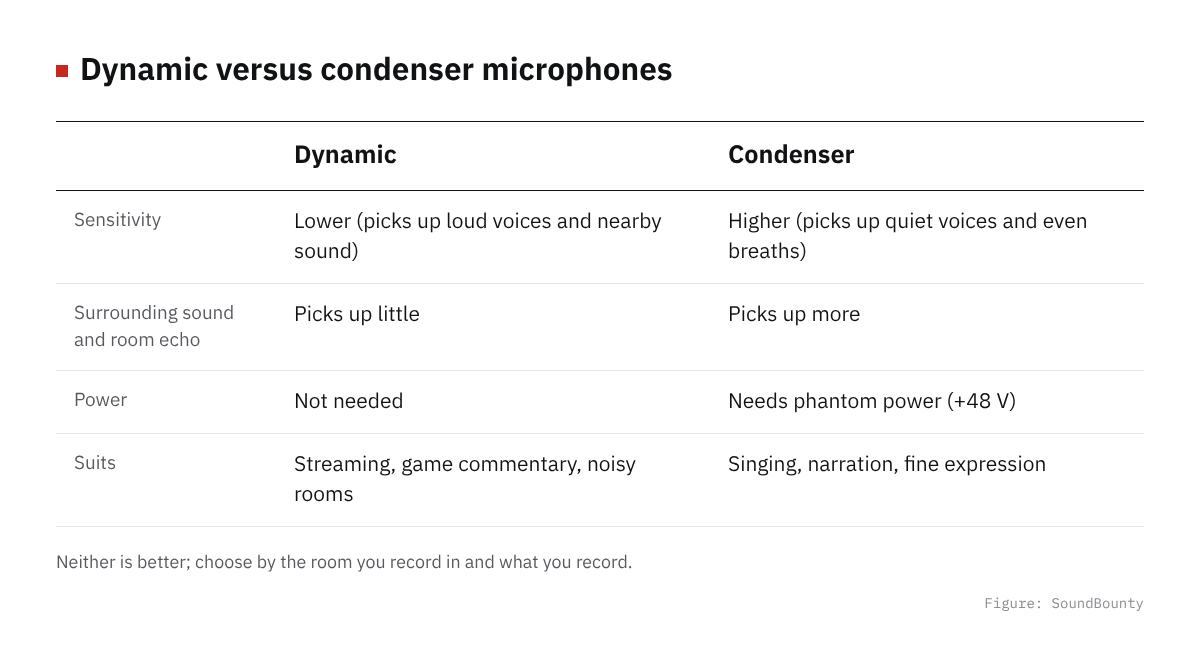
Figure: SoundBounty
Summary
Among the 17 dynamic microphones, SM57 is rank C. The ranks run S, A, B and C, and C is the lowest. Averaging the scores for each criterion (out of 5) gives 2.5.
Things to keep in mind
- High-frequency range (15,000 Hz, 2 points): The range of high sounds it records is somewhat narrow.
- Features (1 of 5, 2 points): The features of the body are simple.
Main features of SM57
A standard for recording instruments and voices up close
Shure describes it as a dynamic microphone for picking up instruments and for vocals. It is said to have a bright, clear sound, designed to lift the mid and high range. Scores are given on the same criteria as the other products in the same genre. You can see the comparison on the genre’s comparison page.
Cardioid and basic specifications
The pickup pattern is cardioid, the frequency response is 40 to 15,000 Hz, the sensitivity is 1.6 mV/Pa and the weight is 0.284 kg.
Where it is useful
- Recording instruments such as guitar amps and snare drums
- Recording singing or narration while keeping the room echo down
Rating by criterion
Ease of getting enough gain: 3 / 5
Whether you can get a good level without turning the gain knob of the audio interface up too far. USB models raise the level inside the microphone and get full marks.
SM57: 1.6 mV/Pa. That is a standard rating among the products we compared.
High-frequency range: 2 / 5
How high a sound it can record (the upper limit of the frequency response).
SM57: 15,000 Hz. That is a modest rating among the products we compared. The range of high sounds it records is somewhat narrow.
Rejection of surrounding sound: 3 / 5
How little it picks up sound from outside the front of the microphone (everyday noise and room echo), decided by the pickup pattern.
SM57: Cardioid. That is a standard rating among the products we compared.
Features: 2 / 5
How many features of the body it has, such as USB and XLR connections, a low-cut and a headphone jack.
SM57: 1 of 5. That is a modest rating among the products we compared. The features of the body are simple.
The gray marks in the figure below (the dotted line on the pentagon) show the average of the 17 products we compared. Price is not part of the score.
How we score (Dynamic microphones)
| Criterion | Basis | 5 pt | 4 pt | 3 pt | 2 pt | 1 pt |
|---|---|---|---|---|---|---|
| Ease of getting enough gain | Sensitivity at the XLR output (USB models have a built-in preamp and get full marks) | ≥2.5 | ≥2 | ≥1.6 | ≥1.3 | <1.3 |
| High-frequency range | Upper limit of the frequency response | ≥20000 | ≥18000 | ≥16000 | ≥15000 | <15000 |
| Rejection of surrounding sound | Pickup pattern | Supercardioid / hypercardioid | — | Cardioid (unidirectional) | — | — |
| Features | USB, XLR, low-cut, presence, headphone jack | 4 to 5 | 3 | 2 | 1 | None |
Scored only on the body specifications published by the manufacturer. Price and accessories are not part of the score. "Ease of getting enough gain" answers the common question "do I need a preamp (booster)?". Over XLR, the higher the sensitivity (mV/Pa), the less you need to turn up the gain on the audio interface. Models that can also connect by USB have a preamp inside the microphone, so there is no worry about running short of gain and they get 5 points. Rejection of surrounding sound is decided by the pickup pattern: supercardioid and hypercardioid, which pick up little from outside the front, score highest. Weight is shown in the table for reference.
SM57 connection and getting started
| Connection | XLR (3-pin) |
|---|---|
| Power | Phantom power is not needed |
Checked on the manufacturer’s official pages on October 17, 2026.
Compared with other dynamic microphones
Click a heading to sort. On a phone, the table scrolls sideways.
| Product | RankAvg. score | Connection | Pickup pattern | SensitivitymV/Pa | Upper limitHz | Weightg | Price (store, date) |
|---|---|---|---|---|---|---|---|
| ShureSM58 | C 2.5 | XLR | Cardioid | 1.6 | 15,000 | 330 | Not disclosed |
| ShureSM7B | B 3.3 | XLR | Cardioid | 1.12 | 20,000 | 764 | Not disclosed |
| ShureBETA 58A | A 3.8 | XLR | Supercardioid | 2.6 | 16,000 | 278 | Not disclosed |
| RØDEPodMic | C 2.3 | XLR | Cardioid | 1.4 | 15,000 | Not disclosed | Not disclosed |
| RØDEPodMic USB | S 4.3 | USB / XLR | Cardioid | 1.4 | 20,000 | 900 | Not disclosed |
| RØDEProcaster | B 3.0 | XLR | Cardioid | 1.6 | 18,000 | Not disclosed | Not disclosed |
| Audio-TechnicaAT2040 | A 3.5 | XLR | Hypercardioid | 2.2 | 16,000 | 615 | Not disclosed |
| Audio-TechnicaAT2040USB | S 4.3 | USB | Hypercardioid | Not disclosed | 16,000 | 600 | Not disclosed |
| Audio-TechnicaATR2100x-USB | A 3.5 | USB / XLR | Cardioid | Not disclosed | 15,000 | 268 | Not disclosed |
| Sennheisere 835 | B 3.3 | XLR | Cardioid | 2.7 | 16,000 | 330 | Not disclosed |
| Sennheisere 945 | A 3.8 | XLR | Supercardioid | 2 | 18,000 | 366 | Not disclosed |
| ShureMV7+ | A 4.0 | USB / XLR | Cardioid | Not disclosed | 16,000 | 574 | Not disclosed |
| ShureSM57 | C 2.5 | XLR | Cardioid | 1.6 | 15,000 | 284 | Not disclosed |
| ShureSM7dB | S 4.3 | XLR | Cardioid | 28.2 | 20,000 | 837 | Not disclosed |
| Electro-VoiceRE20 | B 2.8 | XLR | Cardioid | 1.5 | 18,000 | Not disclosed | Not disclosed |
| SamsonQ2U | A 3.5 | USB / XLR | Cardioid | 2 | 15,000 | 320 | Not disclosed |
| SamsonQ9U | S 4.5 | USB / XLR | Cardioid | 1.4 | 20,000 | 970 | Not disclosed |
Specifications are the manufacturer's published values (checked October 19, 2026). The official pages for the RODE PodMic and Procaster do not state a weight (weight is not part of the score).
Before you buy
- It connects by XLR. You need an audio interface or mixer. It is a dynamic microphone, so it does not need phantom power (+48 V).
Read next
- SM58: features and rating (rank C)
- SM7dB: features and rating (rank S)
- BETA 58A: features and rating (rank A)
- e 945: features and rating (rank A)

Comments