
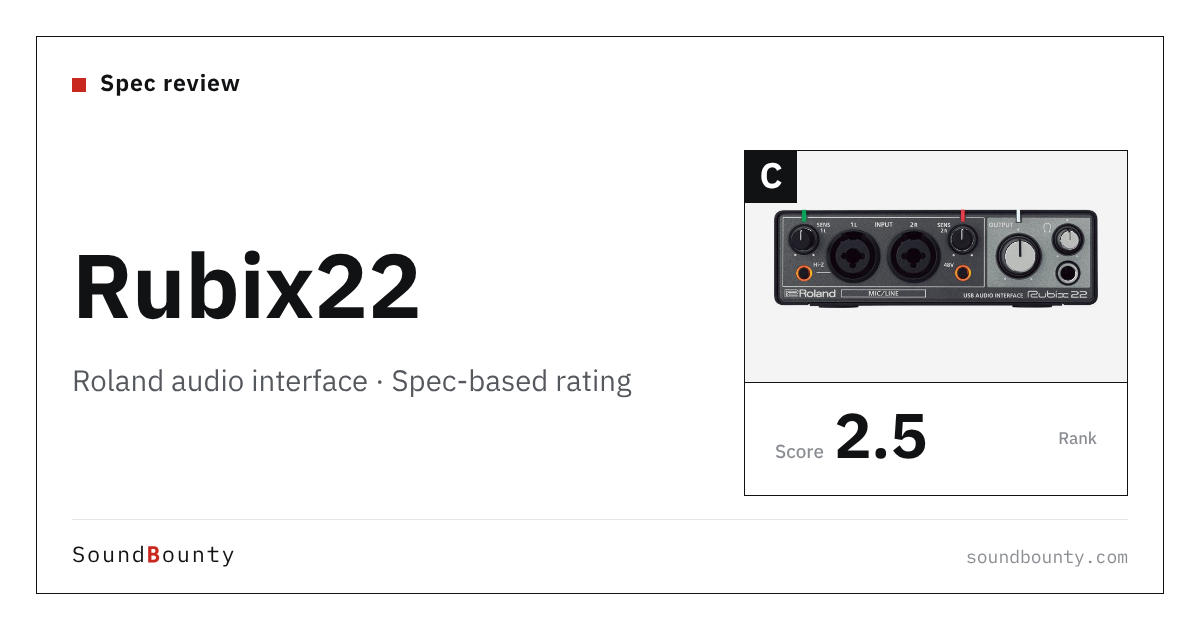
Roland’s Rubix22 is a USB audio interface with 2 inputs and 2 outputs.
An audio interface is the equipment that brings the sound of microphones and instruments into the computer and sends the computer’s sound out to headphones and speakers.
In this article we rate it on 5 criteria using only the specifications the manufacturer publishes, and show how it ranks among the 23 audio interfaces we compare.
Disclosure: This site takes part in affiliate programs. Specifications are as of the date we checked them and can change.
Score 2.5 / 5 (average of the 23 models compared: 3.4)
- Specs last checked
- 2026/10/19
- Inputs
- 2ch
- Hi-Z inputs
- 1
- Loopback
- —
- EIN
- Not disclosed
- Price (store, date)
- Not disclosed
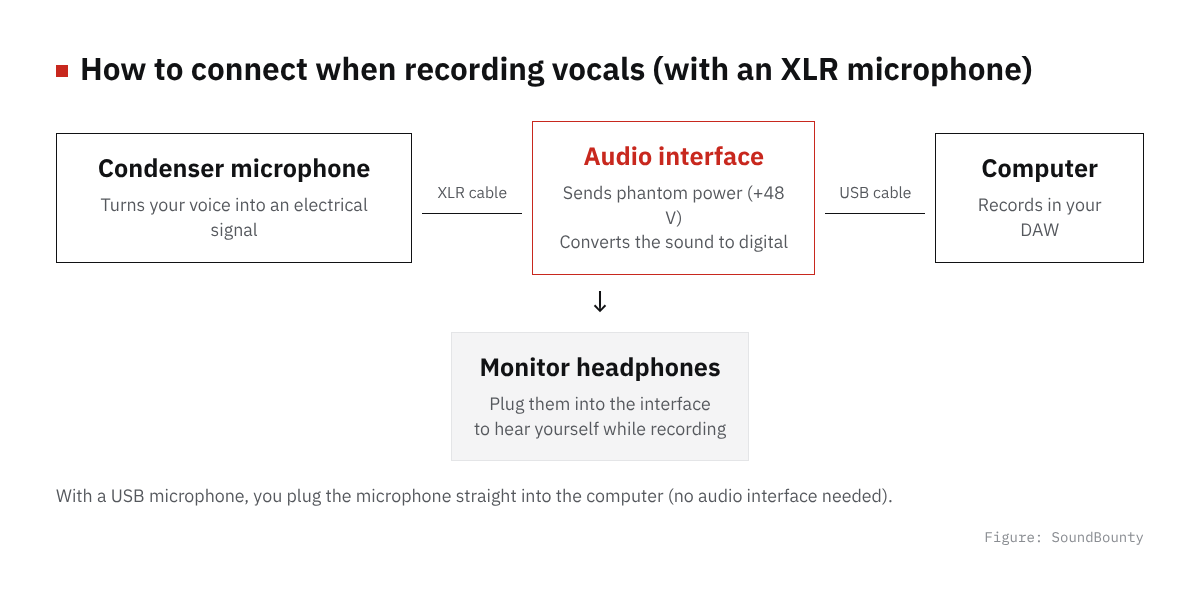
Figure: SoundBounty
Summary
Among the 23 audio interfaces, Rubix22 is rank C. The ranks run S, A, B and C, and C is the lowest. Averaging the scores for each criterion (out of 5) gives 2.5.
Things to keep in mind
- Ease of streaming (loopback: no, 1 point): It has no function (loopback) to combine the computer’s sound and your voice.
Microphone input quality is not scored because the manufacturer does not publish the number.
Main features of Rubix22
Two low-noise microphone preamps
Roland says it has two low-noise, high-definition microphone preamps. In the specifications, the dynamic range of the A/D section is 104 dB (typ.). The EIN and the gain range (dB) are not on the specifications page.
Hi-Z input and MIDI in and out
Input 1 has a Hi-Z switch for connecting a guitar and the like. It also has MIDI in and out.
Metal body and 192 kHz support
It has a sturdy metal build and supports up to 24-bit/192 kHz. It also has a ground lift as a measure against noise.
Where it is useful
- Recording vocals and guitar at home
- Carrying it around with a laptop or an iPad
Rating by criterion
Microphone input quality: not scored
How quietly and how loudly enough it can record a microphone (low noise, gain range and so on).
The manufacturer does not publish this number for the Rubix22, so it is not scored.
Ease of streaming: 1 / 5
Whether it has a function (loopback) that lets you stream the computer’s sound (BGM and game sound) together with a microphone voice.
Rubix22: loopback: no. That is a modest rating among the products we compared. It has no function (loopback) to combine the computer’s sound and your voice.
Ease of recording guitar and other instruments: 3 / 5
The number of inputs (Hi-Z) that take a guitar or bass directly.
Rubix22: 1 Hi-Z input. That is a standard rating among the products we compared.
Number of inputs and outputs: 3 / 5
The number of inputs for microphones and instruments, and outputs for speakers and the like.
Rubix22: 4 analog inputs and outputs. That is a standard rating among the products we compared.
Features for production: 3 / 5
Features for production such as MIDI ports, built-in effect processing (DSP) and digital I/O.
Rubix22: 1 of 3. That is a standard rating among the products we compared.
The gray marks in the figure below (the dotted line on the pentagon) show the average of the 23 products we compared. Price is not part of the score.
How we score (Audio interfaces)
| Criterion | Basis | 5 pt | 4 pt | 3 pt | 2 pt | 1 pt |
|---|---|---|---|---|---|---|
| Microphone input quality | Quietness (EIN), gain range and dynamic range | Average 4.5 or more | 3.5 or more | 2.5 or more | 1.5 or more | Under 1.5 |
| Ease of streaming | Loopback (send the computer's sound together with the microphone for streaming or recording) | Yes | — | — | — | No |
| Ease of recording guitar and other instruments | Number of inputs that take a guitar or bass directly (Hi-Z) | 3 or more | 2 | 1 | — | None |
| Number of inputs and outputs | Analog inputs plus outputs (headphones excluded) | ≥8 | ≥6 | ≥4 | ≥3 | <3 |
| Features for production | Built-in DSP, MIDI ports and digital I/O | All 3 | 2 | 1 | — | None |
Scored only on the body specifications published by the manufacturer and the functions listed on the product page. Price and bundled software are not part of the score. "Microphone input quality" is the average of three scores: quietness (EIN: 5 points at -130 dBu or lower, 4 at -129, 3 at -128, 2 at -127), gain range (5 at 72 dB or more, 4 at 65, 3 at 57, 2 at 54) and dynamic range (5 at 118 dB or more, 4 at 116, 3 at 112, 2 at 108). It is scored when two or more numbers are published. "Ease of streaming" depends on whether the interface has loopback, which sends the BGM or game sound playing on the computer to the streaming software together with your voice.
Rubix22 connection and getting started
| Connection | USB to the computer. It also supports iPad |
|---|---|
| Power | USB bus power (see the power entry on the specifications page) |
| In the box | The official page says 6 months of Roland Cloud Pro is included |
Checked on the manufacturer’s official pages on October 17, 2026.
Compared with other audio interfaces
Click a heading to sort. On a phone, the table scrolls sideways.
| Product | RankAvg. score | EINdBu | Max gaindB | Dynamic rangedB(A) | Inputsch | Hi-Z inputs | Outputsch | Loopback | DSP | MIDI | Digital I/O | Price (store, date) |
|---|---|---|---|---|---|---|---|---|---|---|---|---|
| FocusriteScarlett Solo 4th | B 3.0 | -127 | 57 | 113 | 2 | 1 | 2 | ● | — | — | — | Not disclosed |
| FocusriteScarlett 2i2 4th | B 3.2 | -127 | 69 | 116 | 2 | 2 | 2 | ● | — | — | — | Not disclosed |
| FocusriteScarlett 4i4 4th | A 4.0 | -127 | 69 | 116 | 4 | 2 | 4 | ● | — | ● | — | Not disclosed |
| Universal AudioVolt 1 | C 2.2 | -127 | 55 | 112 | 1 | 1 | 2 | — | — | ● | — | Not disclosed |
| Universal AudioVolt 2 | B 2.6 | -127 | 55 | 112 | 2 | 2 | 2 | — | — | ● | — | Not disclosed |
| ArturiaMiniFuse 1 | B 2.8 | -129 | 56 | 110 | 1 | 1 | 2 | ● | — | — | — | Not disclosed |
| ArturiaMiniFuse 2 | A 3.6 | -129 | 56 | 110 | 2 | 2 | 2 | ● | — | ● | — | Not disclosed |
| ArturiaMiniFuse 4 | S 4.2 | -129 | 56 | 110 | 4 | 4 | 4 | ● | — | ● | — | Not disclosed |
| PreSonusStudio 24c | C 2.4 | -126 | 50 | 106 | 2 | 2 | 2 | — | — | ● | — | Not disclosed |
| RMEBabyface Pro FS | S 4.8 | Not disclosed | 76 | 117 | 4 | 2 | 4 | ● | ● | ● | ● | Not disclosed |
| MOTUM2 | A 3.8 | -129 | Not disclosed | 115 | 2 | 2 | 2 | ● | — | ● | — | Not disclosed |
| MOTUM4 | S 4.2 | -129 | Not disclosed | 115 | 4 | 2 | 4 | ● | — | ● | — | Not disclosed |
| AudientiD4 MKII | A 3.6 | -129 | 58 | Not disclosed | 2 | 1 | 2 | ● | ● | — | — | Not disclosed |
| AudientiD14 MKII | A 4.0 | -129 | 58 | Not disclosed | 2 | 1 | 4 | ● | ● | — | ● | Not disclosed |
| Solid State LogicSSL 2 MKII | A 3.4 | -130.5 | 64 | 116.5 | 2 | 2 | 2 | ● | — | — | — | Not disclosed |
| Solid State LogicSSL 2+ MKII | A 4.0 | -130.5 | 64 | 116.5 | 2 | 2 | 4 | ● | — | ● | — | Not disclosed |
| Universal AudioVolt 176 | C 2.2 | -127 | 55 | 112 | 1 | 1 | 2 | — | — | ● | — | Not disclosed |
| Universal AudioVolt 276 | B 2.6 | -127 | 55 | 112 | 2 | 2 | 2 | — | — | ● | — | Not disclosed |
| AudientEVO 4 | B 3.2 | -128 | 58 | 113 | 2 | 2 | 2 | ● | — | — | — | Not disclosed |
| TASCAMUS-2x2HR | A 3.6 | -128 | 56 | Not disclosed | 2 | 2 | 2 | ● | — | ● | — | Not disclosed |
| FocusriteClarett+ 2Pre | A 3.4 | -129 | 57 | 118 | 2 | 2 | 4 | — | — | ● | ● | Not disclosed |
| RolandRubix22 | C 2.5 | Not disclosed | Not disclosed | 104 | 2 | 1 | 2 | — | — | ● | — | Not disclosed |
| MOTUM6 | S 4.4 | -129 | Not disclosed | 115 | 6 | 4 | 4 | ● | — | ● | — | Not disclosed |
Specifications are the manufacturer's published values for the microphone input (checked October 19, 2026). The RME Babyface Pro FS does not publish EIN, the Audient iD4 MKII and iD14 MKII do not publish dynamic range, and the MOTU M2 and M4 do not publish the gain range, so "Microphone input quality" for them is scored on the remaining numbers. The number of Hi-Z inputs counts inputs that take a guitar or bass directly (including combo jacks shared with microphone and line). The Babyface Pro FS dynamic range is the microphone-input signal-to-noise ratio in the manual (117 dBA).
Before you buy
- It has no loopback. To combine the computer’s sound and your voice for streaming, you need to set it up in the streaming software.
- It has 2 inputs in total for microphones and instruments. Check that the number you want to record at the same time does not exceed the number of inputs.
- It has 1 Hi-Z input that take a guitar or bass directly. When you record without effects pedals or an amplifier, you plug into a Hi-Z input.
- It has MIDI ports. You can connect keyboards and gear that have MIDI jacks directly.
Read next
- Studio 24c: features and rating (rank C)
- Babyface Pro FS: features and rating (rank S)
- M6: features and rating (rank S)
- M4: features and rating (rank S)

Comments