
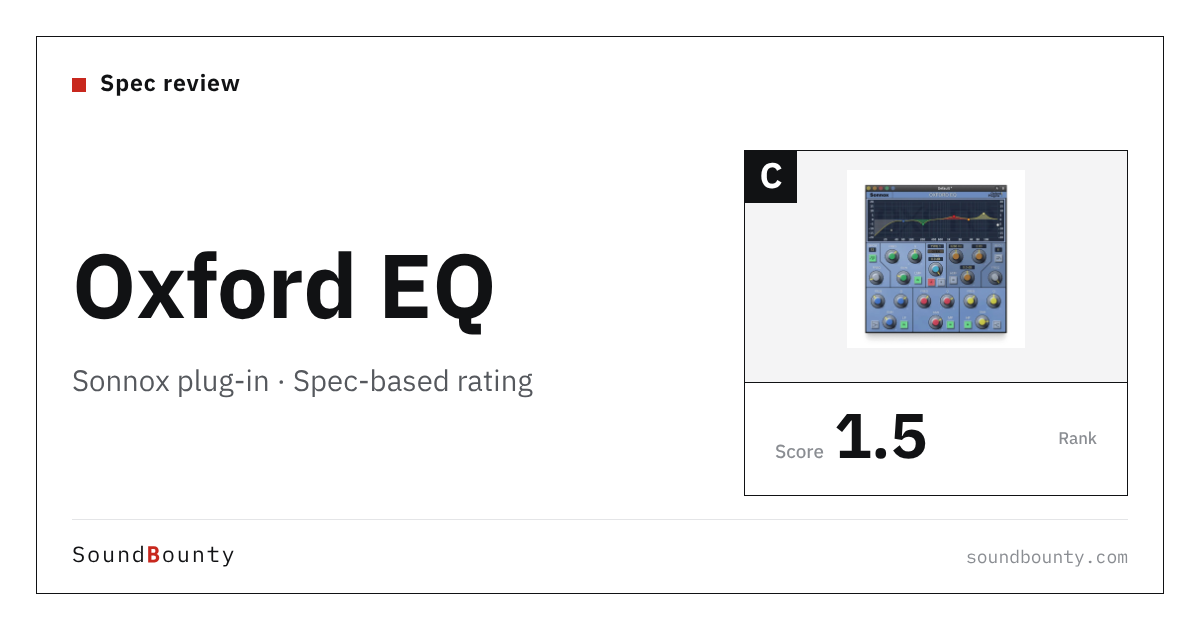
Sonnox’s Oxford EQ is a five-band parametric EQ based on a famous mixing console. You can switch between four types and use it for both correction and sound shaping.
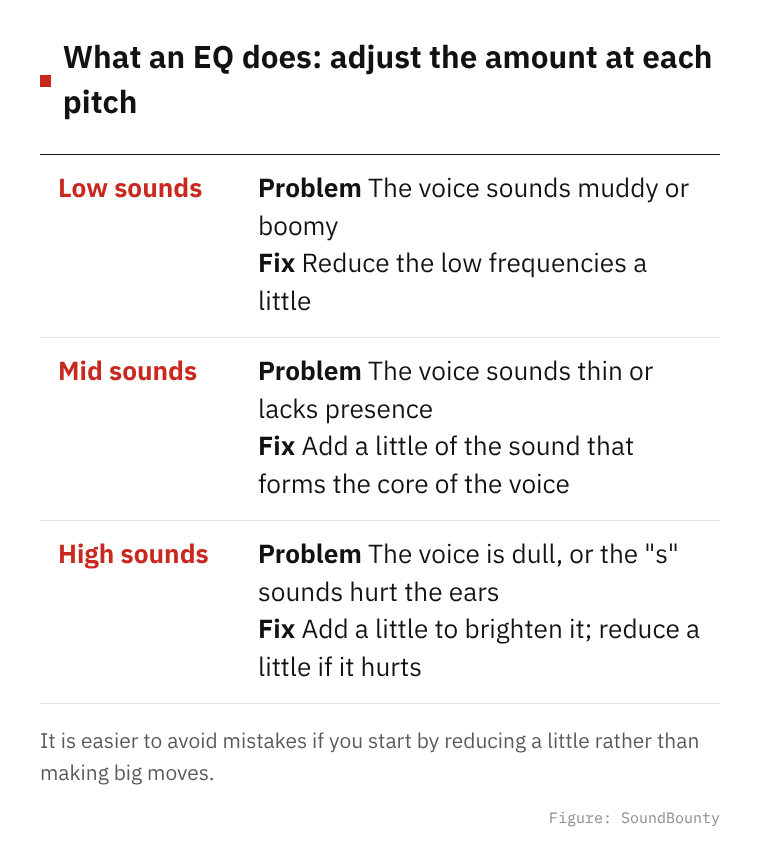
An EQ (equalizer) adjusts the amount of low and high frequencies in a sound. You use it to clear up a muddy voice or reduce sounds that hurt the ears.
In this article we compare Oxford EQ with 15 EQ plug-ins and rate how well it serves its purpose on three criteria. The basis is official manufacturer information.
Disclosure: This article contains affiliate links. If you buy through them, SoundBounty may earn a commission at no extra cost to you. Prices and sale information are as of the date we checked them and can change.
Score 1.5 / 5 (average of the 15 products compared: 3.1)
- Specs last checked
- 2026/09/25
- Handling problem bands
- 5 bands
- Speed
- Not listed
- Stereo processing
- Not listed
- Price (store, date)
- $279.99 [Official, checked Oct 26]
Summary
Among the 15 EQ plug-ins, Oxford EQ is rank C. The ranks run S, A, B and C, and C is the lowest. Averaging the scores for each criterion (out of 5, with the one criterion that matters most for the purpose counted double) gives 1.5.
Things to keep in mind
- Handling problem bands (2 points): it has no function that reduces problem sounds automatically; it centers on basic tone adjustment.
- Speed (1 points): you have to decide the settings by ear.
- Stereo processing (1 points): it has no function for adjusting the center and the sides separately.
Who it suits: people who want a natural, refined-sounding EQ for vocals and the whole mix.
Main features of Oxford EQ
Four types to choose from by use
Oxford EQ has four types in the same five-band EQ. The manufacturer explains them this way: Type 1 is an easy-to-use, natural “everyday” type; Type 2 has a lopsided (asymmetric) boost-and-cut shape suited to fixing resonances, a “correction” type; Type 3 has the soft curves of the EQ of a famous console and suits sound shaping, a “shaping” type; and Type 4 has gentle curves for mastering, a “finishing” type.
For shaping vocals and instruments
The manufacturer explains that Type 3 suits shaping vocals, instruments and the whole mix. For cover songs, you could try its gentle curves when you want to bring out a little presence in a vocal or lightly clear up muddiness.
Keeps its clarity even with large corrections
Following the lineage of the OXF-R3 console used in studios around the world, it lists low noise and a sound that does not get cloudy as its features. It is built to keep a natural sound even when you boost or cut a lot.
Up to two computers with one license
One purchase can be authorized on up to two computers (an iLok account is required, but a dongle is not mandatory). You can first try how it runs in your own environment with the free trial.
Where it is useful
- Softly adding presence to a cover vocal with Type 3
- Targeting and reducing a drum resonance with Type 2
- Applying a very light finishing EQ to the whole mix with Type 4
Rating by criterion
Handling problem bands: 2 / 5
We check whether you can target and fix only the sounds that bother you, such as boominess or harshness.
It is a static EQ, a five-band parametric EQ (with filters) in which you choose from four types.
If “handling problem bands” matters most to you, Pro-Q 4 (5 points) is a better fit.
Speed: 1 / 5
We check whether it has features that get you to a good setting quickly, such as automatic settings and a function that matches a reference sound.
You have to decide the settings by ear.
If “speed” matters most to you, smart:EQ 4 (5 points) is a better fit.
Stereo processing: 1 / 5
We check whether you can adjust the center sound (such as the vocal) and the sound spread to the sides separately.
It has no function for adjusting the center and the sides separately.
If “stereo processing” matters most to you, MAutoEqualizer and EQuilibrium (5 points) are a better fit.
How we score (EQ plug-ins)
| Criterion | Basis | 5 pt | 4 pt | 3 pt | 2 pt | 1 pt |
|---|---|---|---|---|---|---|
| Handling problem bands | The power to target and reduce boomy or harsh sounds | Dynamic EQ, plus processing that reacts only to specific frequencies inside a band | Dynamic EQ (works only when the sound gets loud), or separate processing of the attack and the sustained sound | A static EQ with many bands, or with a choice of processing quality such as linear phase | A static EQ with few bands | — |
| Speed | Features that help you decide settings quickly | AI balances the sound automatically and can also reduce overlap between tracks | Automatic EQ settings or EQ match, plus other aids | One aid, such as EQ match | Analyzer (a visual display of the sound) only | No aids listed |
| Stereo processing | Whether the center and the sides can be processed separately | Supports M/S, separate left/right and surround | Supports M/S plus either separate left/right or surround | M/S only | — | Not mentioned on the official page |
Each criterion is scored from 1 to 5 on how well the product serves one goal: balancing the sound of vocals and backing tracks in a mix. Scores follow the conditions in the table above, and the rank is based on an average in which "Handling problem bands" counts double. The basis is official manufacturer information. Sound quality and CPU load are not measured, so they are not scored; reviews from trade magazines are introduced in the articles for reference. Price is not part of the score. Features that cannot be confirmed from the manufacturer's or a retailer's description are scored as if absent. The "OBS (streaming)" column in the table shows whether the official page lists the VST2 format that the streaming software OBS Studio can use (○). OBS does not support the VST3 format. It is not part of the score.
Oxford EQ system requirements and getting started
| Operating system | Windows 10 (64-bit) or later / Mac (macOS 10.13 or later) |
|---|---|
| Plug-in formats | AU, VST3, AAX Native, AAX DSP |
| Other | Activated with an iLok account (choose local, iLok dongle or iLok Cloud) |
| Trial | Free trial available |
| OBS (streaming) | Does not work as it is (VST3 only). It can be loaded through a bridge plug-in |
Checked on the manufacturer’s official pages on October 17, 2026. How to use plug-ins in the OBS streaming software is explained in How to use VST3 plug-ins in OBS.
Compared with other EQ plug-ins
Click a heading to sort. On a phone, the table scrolls sideways.
| Product | RankAvg. score | Handling problem bands | Speed | Stereo processing | Free | OBS (streaming) | Price (store, date) |
|---|---|---|---|---|---|---|---|
| FabFilterPro-Q 4 | S 4.5 | Dynamic + spectral | EQ match + aids | M/S + surround | — | ○ | $199 [PB, checked Oct 26] |
| soniblesmart:EQ 4 | A 4.0 | Dynamic | AI auto-correction | M/S | — | ○ | $129 [PB, checked Oct 26] |
| MeldaProductionMEqualizer | B 2.8 | 6 bands | Analyzer | M/S, L/R, surround | Free | ○ | Not listed |
| MeldaProductionMAutoEqualizer | A 3.8 | Linear phase | Auto EQ + match | M/S, L/R, surround | — | ○ | $165 [PB, checked Oct 26] |
| EventideSplitEQ | A 3.5 | Attack/sustain split | Analyzer | L/R + M/S | — | ○ | $149 [PB, checked Oct 26] |
| Slate DigitalInfinity EQ 2 | A 3.5 | Dynamic | Analyzer | M/S + L/R | — | ○ | $149 [PB, checked Oct 26] |
| Tokyo Dawn RecordsTDR Nova | A 3.5 | Dynamic | Analyzer | M/S + L/R | Free | ○ | Not listed |
| Universal AudioPultec Passive EQ Collection | C 1.5 | Few bands | Not listed | Not listed | — | × (VST3 only) | $39 (sale; regular $149) [PB, checked Oct 26] |
| WavesF6 | B 3.0 | Dynamic | Not listed | M/S | — | △ (via Waves StudioRack) | $39.99 (sale; regular $149) [PB, checked Oct 26] |
| Plugin Alliancebx_digital V3 | A 3.8 | Dynamic | Auto-Solo | M/S + L/R | — | ○ | Not listed |
| Tokyo Dawn RecordsSlickEQ | C 2.3 | 3 bands | Auto gain | M/S | Free | ○ | Not listed |
| DMG AudioEQuilibrium | A 3.5 | 32 bands + linear phase | Analyzer + Autolisten | M/S, L/R, surround | — | ○ | Not listed |
| SoundtheoryGullfoss | B 2.8 | Auto peak/valley balancing | Auto EQ + sidechain | Not listed | — | ○ | $199 [Official, checked Oct 26] |
| SonnoxOxford EQ | C 1.5 | 5 bands | Not listed | Not listed | — | × (VST3 only) | $279.99 [Official, checked Oct 26] |
| SonnoxOxford Dynamic EQ | C 2.5 | Dynamic | Not listed | Not listed | — | × (VST3 only) | $279.99 [Official, checked Oct 26] |
Features checked on each manufacturer's official website on September 25, 2026. Check the store page behind the buy button for the price.
Read next
- Pultec Passive EQ Collection: features and rating (rank C)
- SlickEQ: features and rating (rank C)
- Pro-Q 4: features and rating (rank S)
- smart:EQ 4: features and rating (rank A)

Comments