
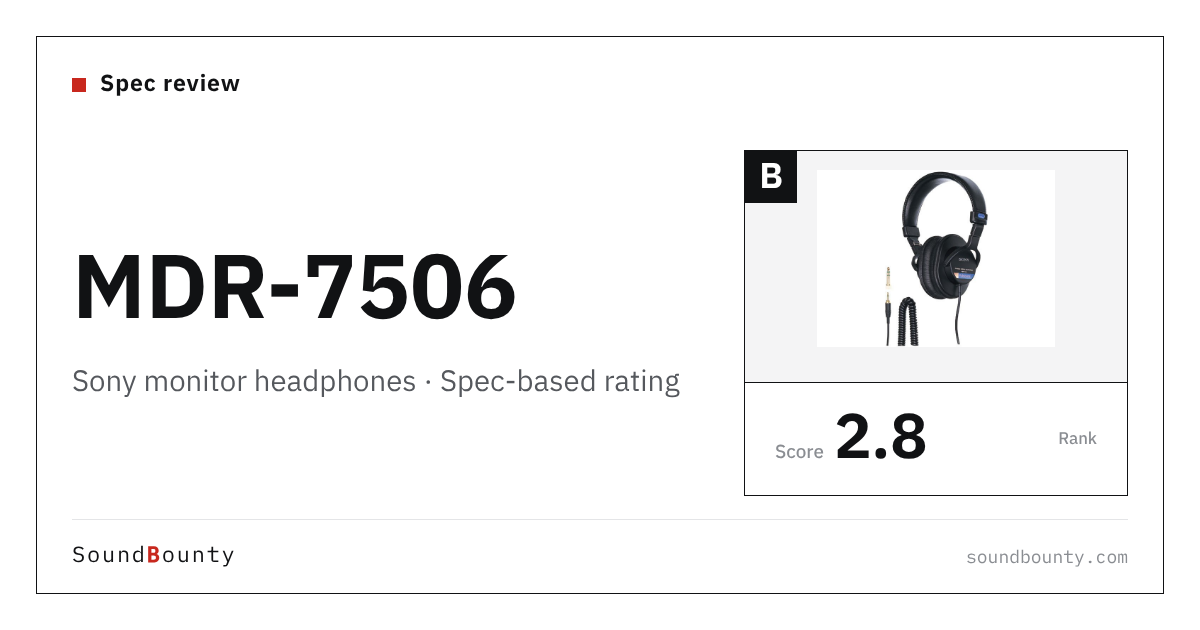
Sony’s MDR-7506 is a pair of closed-back monitor headphones.
Monitor headphones are headphones for hearing sound exactly as it is when you record or mix.
In this article we rate it on 5 criteria using only the specifications the manufacturer publishes, and show how it ranks among the 20 monitor headphones we compare.
Disclosure: This site takes part in affiliate programs. Specifications are as of the date we checked them and can change.
Score 2.8 / 5 (average of the 20 models compared: 3.6)
- Specs last checked
- 2026/10/19
- Type
- Closed-back
- Impedance
- 63Ω
- Weight
- 230g
- Upper limit
- 20,000Hz
- Price (store, date)
- Not disclosed
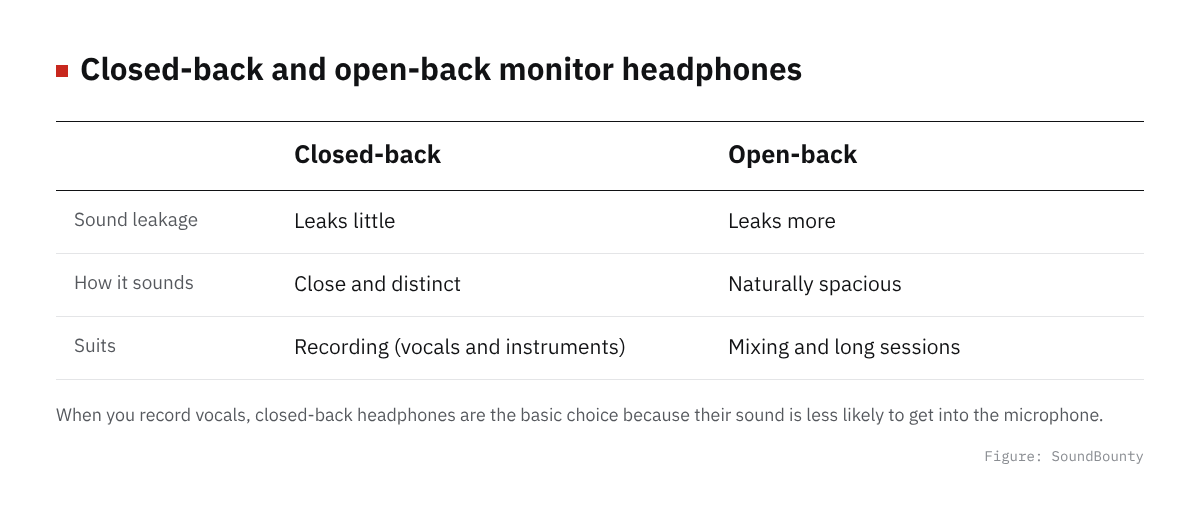
Figure: SoundBounty
Summary
Among the 20 monitor headphones, MDR-7506 is rank B. The ranks run S, A, B and C, and B is third from the top. Averaging the scores for each criterion (out of 5) gives 2.8.
Strengths
- Suitability for recording (sound leakage) (closed-back design, 5 points): They leak little sound, so they can be used while recording vocals.
Things to keep in mind
- Ease of driving (63 Ω, 2 points): They need more power to reach a good volume, and with some equipment the volume may run short.
- High-frequency range (20,000 Hz, 1 point): Checking very high sounds is modest among the products we compared.
Who it suits: judging from the specifications, it suits people who want less sound leakage while recording.
Main features of MDR-7506
Closed-back headphones used professionally
They are closed dynamic headphones with a 40 mm dome driver. The manufacturer describes them as professional headphones with high sound quality and high input tolerance (maximum input 1,000 mW).
Folding design and a coiled cord
They fold, with a coiled cord of about 1.2 m (about 3 m when extended) and a gold-plated stereo two-way plug. A carrying pouch is included.
Specifications
The frequency response is 10 to 20,000 Hz, the impedance is 63 Ω (1 kHz), the sensitivity is 106 dB/mW and the weight is about 230 g without the cord.
Where it is useful
- Keeping the sound of the headphones out of the microphone while recording vocals
- Carrying them around for monitoring
Rating by criterion
Ease of driving: 2 / 5
Whether you can get volume without a headphone amplifier (impedance). The smaller the number, the easier they are to drive.
MDR-7506: 63 Ω. That is a modest rating among the products we compared. They need more power to reach a good volume, and with some equipment the volume may run short.
Low-frequency range: 3 / 5
How low a sound they can reproduce (the lower limit of the frequency response).
MDR-7506: 10 Hz. That is a standard rating among the products we compared.
High-frequency range: 1 / 5
How high a sound they can reproduce (the upper limit of the frequency response).
MDR-7506: 20,000 Hz. That is a modest rating among the products we compared. Checking very high sounds is modest among the products we compared.
Lightness: 3 / 5
The weight of the headphones. The lighter they are, the less they tire you over long periods.
MDR-7506: 230 g. That is a standard rating among the products we compared.
Suitability for recording (sound leakage): 5 / 5
Whether they are closed-back, which leaks little sound. Less leakage means the headphone sound does not get into the microphone while you sing.
MDR-7506: closed-back design. That is a high rating among the products we compared. They leak little sound, so they can be used while recording vocals.
The gray marks in the figure below (the dotted line on the pentagon) show the average of the 20 products we compared. Price is not part of the score.
How we score (Monitor headphones)
| Criterion | Basis | 5 pt | 4 pt | 3 pt | 2 pt | 1 pt |
|---|---|---|---|---|---|---|
| Ease of driving | Impedance (the lower it is, the easier to reach a good volume from a small amplifier) | ≤32 | ≤40 | ≤55 | ≤100 | >100 |
| Low-frequency range | Lower limit of the frequency response | ≤5 | ≤8 | ≤15 | ≤20 | >20 |
| High-frequency range | Upper limit of the frequency response | ≥40000 | ≥30000 | ≥25000 | ≥22000 | <22000 |
| Lightness | Weight (cable excluded) | ≤200 | ≤220 | ≤250 | ≤290 | >290 |
| Suitability for recording (sound leakage) | Closed-back or open-back (closed-back keeps sound out of the microphone while you sing) | Closed-back | — | — | — | Open-back |
Scored only on the body specifications published by the manufacturer. Price and accessories are not part of the score. Ease of driving is compared by impedance (Ω), which every manufacturer publishes. The lower the number, the easier it is to reach a good volume from the headphone jack of an audio interface or a smartphone, so a headphone amplifier is less likely to be needed (sensitivity is shown in the table for reference). "Suitability for recording" scores closed-back headphones higher because the sound is less likely to leak into the microphone while you sing. If you choose open-back headphones for mixing, you can ignore this item.
MDR-7506 connection and getting started
| Connection | Two-way plug for standard stereo and stereo mini (gold-plated). The coiled cord stays attached to the body |
|---|---|
| In the box | Carrying pouch |
Checked on the manufacturer’s official pages on October 17, 2026.
Compared with other monitor headphones
Click a heading to sort. On a phone, the table scrolls sideways.
| Product | RankAvg. score | Type | ImpedanceΩ | SensitivitydB/V | Lower limitHz | Upper limitHz | Weightg | Price (store, date) |
|---|---|---|---|---|---|---|---|---|
| Audio-TechnicaATH-M20x | A 3.4 | Closed-back | 47 | 109.3 | 15 | 20,000 | 190 | Not disclosed |
| Audio-TechnicaATH-M30x | A 3.4 | Closed-back | 47 | 109.3 | 15 | 22,000 | 220 | Not disclosed |
| Audio-TechnicaATH-M40x | A 3.4 | Closed-back | 35 | 112.6 | 15 | 24,000 | 240 | Not disclosed |
| Audio-TechnicaATH-M50x | A 3.4 | Closed-back | 38 | 113.2 | 15 | 28,000 | 285 | Not disclosed |
| Audio-TechnicaATH-M70x | S 4.2 | Closed-back | 35 | 111.6 | 5 | 40,000 | 280 | Not disclosed |
| Audio-TechnicaATH-R70x | B 3.2 | Open-back | 470 | 101.3 | 5 | 40,000 | 210 | Not disclosed |
| SonyMDR-M1 | S 4.4 | Closed-back | 50 | 115 | 5 | 80,000 | 216 | Not disclosed |
| SonyMDR-M1ST | S 4.8 | Closed-back | 24 | 119.2 | 5 | 80,000 | 215 | Not disclosed |
| SonyMDR-CD900ST | S 4.2 | Closed-back | 63 | 118 | 5 | 30,000 | 200 | Not disclosed |
| YamahaHPH-MT8 | B 3.2 | Closed-back | 37 | 116.3 | 15 | 28,000 | 350 | Not disclosed |
| YamahaHPH-MT5 | B 2.8 | Closed-back | 51 | 112.9 | 20 | 20,000 | 245 | Not disclosed |
| beyerdynamicDT 770 PRO 80Ω | A 4.0 | Closed-back | 80 | Not disclosed | 5 | 35,000 | Not disclosed | Not disclosed |
| beyerdynamicDT 990 PRO 80Ω | B 3.0 | Open-back | 80 | Not disclosed | 5 | 35,000 | 250 | Not disclosed |
| SennheiserHD 280 PRO | B 3.2 | Closed-back | 64 | Not disclosed | 8 | 25,000 | 285 | Not disclosed |
| SennheiserHD 25 | B 3.2 | Closed-back | 70 | Not disclosed | 16 | 22,000 | 140 | Not disclosed |
| ShureSRH440A | B 3.2 | Closed-back | 40 | 111 | 10 | 22,000 | 268 | Not disclosed |
| ShureSRH840A | A 3.8 | Closed-back | 40 | 111 | 5 | 25,000 | 273 | Not disclosed |
| AKGK371 | S 4.4 | Closed-back | 32 | 114 | 5 | 40,000 | 255 | Not disclosed |
| beyerdynamicDT 770 PRO X | A 3.8 | Closed-back | 48 | Not disclosed | 5 | 40,000 | 305 | Not disclosed |
| SonyMDR-7506 | B 2.8 | Closed-back | 63 | 118 | 10 | 20,000 | 230 | Not disclosed |
Specifications are the manufacturer's published values (checked October 19, 2026). Sensitivity is written differently by each manufacturer, so it is shown for reference; beyerdynamic and the Sennheiser HD 280 PRO do not publish a sensitivity.
Before you buy
- They are closed-back. They leak little sound, so they are also easy to use for recording vocals.
- The impedance is 63 Ω. The impedance is on the low side, so it is relatively easy to reach a good volume even from the headphone jack of an audio interface. For reference, the sensitivity (loudness per 1 V) is 118 dB/V.
Read next
- ATH-R70x: features and rating (rank B)
- HD 280 PRO: features and rating (rank B)
- K371: features and rating (rank S)
- MDR-CD900ST: features and rating (rank S)

Comments