
Disclosure: This page may contain affiliate links. Prices were checked on the date shown and may change.
An introduction to Pulsar Audio Pulsar 8200, based on information from the maker and distributors: what it does, how to use it and who it may suit. It is not scored.
The paragon of EQs, reinvented. Precise, transparent & versatile, Pulsar 8200 is the superstar EQ of your master bus.
— Pulsar Audio official site
What is Pulsar 8200?
Pulsar 8200 is an analog-style parallel EQ from Pulsar Audio. The maker says it is modelled on the GML 8200 designed by George Massenburg.
The original hardware uses all-discrete, Class-A analog electronics. The maker describes a tight low end, a crystalline high end and detailed control over the spectrum.
The maker says the parallel topology and unique filter shapes aim for a more natural result than a typical digital EQ. Bands behave differently from conventional EQs, so the way of setting them differs.
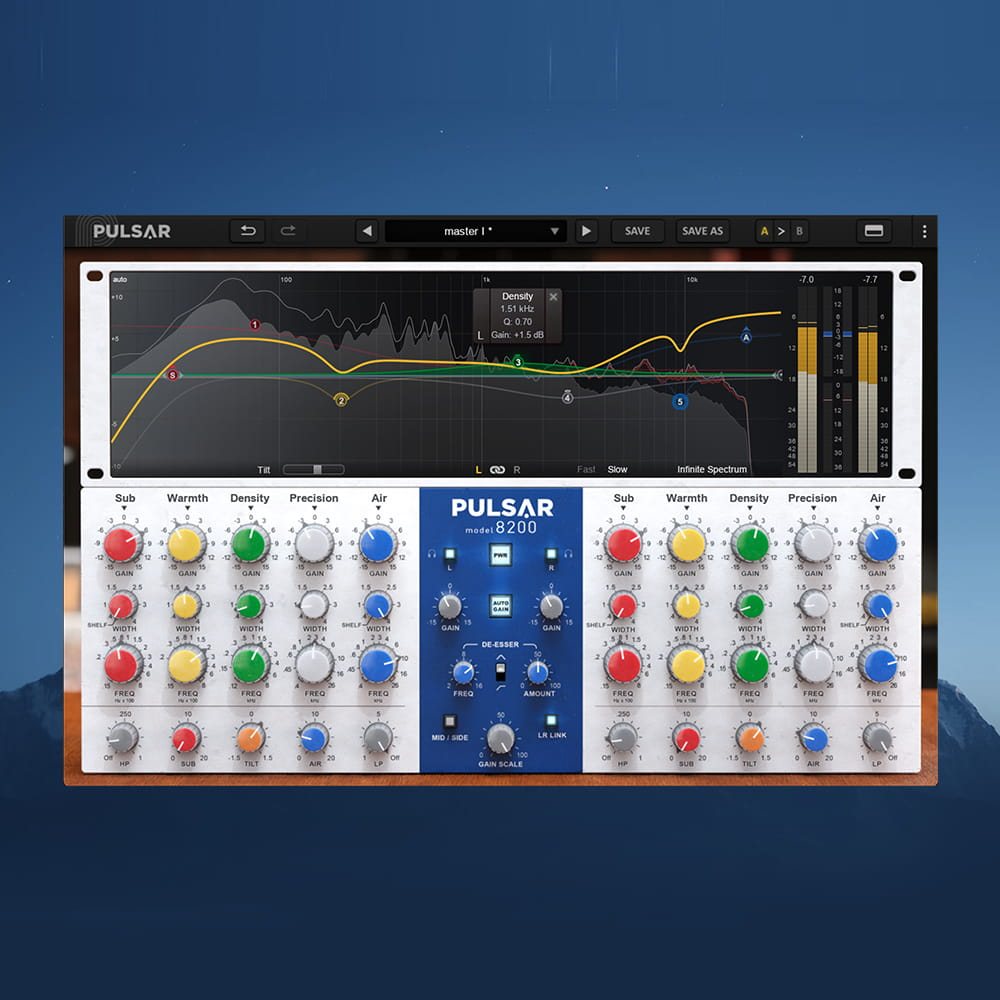
The interface has a curve editor and a spectrum analyser. Additions beyond the hardware include high and low cut filters, a tilt filter, Air and Sub bands and a de-esser.
Key features
Visual curve editing
The analog-style curve can be edited by dragging it on screen. The maker says every property of a filter, including its name, can be edited without touching the lower panel.
Built-in de-esser
A simple de-esser lets you choose frequency, amount and band type (bell or shelf). The maker suggests it for vocal sibilance and for harsh highs on overheads.
Mid/Side processing
A mid/side mode lets you EQ the centre and the stereo information separately. Listen buttons audition each signal on its own.
Auto-gain
This compensates for level changes introduced by the EQ and keeps output close to input. The maker says it depends only on the EQ settings and does not change during playback.
Tilt filter and Sub/Air bands
A 6-pole tilt filter shifts the overall tonal balance with one knob, and the Air and Sub bands adjust the extreme high and low ends.
Metering and Gain Scale
A spectrum analyser, peak and RMS meters and a gain meter are included. Gain Scale works as a multiplier for the gain of all bands.
Specifications
| Item | Details |
|---|---|
| Type | Parallel EQ (modelled on the GML 8200) |
| Formats (Windows) | AAX Native, VST 2.4, VST 3 |
| Formats (Mac) | AAX Native, Audio Unit, VST 2.4, VST 3 |
| Windows | Windows 7 SP1 / 8.1 / 10 (64-bit only), Intel Core i3 or higher or AMD quad-core, 4 GB RAM and 1 GB free disk space, OpenGL 2.0 GPU |
| Mac | macOS 10.9 and higher (M1 supported, 64-bit only), Intel Core i3 or higher or Apple Silicon, 4 GB RAM and 1 GB free disk space, OpenGL 2.0 GPU |
| Display | Minimum 1024×768 (recommended 1920×1080), 60 Hz |
| Activation | An account at ilok.com is required |
What is included and system requirements
- The plug-in (AAX Native, AU, VST 2.4, VST 3)
- An ilok.com account is needed for activation
- A free trial is offered on the maker's page
How to use it
- Create an account at ilok.com.
- Download, install and activate the plug-in with iLok after purchase.
- Insert Pulsar 8200 on the track you want to EQ.
- Move bands in the area of interest while watching the on-screen curve.
- Turn on auto-gain and compare before and after at matched volume.
- For sibilance, set the de-esser frequency and amount.
- On a master bus, try the tilt filter and mid/side processing.
Where it may come in handy
Shaping a master bus
The tilt filter and mid/side processing may help adjust the overall tonal balance of a mix.
Vocal sibilance
The maker gives reducing sibilance between 6 and 8 kHz with the de-esser as an example.
Kick and bass low end
The Sub band and low cut may help sort out very low frequencies.
Acoustic instruments
The maker intends it for fine-tuning acoustic sources such as piano.
Who it may suit
- People who want to try a GML 8200-style parallel EQ
- Anyone who prefers to see the curve while adjusting
- Those balancing a mix or master
- Users who want EQ and de-esser in one plug-in
Good to know before you buy
- An ilok.com account is required for activation.
- The maker's page showed a Black Friday sale price of $59.00; the regular price is $149.00.
- A free trial is available.
How it differs from similar products
We do not pick a winner; the official figures are placed side by side.
Pulsar MP-EQ
Both have a regular price of $149.00. The 8200 has a de-esser, tilt filter and Sub/Air bands, while MP-EQ has linear phase correction and a drive control.
Price
$149 (Pulsar Audio official site, checked 2026-10-27). Prices can vary by region and promotion, so check the official page before buying.
See Pulsar 8200 on the product page
More of the same kind
We have introduced 122 EQs. Here are some of the others.
- McDSP 4020 Retro EQ Native v7
- Antelope Audio MG4+
- Eventide EQ45
- MAAT MAAT SantaCruzEQ12
- McDSP 6020 Ultimate EQ Native v7
- Solid State Logic SSL X-DynEQ
We have introduced 10 other products from Pulsar Audio.
- Pulsar Audio 8200 Analog Parallel Equalizer
- Pulsar Audio W495
- Pulsar Audio MP-EQ
- Pulsar Audio Pulsar Poseidon
- Pulsar Audio Pulsar MP-EQ
For a side-by-side comparison scored on the same criteria, see our comparison of EQs.
See the full list in Product database: Effects.
Sources: pulsar.audio pluginboutique.com (checked 2026-10-27)










Comments