
Disclosure: This page may contain affiliate links. Prices were checked on the date shown and may change.
An introduction to Pulsar Audio Pulsar MP-EQ, based on information from the maker and distributors: what it does, how to use it and who it may suit. It is not scored.
The most complete passive EQ plugin. Musical and intuitive, a must-have for mixing and mastering.
— Pulsar Audio official site
What is Pulsar MP-EQ?
Pulsar MP-EQ is a passive EQ plug-in from Pulsar Audio. The maker says it emulates an analog EQ found in mastering studios worldwide, designed as a synthesis of passive equalizers from the past 70 years.
The maker says its fully parallel topology lets bands interact naturally and gives a frequency response different from a digital EQ with the same settings. It models custom hand-wound inductors, tubes and transformers.
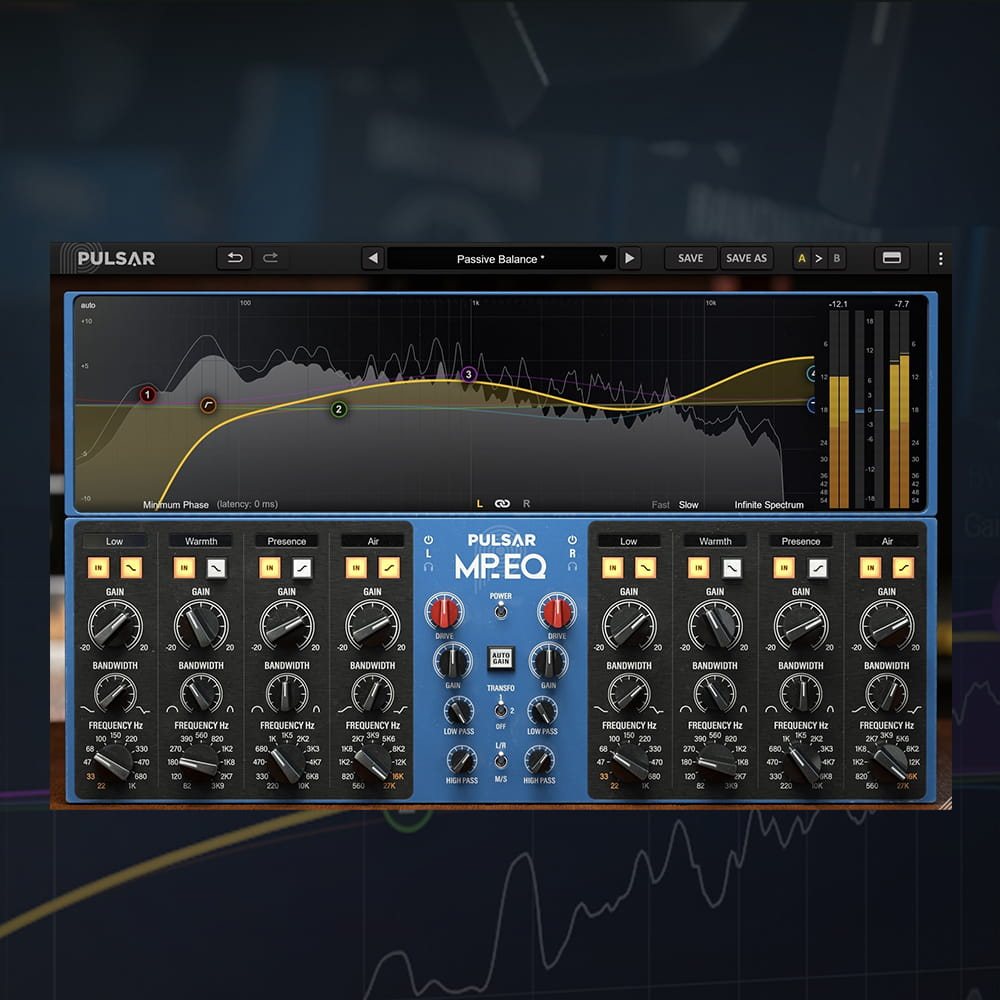
The interface has a curve editor and a spectrum analyser. Modern additions beyond the hardware include a drive control, linear phase correction and auto-gain.
The maker lists mastering, vocals, electric guitar, drum bus and electronic music as uses.
Key features
Fully parallel architecture
Band gains do not accumulate; they recombine into a natural-sounding correction, the maker says. The Pultec-like low shelves are described as giving a generous, tight low end even at extreme boosts.
Drive and harmonic character
Raising drive pushes internal levels so the transformer, tube and inductor models produce harmonics and non-linearities, which the maker ties to a gentle, program-dependent low-end compression.
Linear phase correction
An optional process realigns frequencies after the EQ stage, turning the analog-style EQ into a linear-phase one. The maker suggests it for clearer low end and for avoiding artefacts in mid/side processing.
Mid/Side and auto-gain
Mid/side mode adjusts the centre and sides separately, and auto-gain compensates for level changes.
Transformer and oversampling
A transformer choice is available; the maker says it can be used to beef up or tighten a kick on a mix bus. Oversampling is also included.
Metering and spectrum
A spectrum analyser and meters on screen show the effect of EQ changes, in line with the maker's approach of combining the hardware's behaviour with a modern display.
Specifications
| Item | Details |
|---|---|
| Type | Passive EQ |
| Formats | AAX Native, Audio Unit, VST 2.4, VST 3 |
| Mac | macOS 10.9 and higher (M1 supported, 64-bit only), Intel Core i3 or higher or Apple Silicon, 4 GB RAM and 1 GB free disk space, OpenGL 2.0 GPU |
| Windows | Windows 7 SP1 / 8.1 / 10 (64-bit only), Intel Core i3 or higher or AMD quad-core, 4 GB RAM and 1 GB free disk space, OpenGL 2.0 GPU |
| Display | Minimum 1024×768 (recommended 1920×1080), 60 Hz |
What is included and system requirements
- The plug-in (AAX Native, AU, VST 2.4, VST 3)
- Modern EQ Edition (curve editing and more)
- A free trial is offered on the maker's page
How to use it
- Download, install and activate after purchase.
- Insert MP-EQ on the track or bus you want to EQ.
- Start with low drive and move the bands.
- Adjust low and high end with the low and high shelves.
- Turn on auto-gain and compare before and after at matched volume.
- Adjust the transformer type and drive as needed.
- Try linear phase correction and mid/side on a bus or master.
Where it may come in handy
Mastering
The maker gives adding weight to the low end or air to the highs as examples, and mid/side adjustments can be tried too.
Vocals
The maker describes adjusting the presence range and low-mid warmth and adding saturation with the drive.
Drum bus
Reducing muddy ranges and tame harshness on overheads are given as examples.
Synth basses and pads
Rich sources may be sculpted with extreme curves.
Who it may suit
- People who want to try a passive EQ in the box
- Those who want a passive-style EQ with a visible curve
- Users adjusting masters or mix buses
- Anyone who wants linear phase correction
Good to know before you buy
- The maker's page showed a Black Friday sale price of $49.00; the regular price is $149.00.
- A free trial is available.
- The requirements are listed in older terms (macOS 10.9 and higher). Check the maker's page for current OS support before buying.
How it differs from similar products
We do not pick a winner; the official figures are placed side by side.
Pulsar 8200
Both have a regular price of $149.00. MP-EQ has linear phase correction, drive and transformer options, while the 8200 has a de-esser, tilt filter and Sub/Air bands.
Price
$149 (Pulsar Audio official site, checked 2026-10-27). Prices can vary by region and promotion, so check the official page before buying.
See Pulsar MP-EQ on the product page
More of the same kind
We have introduced 122 EQs. Here are some of the others.
- Waves Silk Vocal
- McDSP AE400 Active EQ
- Three-Body Technology Tube Shelf
- Tokyo Dawn Labs Tokyo Dawn Labs TDR Nova GE
- McDSP 6020 Ultimate EQ Native v7
- Slate Digital SD-PE1
We have introduced 10 other products from Pulsar Audio.
- Pulsar Audio Pulsar Poseidon
- Pulsar Audio W495
- Pulsar Audio 8200 Analog Parallel Equalizer
- Pulsar Audio MP-EQ
- Pulsar Audio Pulsar 8200
For a side-by-side comparison scored on the same criteria, see our comparison of EQs.
See the full list in Product database: Effects.
Sources: pulsar.audio pluginboutique.com (checked 2026-10-27)










Comments