
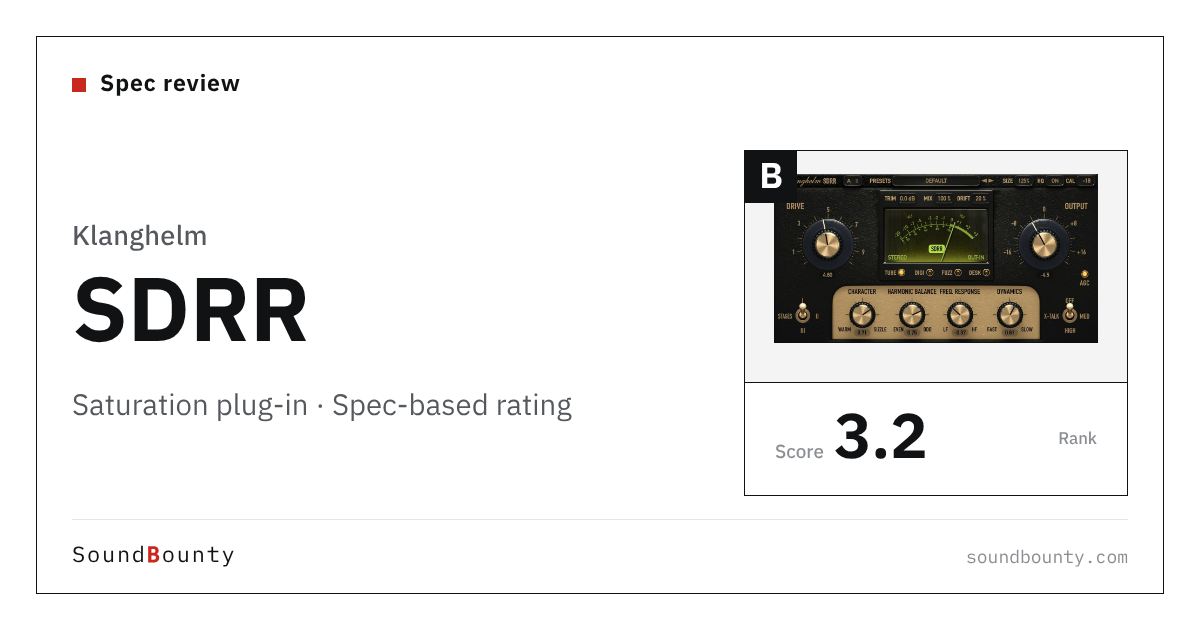
Klanghelm’s SDRR is saturation (a faint distortion, as if passed through analog gear) with four modes, TUBE, DIGI, FUZZ and DESK, each containing two models. You can mix the models to shape the texture, and the DESK mode also has a two-band EQ.
A saturation plug-in adds a faint distortion, as if the sound had passed through analog gear, to add thickness and warmth.
In this article we compare SDRR with 12 saturation plug-ins and rate how well it serves its purpose on three criteria. The basis is official manufacturer information.
Disclosure: This article contains affiliate links. If you buy through them, SoundBounty may earn a commission at no extra cost to you. Prices and sale information are as of the date we checked them and can change.
Score 3.3 / 5 (average of the 12 products compared: 3.0)
- Specs last checked
- 2026/09/25
- Range of texture
- 4 modes x 2 models
- Per-band processing
- None
- Mix and tone control
- Mix + RESPONSE
- Price (store, date)
- ≈$25.78 [Official, checked Oct 26]
Image: from the Klanghelm official website (product image)
Summary
Among the 12 saturation plug-ins, SDRR is rank B. The ranks run S, A, B and C, and B is third from the top. Averaging the scores for each criterion (out of 5, with the one criterion that matters most for the purpose counted double) gives 3.3.
Strengths
- Range of texture (4 points): you can choose from a wide range, from subtle warmth to strong distortion.
- Mix and tone control (4 points): you can adjust in detail how much is mixed with the original sound, and the tone.
Things to keep in mind
- Per-band processing (1 points): it has no function for changing the distortion by pitch range.
Who it suits: people who want to try everything from tube-style to fuzz in one plug-in at a reasonable price.
Main features of SDRR
Four modes: TUBE, DIGI, FUZZ and DESK
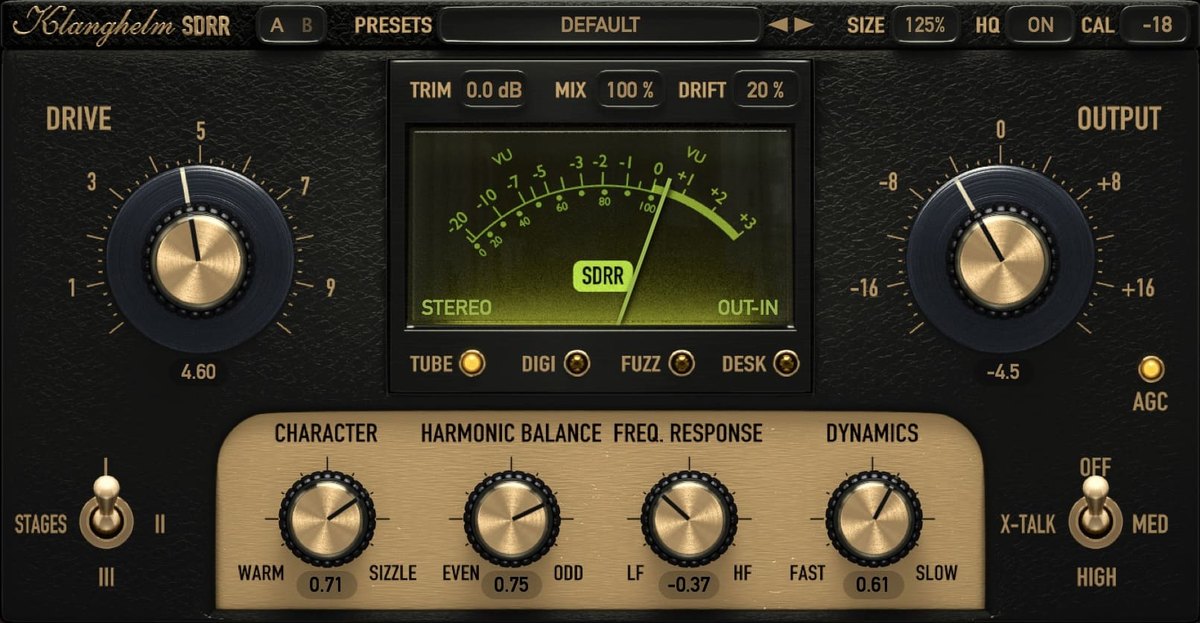
SDRR is saturation with four modes: TUBE (tube), DIGI (digital), FUZZ (fuzz) and DESK (mixing console). In each mode you can move smoothly between two models. In TUBE, for example, you can choose between WARM, which rounds the edges for warmth, and SIZZLE, which keeps the attack and adds heat.
RESPONSE changes the band that distorts
RESPONSE changes whether the lows or the highs are distorted more strongly. Toward the lows it thickens the low end, and toward the highs the manual explains it gives a tape-like effect or acts like a smooth de-esser. The DESK mode also has a two-band EQ.
Mix and automatic level compensation
The Mix knob blends the original and the processed sound. With AGC (automatic level compensation) on, the volume does not change much when you distort, so you can compare the effect fairly. You can choose 1 to 3 processing stages, and more stages give more complex coloration.
Where it is useful
- Using WARM in TUBE to round the edges of a vocal and add warmth
- Setting RESPONSE toward the highs to smooth the harsh “S” sounds of a vocal
- Using DESK on a drum bus to add the cohesion of a mixing console
Rating by criterion
Range of texture: 4 / 5
We check the range of distortion types you can choose, from subtle warmth to strong distortion.
Four modes, TUBE, DIGI, FUZZ and DESK, each with two models that can be mixed.
Per-band processing: 1 / 5
We check whether the distortion can differ for low and high pitches.
There is no function for distorting by split bands. RESPONSE can change whether the lows or the highs are distorted more.
If “per-band processing” matters most to you, Saturn 2 (5 points) is a better fit.
Mix and tone control: 4 / 5
We check whether you can adjust how much is mixed with the original sound, and the tone.
There is a Mix knob for the original sound and RESPONSE, which tilts the band that distorts (the DESK mode has a two-band EQ).
How we score (Saturation plug-ins)
| Criterion | Basis | 5 pt | 4 pt | 3 pt | 2 pt | 1 pt |
|---|---|---|---|---|---|---|
| Range of texture | The range of distortion types you can choose, from subtle to strong | Choose from 20 or more kinds of distortion | Choose from 5 or more kinds of distortion | 2 to 4 kinds | 1 kind | — |
| Per-band processing | Whether the distortion can differ for lows and highs | Multiband processing of up to 6 bands | 2 to 3 bands | — | — | No per-band processing |
| Mix and tone control | Control of how much is mixed with the original sound, and of the tone | Mix, tone, dynamics and more can be adjusted for each band | Both mix and tone are available | One of the two | — | Not mentioned on the official page |
Each criterion is scored from 1 to 5 on how well the product serves one goal: adding thickness and presence to vocals and backing tracks. Scores follow the conditions in the table above, and the rank is based on an average in which "Range of texture" counts double. The basis is official manufacturer information. Sound quality and CPU load are not measured, so they are not scored; reviews from trade magazines are introduced in the articles for reference. Price is not part of the score. Features that cannot be confirmed from the manufacturer's or a retailer's description are scored as if absent. The "OBS (streaming)" column in the table shows whether the official page lists the VST2 format that the streaming software OBS Studio can use (○). OBS does not support the VST3 format. It is not part of the score.
SDRR screens and images
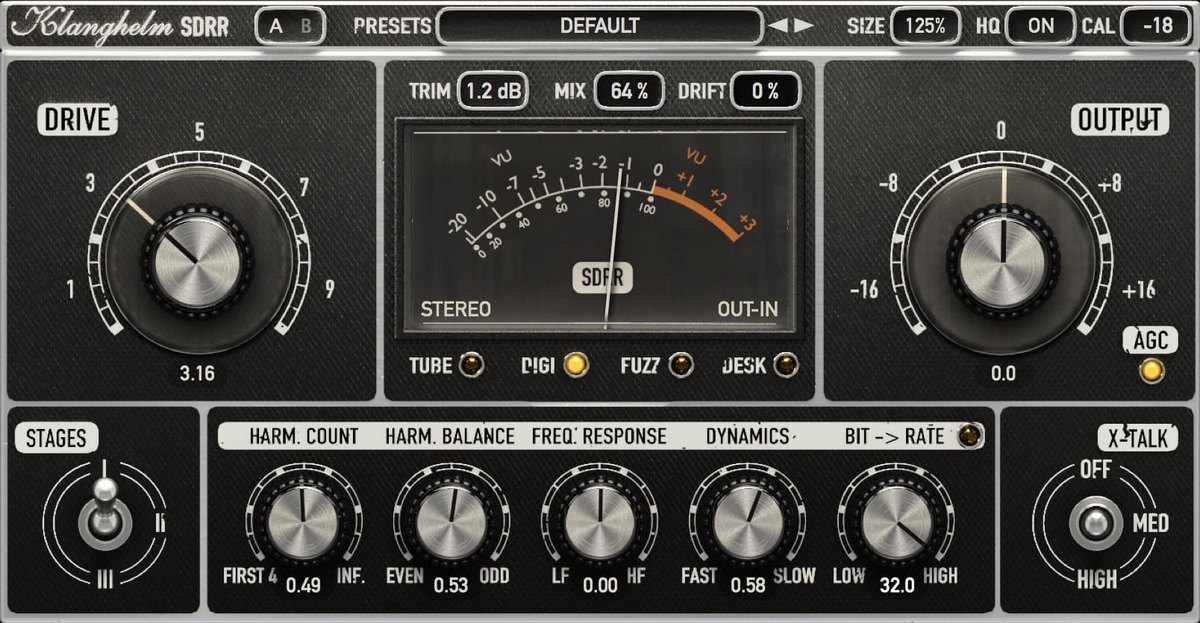
Image: from the Klanghelm official website (product image)
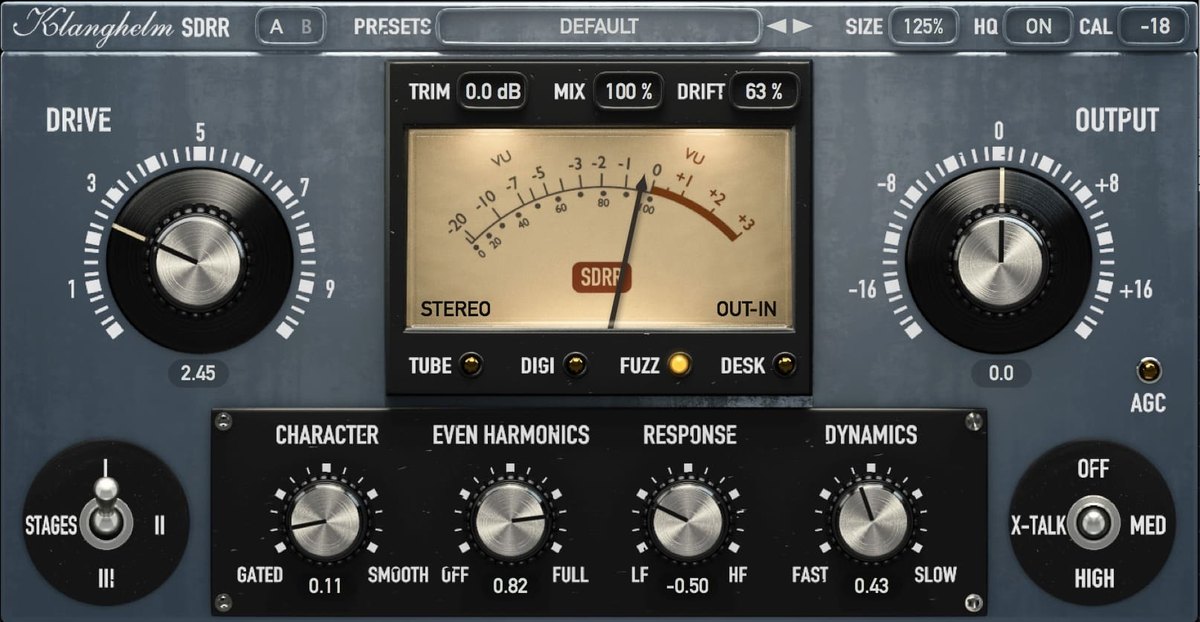
Image: from the Klanghelm official website (product image)
SDRR system requirements and getting started
| Operating system | Windows / Mac |
|---|---|
| Plug-in formats | Windows: VST, VST3, AAX / Mac: AU, VST, VST3, AAX (64-bit) |
| OBS (streaming) | Works as it is (VST2 is listed) |
Checked on the manufacturer’s official pages on September 27, 2026. How to use plug-ins in the OBS streaming software is explained in How to use VST3 plug-ins in OBS.
Compared with other saturation plug-ins
Click a heading to sort. On a phone, the table scrolls sideways.
| Product | RankAvg. score | Range of texture | Per-band processing | Mix and tone control | Free | OBS (streaming) | Price (store, date) |
|---|---|---|---|---|---|---|---|
| FabFilterSaturn 2 | S 5.0 | 28 types | Up to 6 bands | Adjust per band | — | ○ | $149 [PB, checked Oct 26] |
| SoundtoysDecapitator | B 3.3 | 5 types | None | Mix + tone | — | ○ | $199 [PB, checked Oct 26] |
| MeldaProductionMSaturator | C 2.0 | Tube-style + harmonics | None | Dry/Wet + harmonics | Free | ○ | Not listed |
| SoundtoysRadiator | C 2.3 | One tube type | None | Mix + bass/treble | — | ○ | $99 [PB, checked Oct 26] |
| SoftubeSaturation Knob | C 2.0 | 3 modes | None | One knob | Free | ○ | Not listed |
| KlanghelmSDRR | B 3.3 | 4 modes x 2 models | None | Mix + RESPONSE | — | ○ | ≈$25.78 [Official, checked Oct 26] |
| KlanghelmIVGI | C 2.0 | 1 type | None | RESPONSE | Free | ○ | Not listed |
| OutputThermal | A 3.8 | 19 types | Band split | Tone, width | — | ○ | $149 [PB, checked Oct 26] |
| KazrogTrue Iron | B 3.0 | 6 transformers | None | Strength + mix | — | Not confirmed | $39.99 [Official, checked Oct 26] |
| iZotopeTrash | S 4.5 | 60+ types | 3 bands | Mix + Tilt + envelope | — | × (VST3 only) | $99 [Official, checked Oct 26] |
| Plugin Alliancebx_saturator V2 | B 2.8 | 1 type | 4 bands + M/S | Drive and mix per band | — | ○ | $100 [Official, checked Oct 26] |
| Plugin AllianceHG-2 | B 2.8 | 4 tube stages + switch | None | Mix + Air + Calibration | — | ○ | $125 [Official, checked Oct 26] |
Features checked on each manufacturer's official website on September 25, 2026. Check the store page behind the buy button for the price.
Read next
- Decapitator: features and rating (rank B)
- True Iron: features and rating (rank B)
- Saturn 2: features and rating (rank S)
- MSaturator: features and rating (rank C)

Comments