
Arturia’s soft synth “Pure SUB” went on sale on August 27, 2026 (the date of the official press release). The official page calls it a “Bass Design Synthesizer”, software made only for bass. Based on official information, this article introduces its features and where it could fit.
Disclosure: This article contains affiliate links. The content reflects the date we checked the maker’s official page (October 5, 2026).
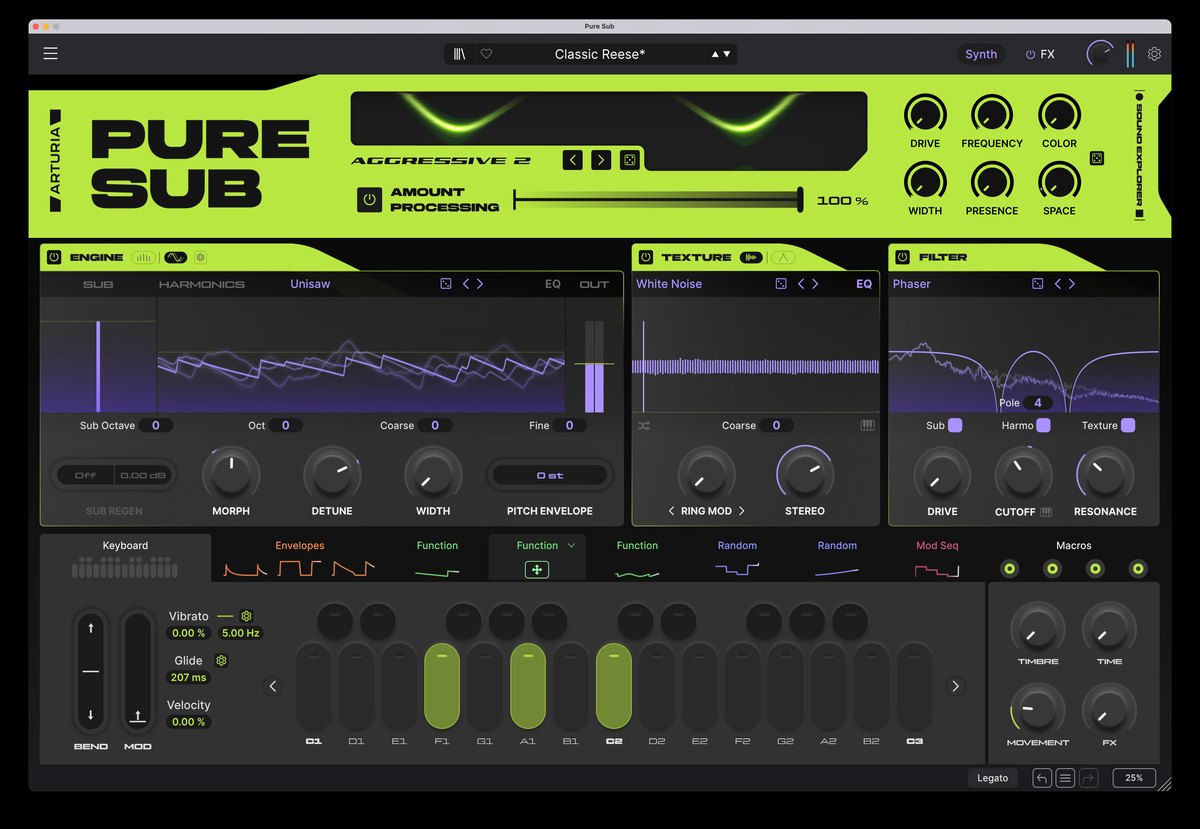
Image: from the Arturia official press material
Key points
- Pure SUB is a synth narrowed down to making bass tones. It is not software for recording vocals; it is an instrument for your own songs and backing tracks.
- It divides bass into three layers, “Sub”, “Harmonics” and “Texture”, and makes each separately.
- It has a “Sub Processor” (33 modes) for processing sound, 12 effect slots, three envelopes and six modulators.
- There are 300 presets (per the manufacturer).
- The official page has a free demo.
What kind of software is it?
The official page explains that modern bass is something that “builds pressure, moves energy and shapes the depth and energy of a song”. Pure SUB is a synth that puts together that bass design and the finishing processing. It is said to make a wide range of bass tones: clean sub bass and 808s, growling Reese, wobbles and distorted sounds.
Features
Build the sound in three layers
According to the official page, Pure SUB divides the sound into three layers.
- Sub: builds the low fundamental (the lowest foundation of the sound) separately from the other sounds. Volume, phase (the position of the wave) and pitch can be set individually.
- Harmonics: the tone part. It has two modes, “Pressure” and “Reese”, and you can choose anything from a clean 808 to a complexly changing waveform.
- Texture: a layer that adds noise and the like to give grit and presence. It has “Noise” or “Corroder” modes, and can be combined with the fundamental through ring modulation, AM and distortion.
There is also a function called “Sub Regen”. When you process heavily with filters and effects, the level and phase of the fundamental can fall apart; Sub Regen is explained as running the filters and effects on the original fundamental and then replacing the processed bass with a clean fundamental (per the manufacturer).
Shape, process and finish
- Shape: more than 40 filter modes. You can choose individually which of the Sub, Harmonics and Texture layers each acts on.
- Process: the “Sub Processor” has 33 modes and changes distortion, texture and the shape of the sound. In addition, 18 kinds of effects can be used in 12 slots.
- Maximise: after shaping with EQ, a compressor and multiband, the “Maximiser” brings out loudness and impact.
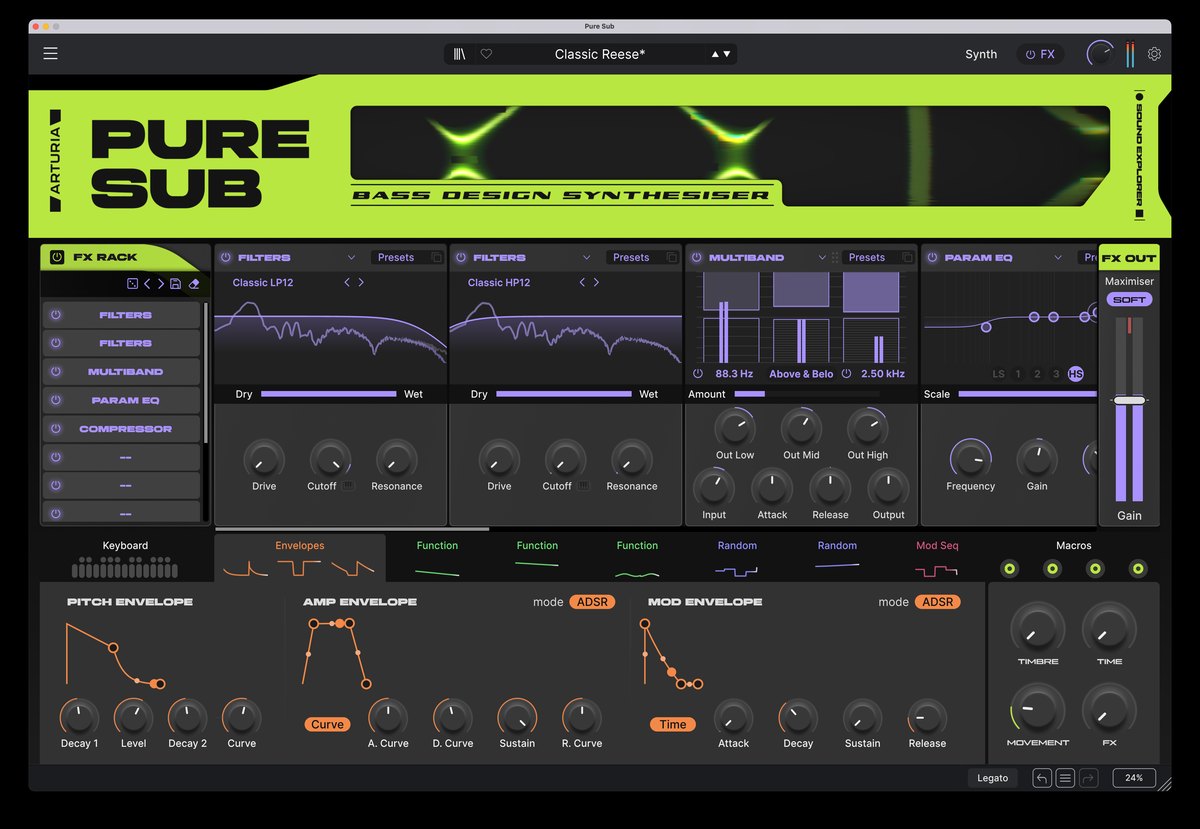
Image: from the Arturia official press material
Moving the sound: envelopes and modulators
According to the official page, besides three fixed envelopes (the shape of how a sound starts and decays), there is a dedicated pitch envelope. By changing how the pitch falls, it is said you can make the punchy “thump” at the start of a sound and the smooth movement of an 808.
The part that adds movement has six slots, and each can hold an Envelope, a Function (a curve like a mathematical function), Random, a Voice Modulator or a Step Sequencer. You drag and drop a modulator onto the knob you want to move and set the depth. The amount of modulation can itself be moved by another modulator.
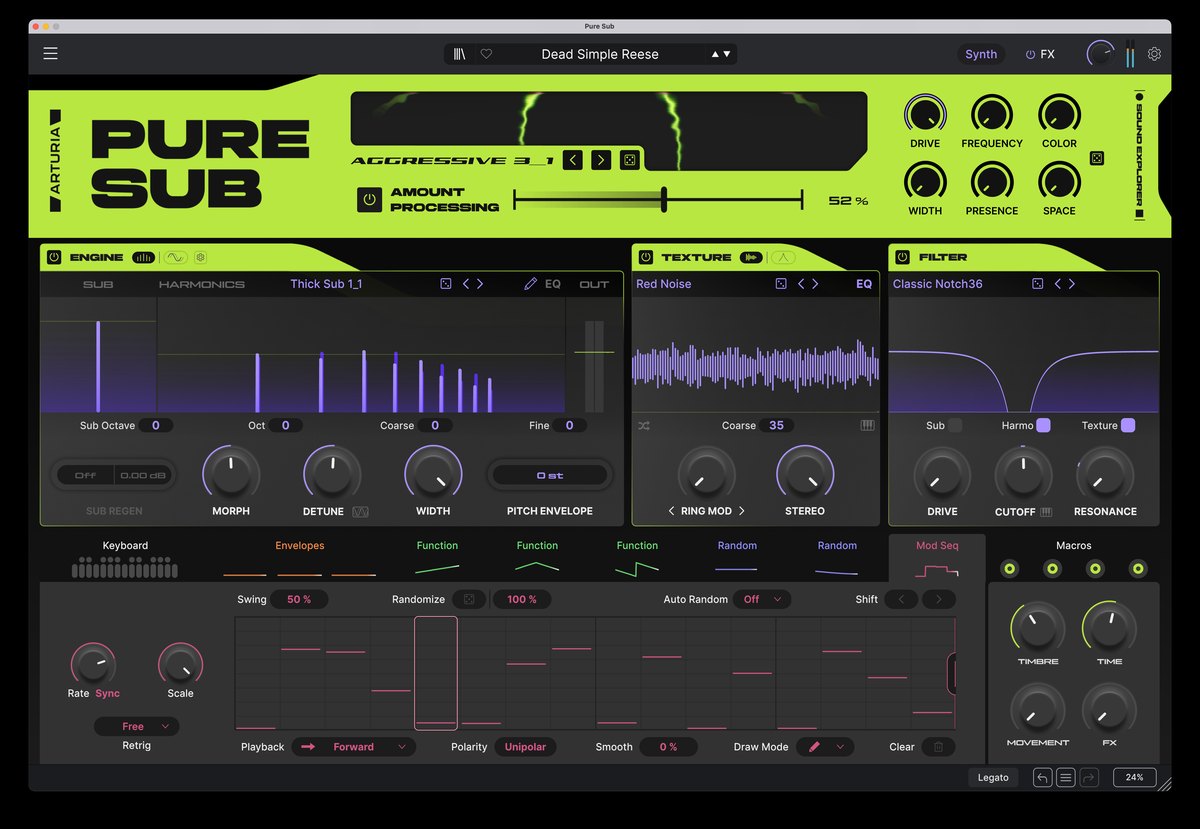
Image: from the Arturia official press material
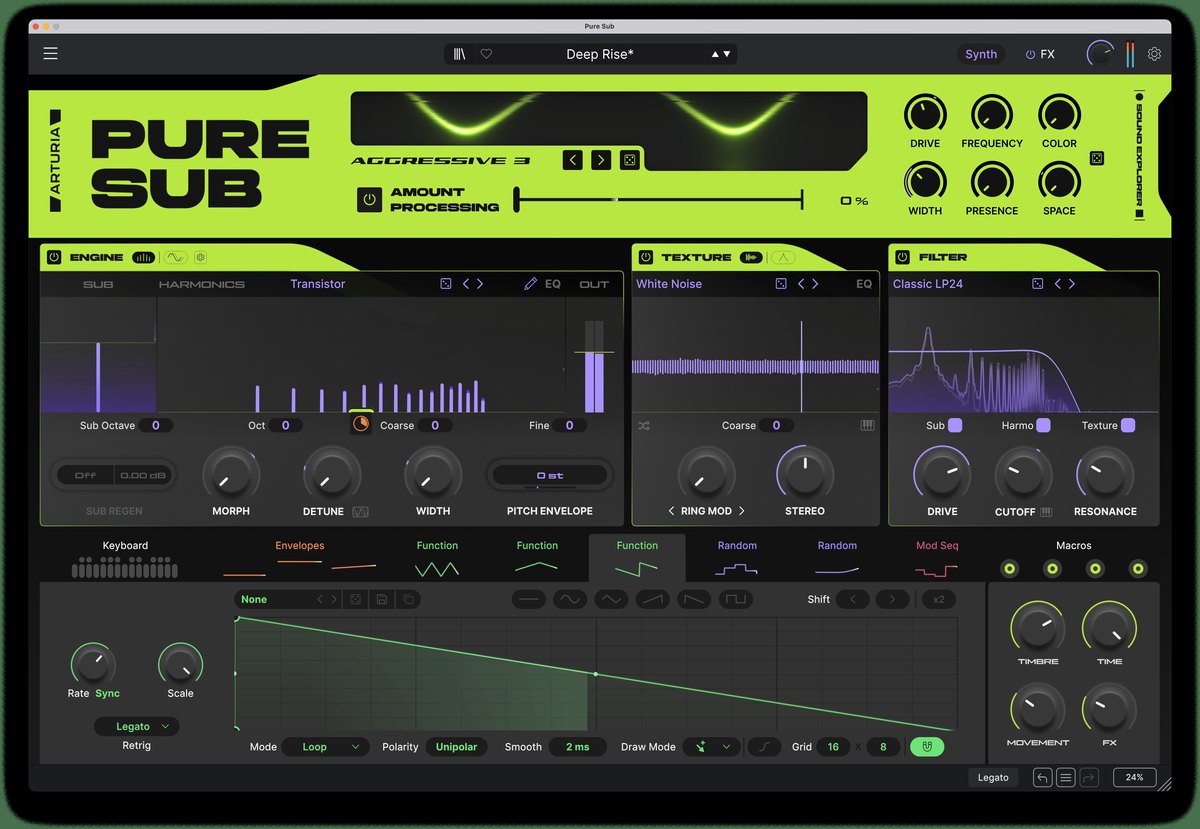
Image: from the Arturia official press material
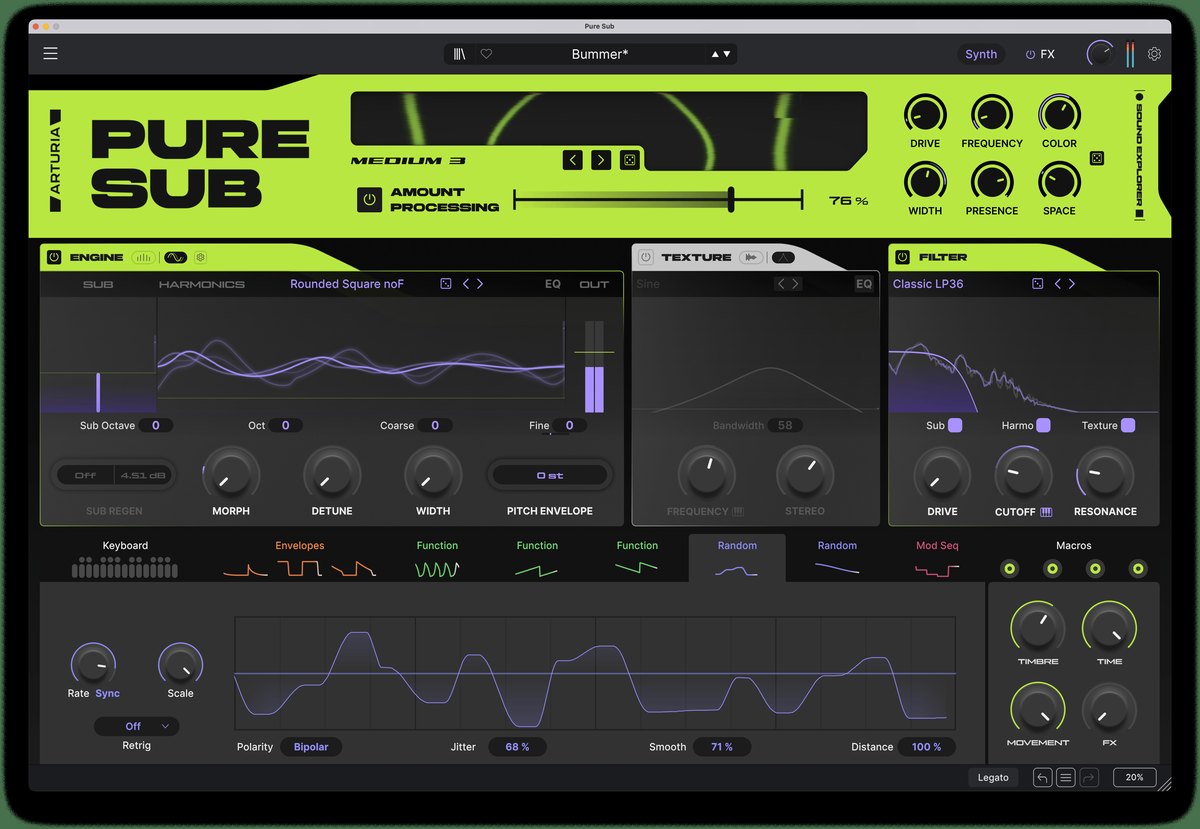
Image: from the Arturia official press material
Presets and randomizing
There are 300 factory presets, which are explained as aiming to be “usable as they are” and “easy to take apart and rebuild”. There is also a function where, after loading a preset, pressing the dice button randomly changes the layers, filters, Sub Processor settings and so on (per the manufacturer).
Where it could fit in home recording and your own songs
From here on, these are examples of use based on the official description.
- When you want to make the bass of your own backing track yourself: Pure SUB specializes in bass tone design. Searching the presets and adjusting a sound you like a little may be an easy way to start.
- When the bass is hard to hear on small speakers or headphones: the official release material has a hint that very low sounds tend to disappear on small speakers and that adding noise makes the bass easier to hear. The Texture layer could be used for that.
- When heavy processing has made the bass thin: Sub Regen is explained as replacing the processed bass with a clean fundamental.
What to check before you buy
- System requirements: the official download page says “Mac OS 11.0 or later” for Mac and “Windows 10 or later” for Windows. The plug-in formats listed are VST and Audio Unit. Check on the official page that it loads in the DAW you use.
- Try before you decide: the official product page has a “Get Free Demo” link.
- How bass is built: whether it fits depends on “what you want to build yourself, and how far”. The differences among bass instruments are sorted out in bass instruments compared.
Official page: Arturia “Pure SUB”




Comments