
Disclosure: This page may contain affiliate links. Prices were checked on the date shown and may change.
An introduction to Arturia 1973-Pre, based on information from the maker and distributors: what it does, how to use it and who it may suit. It is not scored.
The iconic vintage sound of the world’s best studios, perfectly recreated for the modern producer.
— Arturia official site
What is 1973-Pre?
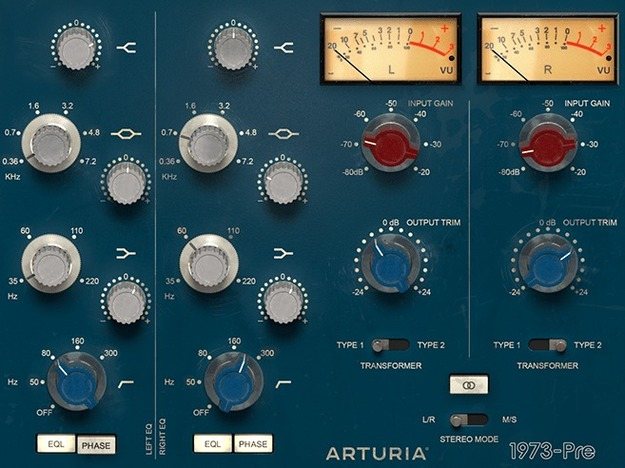
1973-Pre is a microphone preamp effect plug-in from Arturia. It recreates the British transistor preamp of the 1970s, known as the Neve 1073, using Arturia's own TAE analog modeling technology. It is meant to be inserted at the start of a channel in a DAW to add the harmonic coloring and tone-control character of that circuit.
According to the manufacturer's description, Arturia engineers examined an unmodified unit from 1971 (serial number 3392) in London and analyzed the response of each component to build the model. The input gain is continuously variable up to 60 dB, the output trim covers +/-24 dB, and pushing the input adds harmonic distortion as on the hardware.
The EQ section has three bands: a high shelf fixed at 12 kHz (+/-18 dB), a midrange bell from 360 Hz to 7.2 kHz (+/-18 dB), and a low shelf from 35 Hz to 220 Hz (+/-18 dB). The high-pass filter runs from 50 Hz to 300 Hz with an 18 dB/octave slope, and there are bypass and phase-invert switches.
Additions beyond the original hardware include automatic gain control that compensates the output when the input is changed, a switch between two output transformers (the original Carnill and the modified Marinair types), and a self-contained mid/side mode. Both 1-channel and 2-channel versions are included, and the Plugin Boutique page lists Standalone, VST, AAX, Audio Unit and NKS support.
Key features
TAE preamp modeling
The model is built from an analysis of each component, and harmonics increase as the gain is raised. It may be worth trying at the start of a vocal or guitar channel when adding body or warmth.
3-band EQ and high-pass filter
The high shelf, mid bell and low shelf each move +/-18 dB, and the high-pass covers 50-300 Hz. Low-end cleanup and mid balance can be handled in one plug-in.
Switchable transformers
The original Carnill and modified Marinair types can be selected. Because the voicing changes with the same settings, they can be compared against the material at hand.
Automatic gain control
Output volume is adjusted automatically when the input gain changes, which may help when comparing the amount of drive without being misled by level differences.
Mid/side mode
Encoding and decoding are handled inside the plug-in, so center and sides can be treated separately without an extra M/S utility.
Three stereo modes
Stereo link, dual mono and M/S are available, and both 1-channel and 2-channel versions are included, covering mono tracks and stereo buses.
Analog-style VU meter
The output VU meter offers three calibrations (-18, -12 and -8 dBFS) and an analog-style clip LED, giving a visual guide while adjusting levels.
Specifications
| Item | Details |
|---|---|
| Manufacturer | Arturia |
| Type | Hardware-modeled mic preamp effect |
| Input gain | Continuous, up to 60 dB |
| Output trim | +/-24 dB |
| High shelf | 12 kHz fixed, +/-18 dB |
| Mid (bell) | 360 Hz-7.2 kHz, +/-18 dB |
| Low shelf | 35 Hz-220 Hz, +/-18 dB |
| High-pass | 50-300 Hz, 18 dB/oct |
| Stereo modes | Stereo link / dual mono / M/S |
| Meter | VU (-18 / -12 / -8 dBFS calibration) |
| Formats | Standalone, VST, AAX, Audio Unit, NKS (64-bit) |
| OS | macOS 10.13+ / Windows 10+ (64-bit) |
What is included and system requirements
- 1-channel and 2-channel plug-in versions
- Preset collection
- Formats: Standalone, VST, AAX, Audio Unit, NKS
- Mac: macOS 10.13+, 4 GB RAM, 4-core 3.4 GHz or Apple Silicon, 1 GB free disk, OpenGL 2.0 GPU
- Windows: Windows 10+ (64-bit), 4 GB RAM, 4-core 3.4 GHz, 1 GB free disk (ARM processors not supported)
- Activation through the Arturia Software Center
How to use it
- After purchase, authorize the license in the Arturia Software Center and install the plug-in.
- Insert 1973-Pre at the start of the insert chain on a track in your DAW, choosing the 1-channel version for mono and the 2-channel version for stereo.
- Load a preset first to see the general direction.
- Raise the input gain a little at a time and listen to how the harmonics develop.
- With auto gain enabled the level stays matched, so the amount of drive can be compared on its own.
- Use the 3-band EQ and high-pass to tidy the low end and mid balance.
- Switch between the transformers and pick the one that suits the source.
- Finally, use the output trim to set the level handed to the next plug-in.
Where it may come in handy
At the start of a vocal chain
It may be used at the top of a recorded vocal track, adding a little body with the input gain and EQ. Cleaning the low end with the high-pass first can make it easier to decide the overall texture.
On drums and guitars
Pushing the input gain further on a drum bus or guitar track may add harmonics, and switching the transformers lets the difference in character be compared.
Adjusting width with M/S
Inserted on a stereo bus in M/S mode, it may allow the center and sides to be equalized separately without a separate M/S tool.
As a coloring stage for home recording
After tracking through an audio interface's own preamp, color can be added in software, which may leave room to choose the character after recording.
Who it may suit
- People who want to add preamp-style coloring after recording
- People who want to shape a source simply with a 3-band EQ and high-pass
- Those curious about Neve-style hardware design who want to try it in software
- People who want M/S processing in a single plug-in
Good to know before you buy
- Windows on ARM processors is not supported.
- Activation uses the Arturia Software Center.
- As a software model, it does not necessarily sound identical to the hardware.
- Check that your DAW's plug-in format is supported before buying.
Price
$49 (Plugin Boutique, checked 2026-10-27). Prices can vary by region and promotion, so check the official page before buying.
See 1973-Pre on the product page
More of the same kind
We have introduced 16 preamps. Here are some of the others.
- Waves Waves Scheps 73
- Wave Arts Tube Saturator 2
- Rhodes V-Rack
- Kuassa Efektor Bass Cruncher Preamp
- Slate Digital Virtual Preamp Collection
- Black Rooster Audio VPRE-73
We have introduced 45 other products from Arturia.
- Arturia Pre V76
- Arturia Chorus JUN-6
- Arturia Vox Continental V
- Arturia Arturia SEM V
- Arturia Arturia Emulator II V
See the full list in Product database: Effects.
Sources: pluginboutique.com (checked 2026-10-27)










Comments