
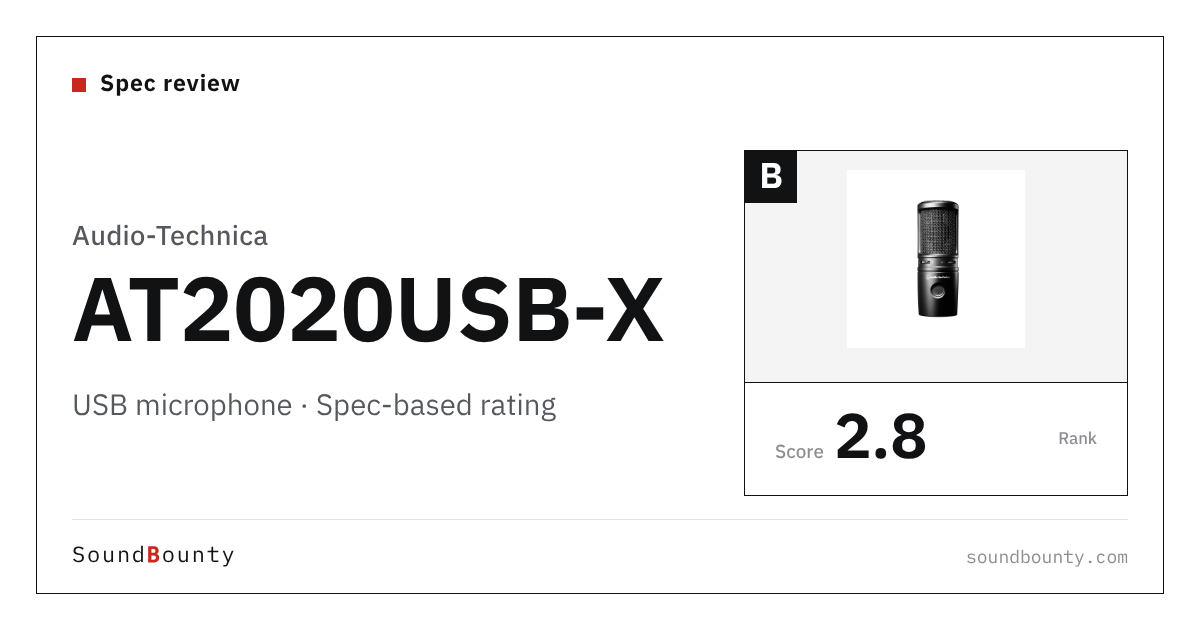
Audio-Technica’s AT2020USB-X is a cardioid condenser USB microphone.
A USB microphone is a microphone you can plug straight into a computer by USB. You can start streaming or recording without an audio interface.
In this article we rate it on 4 criteria using only the specifications the manufacturer publishes, and show how it ranks among the 11 USB microphones we compare.
Disclosure: This site takes part in affiliate programs. Specifications are as of the date we checked them and can change.
Score 2.8 / 5 (average of the 11 models compared: 3.0)
- Specs last checked
- 2026/10/20
- Type
- Condenser
- Pickup pattern
- Cardioid
- Recording
- 24bit/96kHz
- Connection
- USB
- Price (store, date)
- Not disclosed
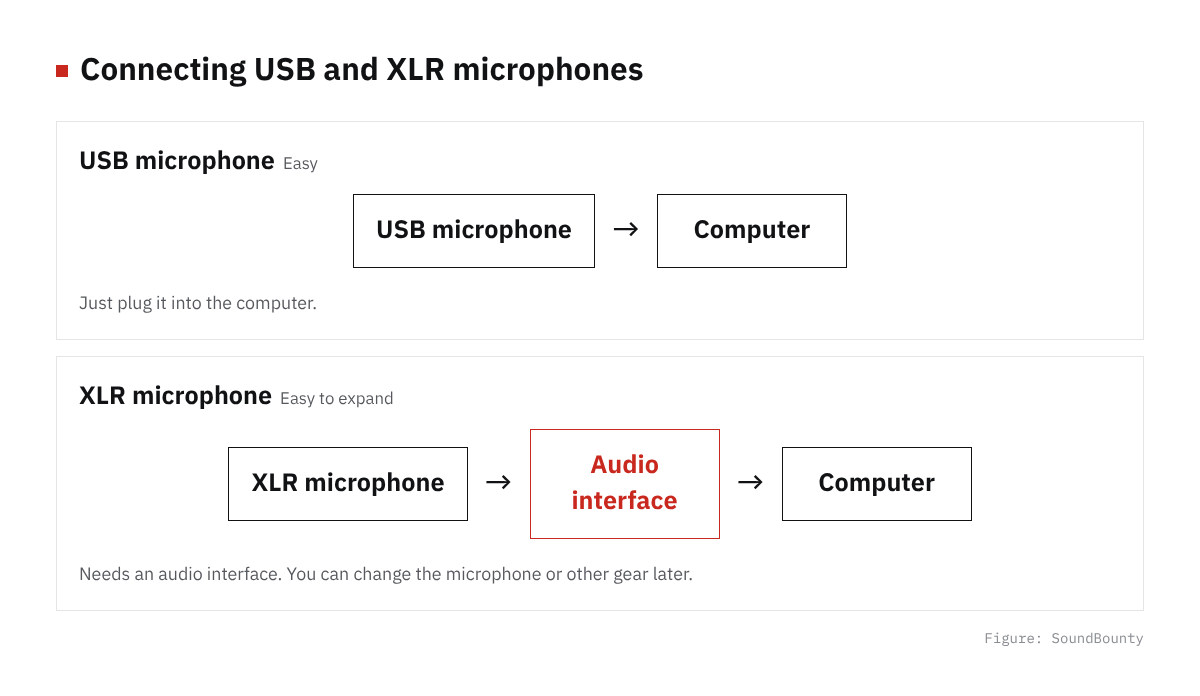
Figure: SoundBounty
Summary
Among the 11 USB microphones, AT2020USB-X is rank B. The ranks run S, A, B and C, and B is third from the top. Averaging the scores for each criterion (out of 5) gives 2.8.
Strengths
- Recording detail (24-bit/96 kHz, 4 points): It records finely, at a high sampling rate.
- Controls at hand (4 of 5, 5 points): You can control mute and volume at the microphone.
Things to keep in mind
- Switchable pickup patterns (1 pattern, 1 point): It has one pickup pattern.
- Range of connections (0 of 2, 1 point): It connects only one way, by USB.
Who it suits: judging from the specifications, it suits people who want to record in fine detail at a high sampling rate; people who want to control mute and volume at the microphone.
Main features of AT2020USB-X
A USB condenser microphone with the AT2020 sound
It carries on the sound quality of the standard AT2020 series condenser microphones and connects straight to a computer by USB-C. It can record at up to 24-bit/96 kHz. It is made for video streaming, game commentary, home recording and narration.
Controls you can operate by hand
It has a headphone jack that lets you hear your own voice without delay, and a volume knob for it. It also has a mix dial that changes the balance between the microphone’s voice and the computer’s sound (BGM and game sound).
A touch mute
A touch-sensitive mute silences the microphone when you simply touch the body, and the state is shown by the color of the light (blue while recording, red while muted). The official page says it mutes “quickly and quietly”. A desk stand is included.
Video: official Audio-Technica YouTube channel (narration in Japanese) Watch on YouTube
Where it is useful
- Starting cover songs or narration without an audio interface
- Adjusting the balance between game sound and your voice by hand during game commentary
- Muting quickly for just the moment of a cough or sneeze during a stream
Rating by criterion
Recording detail: 4 / 5
How finely it can record the sound (the sampling rate).
AT2020USB-X: 24-bit/96 kHz. That is a high rating among the products we compared. It records finely, at a high sampling rate.
Switchable pickup patterns: 1 / 5
How many pickup patterns (directions it listens in) you can choose from.
AT2020USB-X: 1 pattern. That is a modest rating among the products we compared. It has one pickup pattern.
Controls at hand: 5 / 5
How many controls you can operate at hand, such as mute, a gain knob and a headphone jack.
AT2020USB-X: 4 of 5. That is a high rating among the products we compared. You can control mute and volume at the microphone.
Range of connections: 1 / 5
How widely it connects: an XLR output, and whether it can be used with a smartphone.
AT2020USB-X: 0 of 2. That is a modest rating among the products we compared. It connects only one way, by USB.
The gray marks in the figure below (the dotted line on the pentagon) show the average of the 11 products we compared. Price is not part of the score.
How we score (USB microphones)
| Criterion | Basis | 5 pt | 4 pt | 3 pt | 2 pt | 1 pt |
|---|---|---|---|---|---|---|
| Recording detail | Highest supported sampling rate | 192 kHz | 96 kHz | 48 kHz | 44.1 kHz | Lower |
| Switchable pickup patterns | Number of selectable pickup patterns | 4 or more | 3 | 2 | — | 1 (no switching) |
| Controls at hand | Mute, gain knob, headphone jack, headphone volume, mix control | 4 to 5 | 3 | 2 | 1 | None |
| Range of connections | XLR output and smartphone (iOS / Android) support | 2 | — | 1 | — | None |
Scored only on the specifications published by the manufacturer. Price and accessories are not part of the score. USB microphones often do not publish the sensitivity or self-noise that ordinary microphones do, so they are compared on the things that make a difference when you plug straight into a computer: recording detail, switchable pickup patterns, controls at hand and range of connections. Smartphone support counts only where the manufacturer states iOS or Android compatibility. Weight is shown in the table for reference.
AT2020USB-X connection and getting started
| Connection | USB-C (directly to the computer) |
|---|---|
| Power | Runs on USB power (5 V) |
| In the box | Stand AT8702, adapter screw, USB cable (about 2 m, Type-C to Type-A) and a USB adapter |
| Other | The shock mount AT8455, which reduces vibration, is sold separately |
Checked on the manufacturer’s official pages on September 27, 2026.
Compared with other USB microphones
Click a heading to sort. On a phone, the table scrolls sideways.
| Product | RankAvg. score | Type | Pickup pattern | Recording | Connection | Mute | Headphone jack | Weightg | Price (store, date) |
|---|---|---|---|---|---|---|---|---|---|
| Audio-TechnicaAT2020USB-X | B 2.8 | Condenser | Cardioid | 24bit/96kHz | USB | ● | ● | 373 | Not disclosed |
| Audio-TechnicaAT2040USB | B 2.8 | Dynamic | Hypercardioid | 24bit/96kHz | USB | ● | ● | 600 | Not disclosed |
| Audio-TechnicaATR2100x-USB | B 3.3 | Dynamic | Cardioid | 24bit/192kHz | USB / XLR | ● | ● | 268 | Not disclosed |
| RØDEPodMic USB | B 3.0 | Dynamic | Cardioid | 24bit/48kHz | USB / XLR | — | ● | 900 | Not disclosed |
| RØDENT-USB+ | B 2.8 | Condenser | Cardioid | 24bit/48kHz | USB | — | ● | Not disclosed | Not disclosed |
| Logicool GBlue Yeti | B 3.3 | Condenser | Cardioid / bidirectional / omni / stereo | 16bit/48kHz | USB | ● | ● | 880 | Not disclosed |
| ShureMV7+ | B 3.3 | Dynamic | Cardioid | 24bit/48kHz | USB / XLR | ● | ● | 574 | Not disclosed |
| ShureMV7 | A 3.5 | Dynamic | Cardioid | 24bit/48kHz | USB / XLR | ● | ● | 550 | Not disclosed |
| SamsonQ2U | B 2.8 | Dynamic | Cardioid | 16bit/48kHz | USB / XLR | ● | ● | 320 | Not disclosed |
| SamsonQ9U | B 2.8 | Dynamic | Cardioid | 24bit/96kHz | USB / XLR | ● | ● | 970 | Not disclosed |
| RØDENT-USB Mini | C 2.5 | Condenser | Cardioid | 24bit/48kHz | USB | — | ● | Not disclosed | Not disclosed |
Specifications are the manufacturer's published values (official pages and datasheets), checked October 19, 2026. The official page for the RODE NT-USB+ does not state a weight. The weight of the Blue Yeti is the microphone body without the stand.
Before you buy
- It connects straight to a computer by USB. You can start recording without an audio interface. It cannot connect by XLR, so if you plan to use an audio interface later, compare models that also support XLR.
- It records at up to 24-bit/96 kHz. For ordinary streaming and singing, 48 kHz is enough. A bigger number records in finer detail, but the files are larger.
- Controls at hand: mute, headphone jack, headphone volume, mix control. Anything not on that list (gain, for example) is adjusted in software on the computer.
Read next
- ATR2100x-USB: features and rating (rank B)
- Blue Yeti: features and rating (rank B)
- MV7: features and rating (rank A)
- NT-USB Mini: features and rating (rank C)

Comments