
An audio interface has a preamp built into its microphone input, but as your gear grows, you will see the term “external microphone preamp” more often. This article sorts out the basic role of a microphone preamp, when a built-in preamp is no longer enough and what to watch for in connection order, and introduces representative external preamps.
Disclosure: This article contains affiliate links. If you buy through them, SoundBounty may earn a commission at no extra cost to you. Information is as of the date we checked it and can change.
What a microphone preamp is
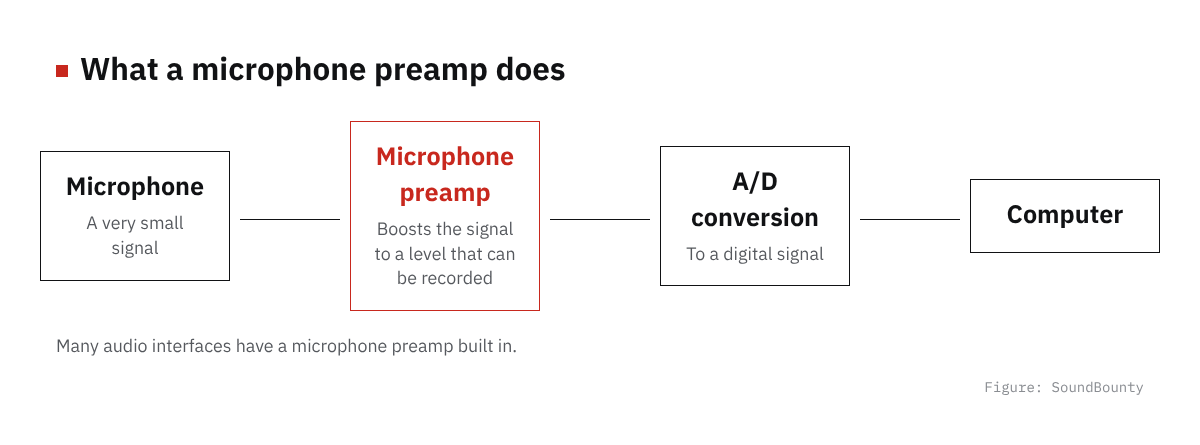
Figure: SoundBounty
The electrical signal of the sound a microphone picks up (microphone level) is very small, and as it is, it does not reach a size a DAW can handle (line level). The circuit that amplifies this small signal is the microphone preamp. Behind the “microphone input” and the “GAIN” knob of an audio interface, there is always this preamp circuit. In other words, once you use an audio interface for home recording, you are already going through some kind of microphone preamp. How to choose is also explained in How to choose an audio interface.
The difference between built-in and external preamps
What a built-in preamp in an audio interface can do
Recent entry- to mid-class audio interfaces have enough gain range in their built-in preamps alone to record ordinary condenser and dynamic microphones. For recording one or two vocals or acoustic guitars, you can first record without problems with the built-in preamp.
When you need an external preamp
On the other hand, an external microphone preamp enters the choices in situations like these.
- Lack of gain: a low-sensitivity dynamic microphone such as the Shure SM7B has a small output, and even with the built-in preamp’s gain fully up, the volume may not be enough. There are methods to make up for it with an external preamp with a wide gain range, or with the inline booster described below.
- Noise: if you raise the built-in preamp’s gain close to its limit, hiss can become noticeable. Lifting the signal at an earlier stage with an external preamp that has gain to spare is said to improve the signal-to-noise ratio as a result.
- Character of the sound: external preamps that use tubes and transformers are often explained as giving each maker’s own personality, such as “thickness” and “saturation”, and are used to aim for a change in sound that differs from the clean amplification of a built-in preamp.
- Expanding the number of inputs: if you want to record several microphones at once beyond the number of built-in preamps, you can add inputs by combining with a multichannel external preamp.
The relationship with phantom power
To run a condenser microphone you need +48 V phantom power. When you use the audio interface alone, you turn on the interface’s +48V switch, but when you put an external preamp in between, phantom power is supplied from the external preamp. The basic usage is to plug the microphone into the external preamp and turn on the preamp’s +48V, leaving the audio interface’s phantom power off. In a setup where the preamp’s output goes to the interface’s line input, the interface does not need phantom power.
Connection order: microphone → external preamp → the audio interface’s line input
The basic connection order when you use an external preamp is microphone → external microphone preamp → the audio interface’s line input. The preamp’s output has already been amplified to line level, so connect it to the interface’s “line input”, not the “microphone input (the path that goes through the preamp)”. If you connect it to the microphone input, the interface’s preamp amplifies it one more stage, which can make the signal too big and distort, or layer unintended character.
For gain settings, it is easier to understand if you divide the roles: make the rough volume on the external preamp, and fine-tune the interface’s line input trim around 0 dB (unity gain).
Representative external microphone preamps
Here we introduce representative models by their features. We do not give prices; check the current price at the store you buy from.
| Model | Features |
|---|---|
| dbx 286s | A channel strip that combines a compressor, de-esser and expander with the preamp in one unit. Supports +48 V, with an 80 Hz high-pass filter |
| Golden Age Project PRE-73 Jr mk2 | Gain of 20 to 70 dB, a transformer-balanced discrete circuit. Said to be designed with the texture of vintage gear in mind |
| Warm Audio WA12 MKII | Gain up to 71 dB, a discrete circuit using a CineMag transformer |
| oz design OZ-3360 | Gain of 16 to 56 dB, a Japanese-made preamp with a built-in optical compressor. If you turn the compressor off, you can also use it as a preamp alone |
We plan a hands-on review of the OZ-3360 on this site.
For microphones that easily run short of gain, such as the SM7B, there is also a choice called an “inline booster”, like the Cloud Microphones Cloudlifter CL-1, which has no preamp function and lifts only the signal using phantom power. It adds less personality than a full-size preamp, and is used when you just want to easily fix the built-in preamp’s lack of gain. The difference in sensitivity between dynamic and condenser microphones is also explained in Dynamic vs condenser microphones.
Frequently asked questions
Q. Who is the built-in preamp enough for?
If you record one or two ordinary-sensitivity condenser or dynamic microphones in a quiet environment, the built-in preamp is often enough at first. It is fine to consider an external preamp after lack of gain or noise starts to bother you.
Q. Does adding an external preamp always improve sound quality?
There are effects such as less noise from having gain to spare and getting the character of sound you aim for, but we cannot state that it “always improves sound quality”. It is said that how much you feel the effect changes with the combination with the microphone and the recording environment.
Q. What if both the external preamp and the audio interface have a phantom power switch?
If the microphone is plugged into the external preamp, turn on only the preamp’s +48V and leave the audio interface’s off. You do not need to turn both on.
Q. How is a channel strip like the dbx 286s different?
A channel strip is a product that combines processing such as a compressor and de-esser with the preamp. It has more functions than a preamp-only product and suits people who want to record through effects for streaming or home recording.
Summary
A microphone preamp is a circuit that amplifies the microphone’s small signal, and it is built into every audio interface as standard. When lack of gain, noise or giving the sound character starts to bother you, adding an external preamp becomes a choice. When you add one, be careful to get right the connection order of microphone → external preamp → the audio interface’s line input, and which one supplies the phantom power.


Comments