
When you choose a microphone for home recording or streaming, the first fork in the road is “dynamic or condenser?” This article sorts out how the two work, then explains sensitivity, room pickup, whether phantom power is needed and how to choose by use, and introduces standard models.
Disclosure: This article contains affiliate links. If you buy through them, SoundBounty may earn a commission at no extra cost to you. Information is as of the date we checked it and can change.
The difference in principle
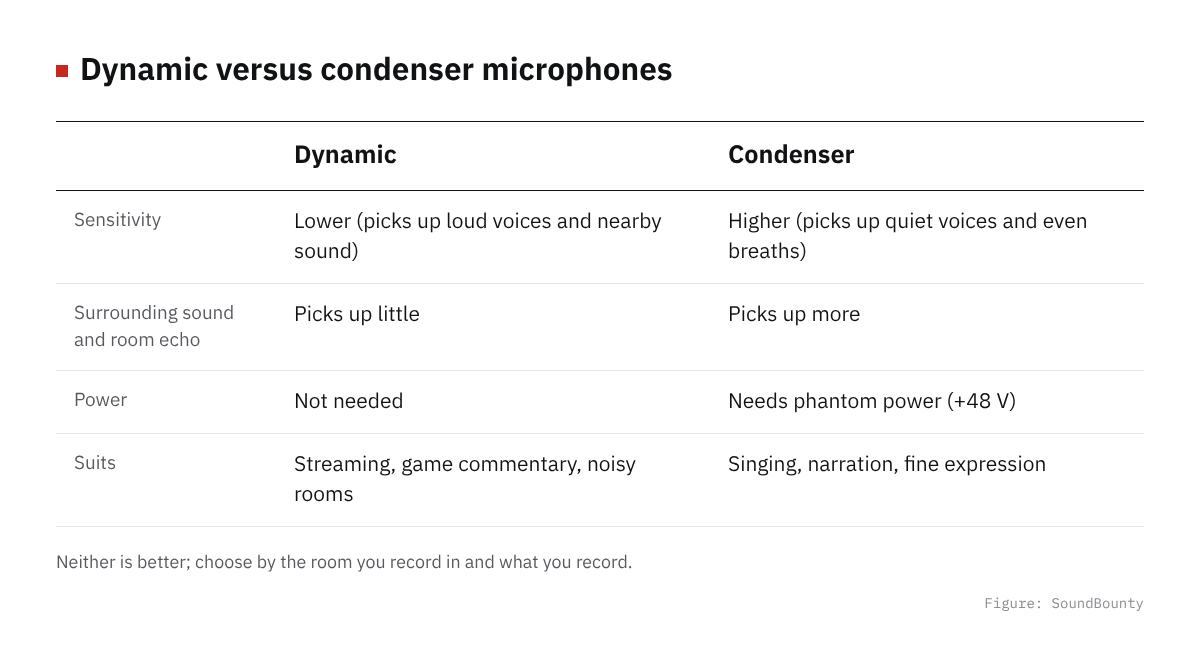
Figure: SoundBounty
A dynamic microphone picks up sound through “electromagnetic induction”: the vibration of sound moves a diaphragm and a coil, producing electricity between it and a magnet. It is simple in structure and tough, and it works without external power.
A condenser microphone produces a signal when the gap between two plates that store electricity (a diaphragm and a fixed plate) changes with the vibration of sound. A voltage must be kept applied to the plates, so external power such as +48 V phantom power, described below, is essential.
The difference in sensitivity
In general, condenser microphones are more sensitive than dynamic ones and are said to pick up small sounds and even breaths more finely. A dynamic microphone, by contrast, is less sensitive, and the output signal tends to be small even if you sing at the same volume. Broadcast and streaming dynamic microphones such as the Shure SM7B in particular have a small output, and even with the audio interface’s gain fully up you may feel the volume is not enough. External preamps and inline boosters that fix lack of gain are explained in detail in What is a microphone preamp?
The difference in room echo and surrounding sound
High sensitivity is directly linked to how easily it picks up room reflections and everyday noise. A condenser microphone easily picks up room reflections and sounds from outside, so in a room without acoustic treatment the voice can sound muffled and noise can stand out. A dynamic microphone is less sensitive, so it assumes you speak or sing close to it (“close talking”), but it tends to pick up little room reflection and everyday noise, and is chosen as an easy-to-handle microphone even in environments where soundproofing and absorption are hard.
Whether phantom power is needed
To use a condenser microphone, you need to supply +48 V phantom power from an audio interface or an external preamp. You turn on the “+48V” or “PHANTOM” switch on the interface. A dynamic microphone, on the other hand, makes its own signal by electromagnetic induction, so it does not need phantom power. Even if you plug a dynamic microphone in with phantom power on, it is said to be fine on many models, but if you are worried, check the microphone’s manual. The input specifications on the audio interface side are also explained in How to choose an audio interface.
How to choose by use
You want to refine cover songs and vocal recording
For cover songs, where you want to record the fine nuances of a voice, condenser microphones with high sensitivity and a wide range are often chosen. But they easily pick up room echo, so consider them together with acoustic treatment.
Streaming, chatting and game commentary
For long streams, dynamic microphones, which pick up little environmental noise and are easy to handle, are popular. They assume close talking, so you need to keep the distance to the microphone constant.
Recording live instruments
For recording instruments where you want to pick up delicate harmonics, such as acoustic guitar and piano, condenser microphones suit. Conversely, for electric guitar and drums recorded close to the amp, dynamic microphones, which handle loud sound, are said to be used often.
A room where soundproofing is hard
When acoustic treatment is hard, as in an apartment, a dynamic microphone, which picks up little surrounding sound, tends to be easier to handle. If you use a highly sensitive condenser microphone, also consider measures such as putting absorbing material or a reflection filter around the microphone.
Representative models
For a wider comparison of condenser microphones, see our microphone comparison. We rate the models we have reviews for on specifications, and do not give prices here; check the current price at the store you buy from.
| Type | Model | Features |
|---|---|---|
| Dynamic | Shure SM58 | The standard dynamic microphone for vocals. Unidirectional and tough, and long used for both live and streaming |
| Dynamic | RODE PodMic | A dynamic microphone designed for streaming and podcasts. A tough metal body |
| Dynamic | Shure SM7B | A standard for broadcast and streaming. The output is on the small side, and Shure advises using a booster or a powerful preamp if you do not have more than 60 dB of gain |
| Condenser | Audio-Technica AT2020 | The standard entry-level XLR condenser. Unidirectional, with a maximum input sound pressure of 144 dB |
| Condenser | Austrian Audio OC16 | A large-diaphragm condenser microphone. A two-step low-cut (40 Hz and 160 Hz) and a maximum sound pressure of 148 dB |
| Condenser | RODE NT1 5th Generation | Self-noise of 4 dBA (published), and supports both XLR and USB-C |
Frequently asked questions
Q. Which should I buy first?
Choosing by your room’s environment is the way least likely to fail. If you mainly stream and chat in a room where acoustic treatment is hard, a dynamic microphone; if you want to record the delicate expression of singing and instruments in a fairly quiet environment, a condenser microphone is a candidate. If you cannot decide on your first microphone, also see What you need to start DTM.
Q. Is the sound quality of dynamic microphones worse?
They simply differ in sensitivity and frequency range characteristics; it is not a question of better or worse. Dynamic microphones continue to be chosen in broadcast and streaming because their characteristic of picking up little surrounding noise and being easy to handle is valued.
Q. Do USB microphones also differ between dynamic and condenser?
USB microphones also exist in both dynamic and condenser forms as their internal mechanism. The difference in how USB and XLR microphones connect is explained in How to choose a condenser microphone.
Q. How do I fix the lack of gain on a dynamic microphone like the SM7B?
The usual fixes are to choose an audio interface with a wide gain range, or to add an external microphone preamp or an inline booster. See What is a microphone preamp? for details.
Summary
A dynamic microphone picks up sound by electromagnetic induction, and a condenser microphone by changes in capacitance. This difference is directly linked to sensitivity, resistance to room echo and whether power is needed. The basic idea is: dynamic for streaming in a room where soundproofing is hard, and condenser for recording singing where you want to capture delicate expression.


Comments