
Disclosure: This page may contain affiliate links. Prices were checked on the date shown and may change.
An introduction to D16 Group Spacerek, based on information from the maker and distributors: what it does, how to use it and who it may suit. It is not scored.
This compact, intuitive reverb plugin creates amazingly authentic real-world spaces without bogging you down in complex parameters.
— D16 Group official site
What is Spacerek?
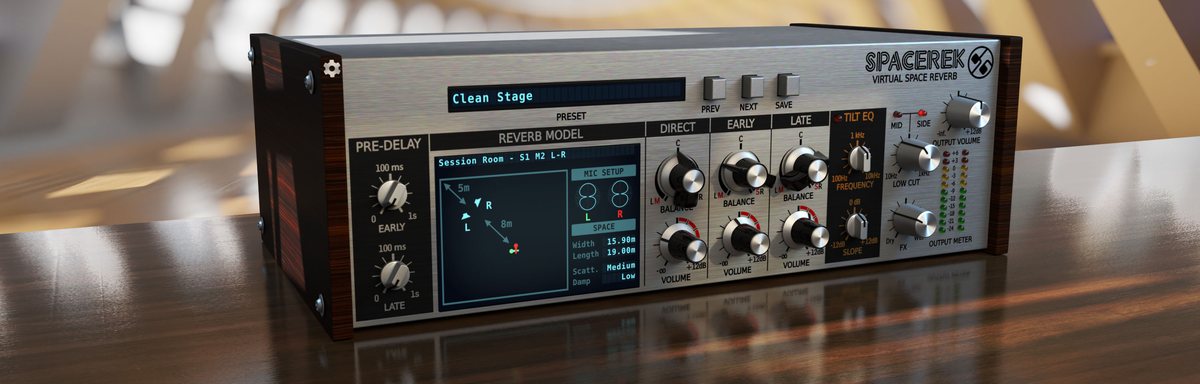
Spacerek is a reverb plug-in from Poland's D16 Group that simulates real-world spaces. The maker describes it as compact and intuitive, creating authentic spaces without burying you in complex parameters.
The sound is built in two stages. Early reflections come from D16's proprietary Virtual Space Reverb engine, which simulates real spaces and even the positioning of the speakers and microphones within them. Late reflections are built by a dynamic delay network that blends with the early reflections into a natural tail.
There are many room types, such as booths, chambers, halls, tunnels, chapels and towers, each with several microphone and speaker setups, for 114 Reverb Models in total. Each model is pre-configured for left-right or mid-side stereo operation.
A three-channel mixer balances the direct signal, early reflections and late reflections, and early and late have independent pre-delay (up to 1 second, adjustable in nanoseconds, microseconds and milliseconds). A tilt EQ and a low cut filter finish the tail, and the maker also highlights its low CPU use.
Key features
Early reflections from Virtual Space
Early reflections come from simulating real spaces together with the speaker and microphone placement inside them, so you choose not only the room but also how it is captured.
Hybrid design for low CPU use
Late reflections are built by a dynamic delay network, which the maker says keeps CPU load lower than you might expect. This may help in projects with many tracks.
114 Reverb Models
114 models combine room types such as booths, chambers, halls, tunnels, chapels and towers with several microphone and speaker setups. You can switch between them to find a space that suits the source.
Three-channel mixer
Set level and balance for direct signal, early reflections and late reflections in a simple mixer, allowing you to shape each part of the space separately.
Tilt EQ and low cut
The tilt EQ lifts lows or highs in one move, while the low cut clears mud and rumble from the mid and/or side signals. They are meant for final fitting of the reverb into a mix.
Pre-delay and tag-based browser
Early and late reflections have independent pre-delay, and presets can be found by tag. A resizable GUI, MIDI Learn and 64-bit internal processing are also included.
Specifications
| Item | Details |
|---|---|
| Type | Reverb (room / hall) |
| Reverb Models | 114 |
| Pre-delay | Up to 1 second each for early and late |
| EQ / filter | Tilt EQ, low cut (mid / side selectable) |
| Formats | Windows: VST2 / VST3 / AAX, Mac: VST2 / VST3 / AU / AAX |
| OS (per Plugin Boutique) | Windows 7 to 10, macOS 10.13 to 12 Monterey (64-bit) |
| Recommended | Multi-core 4.0 GHz SSE CPU / 16 GB RAM (8 GB minimum) |
What is included and system requirements
- Spacerek plug-in
- 114 Reverb Models
- Tag-based preset browser
- English user manual (downloadable from the maker's site)
- A demo version is offered on the maker's site
How to use it
- Try the demo version to check operation and sound before buying.
- Load Spacerek on a send or as an insert in your DAW.
- Pick a room type in the preset browser.
- Switch between models with different microphone and speaker setups in the same room and compare.
- Balance the direct signal, early reflections and late reflections in the mixer.
- Fit it into the mix with the pre-delay, tilt EQ and low cut.
- Resize the interface to suit your screen.
Where it may come in handy
Adding a natural room to vocals and acoustic instruments
Room or chamber models could place a recorded source in a believable space.
Comparing spaces on drums
Because microphone and speaker setups can be switched, it may be useful for comparing how drums sound in different spaces.
Shaping width with mid-side
On models running in M-S, applying the low cut to the side signal could help tidy muddiness while managing width.
Who it may suit
- People looking for reverb that follows real rooms and halls
- People who prefer choosing a model over adjusting many parameters
- People who want a reverb with modest CPU load
Good to know before you buy
- Plugin Boutique's OS listing is dated and stops at macOS 12 Monterey. If you use a newer macOS, try the maker's demo to check operation.
- It is not a standalone program; a DAW is required.
- The maker's list price is 79 euros (sale prices are shown separately).
How it differs from similar products
We do not pick a winner; the official figures are placed side by side.
Waves TrueVerb
Spacerek offers 114 Reverb Models and a three-channel mixer with separate early and late reflection control. TrueVerb has four sections (early reflections, reverb tail, EQ, damping) and 30 presets.
Price
about $89 (converted from €79.00) (D16 Group official site, checked 2026-10-27). Prices can vary by region and promotion, so check the official page before buying.
See Spacerek on the product page
More of the same kind
We have introduced 112 reverbs. Here are some of the others.
- Wave Arts MasterVerb 7
- FLUX:: Ircam Verb
- Sonnox Oxford Reverb
- AudioThing Fog Convolver 2
- Eventide UltraReverb
- Wave Alchemy Glow
We have introduced 14 other products from D16 Group.
For a side-by-side comparison scored on the same criteria, see our comparison of reverbs.
See the full list in Product database: Effects.
Sources: d16.pl pluginboutique.com (checked 2026-10-27)










Comments