
You want to make the vocal of a cover song thicker. You want to add a harmony to the chorus. Harmony and doubling effects are what you use then. This article explains four ways to add thickness from one vocal, and the plug-ins that suit each, based on manufacturers’ official information.
Disclosure: This article contains affiliate links. If you buy through them, SoundBounty may earn a commission at no extra cost to you. Prices are as of the date we checked them and can change.
Key points
- Ways to add thickness to a voice fall into four: harmony, doubling, choir and widening.
- Harmony adds a voice at a different pitch. Doubling layers a voice at the same pitch.
- You can also sing and layer yourself. A plug-in reduces the effort of double tracking.
- Put the added voices under the main vocal, and adjust their volume and left-right position.
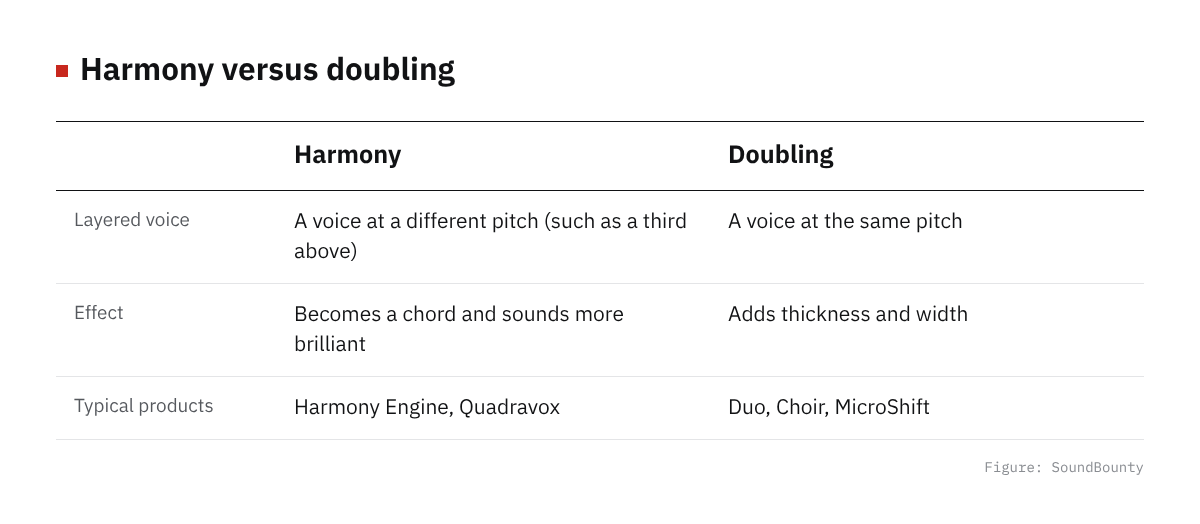
Figure: SoundBounty
Four ways to add thickness
1. Harmony: add a voice at a different pitch
This is a voice that sings the same lyrics at a different pitch from the main vocal. You use it when you want to make the chorus more brilliant.
Antares’ “Harmony Engine” is a plug-in that makes harmonies from one vocal. The maker explains that you can adjust up to four voices separately, each with its own tone, vibrato, left-right position and octave. The harmony notes are decided by placing them one at a time by hand, by playing a MIDI keyboard, or by choosing a chord and leaving it to the plug-in.
Eventide’s “Quadravox” is a plug-in that layers up to four voices with changed pitch to suit a key and scale. You place notes on a screen like sheet music.
2. Doubling: layer a voice at the same pitch
This is an effect as if you had sung the same melody again and layered it. It gives the voice depth and presence.
Antares’ “Duo” automatically makes a doubling voice from the vocal you recorded. You can adjust the volume and left-right position of the original voice and the made voice separately. It suits when you want to cut down the effort of double tracking.
3. Choir: grow it into a large group
This is a way of making one person’s voice sound as thick as many people singing.
Antares’ “Choir” turns one voice into a unison (a choir at the same pitch) of 4, 8, 16 or 32 singers. It adds variation in pitch, timing and vibrato for each voice, and you adjust the amount.
4. Widen it left and right
This is a way of widening a voice left and right by layering it with its pitch and timing shifted only slightly.
Soundtoys’ “MicroShift” widens a voice by combining a pitch shift with a delay that changes over time. The maker explains that you can choose from three kinds of widening based on famous gear. Eventide’s “MicroPitch” widens a voice left and right by layering two voices with slightly shifted pitch, slightly delayed.
Sources: Antares, Eventide and Soundtoys official sites
Which one to choose?
- I want to add harmony to the chorus: a type that makes harmonies, such as Harmony Engine or Quadravox.
- I want to cut the effort of double tracking: a type that makes doubling, such as Duo.
- I want the power of a big group: a type that makes a choir, such as Choir.
- I want to widen the voice: a widening type, such as MicroShift or MicroPitch.
We summarize a comparison with scores based on official information in our harmony and doubling comparison.
Tips for blending in the added voices
- Keep the volume below the main vocal: do not let the added voices come forward too much.
- Change the left-right position: some, like Duo, let you adjust volume and left-right position separately.
- Check the pitch: if a harmony sounds off, check the pitch. How to think about pitch correction is explained in How to do pitch correction on a cover song.
- Listen with the backing track: listening to the vocal alone can make the added voices stand out too much.
Apply EQ, compressor and reverb to the added voices just as you do to the other vocals. The order is explained in The order of plug-ins for a cover-song mix.
Paid plug-ins
Products you can buy at Plugin Boutique (from the lowest regular price)
The regular prices are in US dollars shown on Plugin Boutique on October 10, 2026.
- Quadravox (rank B, regular price $49): View at Plugin Boutique
- MicroPitch (rank B, regular price $99): View at Plugin Boutique
- MicroShift (rank B, regular price $99): View at Plugin Boutique
Antares products
Harmony Engine, Choir and Duo are Antares products. You can see the maker’s pages from the links below.
How to install and authorize a plug-in is explained in How to install plug-ins you bought in a sale or got as a free giveaway.
Frequently asked questions
Q. Which is better, singing and layering yourself or using a plug-in?
If you sing and layer yourself, the nuance of the voice changes naturally. A plug-in takes less effort and makes it easier to adjust pitch and timing. You can also combine both.
Q. What is the difference between doubling and choir?
Doubling layers one voice at the same pitch to add depth. A choir grows the voice to 4, 8 or more singers so it sounds as thick as a big group. Among Antares products, Duo is doubling and Choir is a choir.
Q. How do I decide the pitch of a harmony?
There are methods like Harmony Engine’s, where you choose a chord and leave it to the plug-in. You can also place notes one at a time by hand. Check the key and chords of the song before you decide.
Q. Can I do it for free?
Among the products we compared on this site, there is no free harmony or doubling plug-in. Plug-ins you can use for free are summarized in Free plug-ins for a cover-song mix.
Q. Are there fixed settings in numbers?
They change with the voice and the song, so we do not give fixed values. Decide while listening.


Comments